
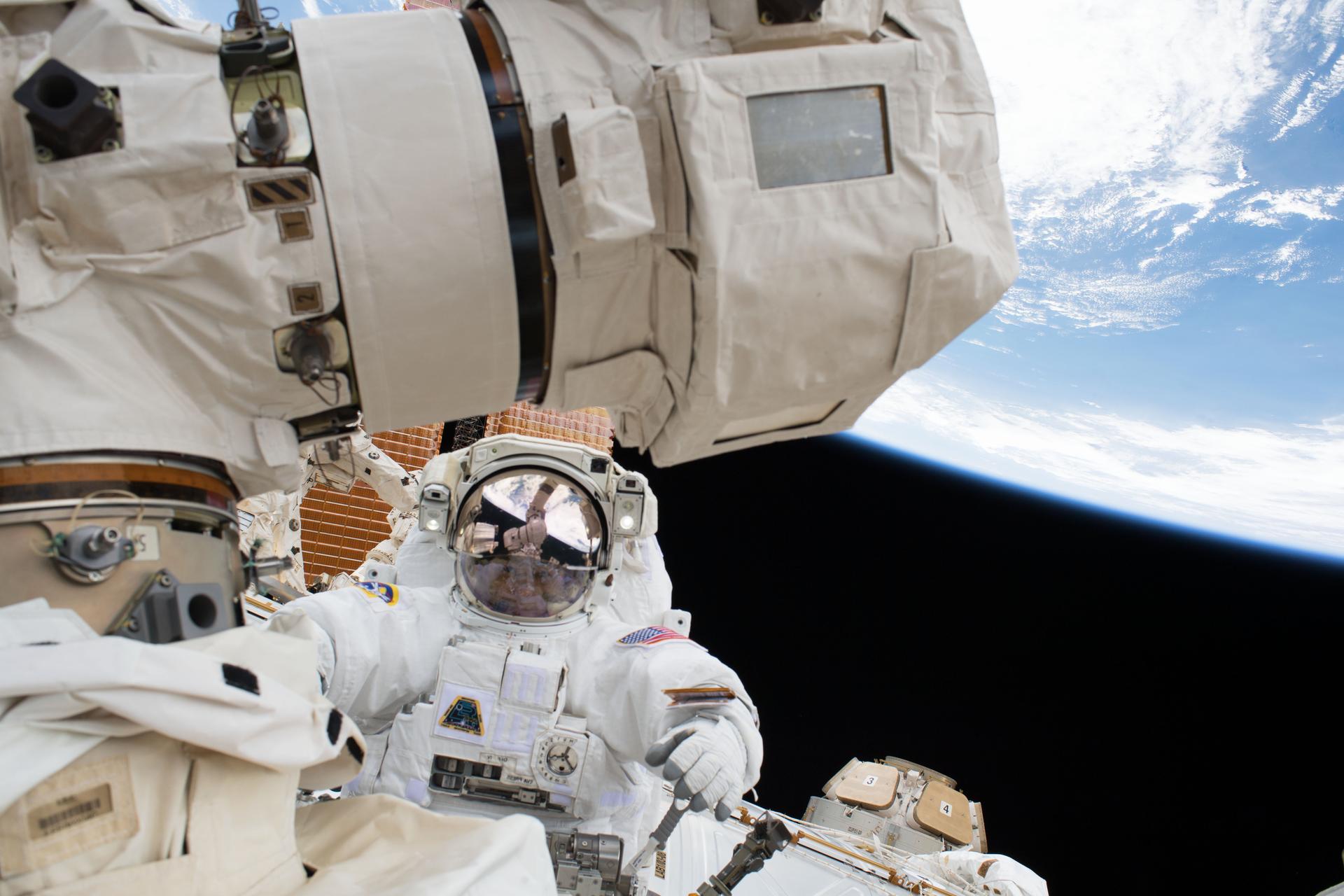
Two astronauts on the International Space Station spent the week of Aug. 10-14 running through robotics simulations, suit checks, and procedure reviews for a spacewalk that will swap out a piece of hardware most people never think about: the antenna that lets Mission Control actually talk to the station at broadband speed.
NASA astronaut Anil Menon and ESA astronaut Sophie Adenot are scheduled to head outside on Aug. 18 for U.S. Spacewalk 97, a roughly 6.5-hour excursion to replace a space-to-ground antenna mounted on the station's Z1 truss. According to NASA's Aug. 14 station blog post, the pair spent the preceding days practicing simulated robotics maneuvers alongside crewmates Jack Hathaway and station commander Jessica Meir, who will operate the Canadarm2 robotic arm and support suit operations from inside the station during the walk itself. NASA's account also notes that Meir assisted Adenot in her spacesuit to conduct leak and pressure checks ahead of the excursion.
The antenna in question isn't cosmetic. It's part of the space-to-ground communications chain that routes high-speed data and voice communications between the orbiting laboratory and NASA's Mission Control Center in Houston. When a unit like this degrades or fails, the fix isn't a software patch; it's two people in suits, tethered to a truss in orbit, swapping hardware by hand.
Adenot's First Spacewalk
Aug. 18 will be Adenot's first spacewalk. ESA's coverage confirms the spacewalk is set to begin at 14:35 CEST, with ESA WebTV and YouTube livestreaming starting at 13:00 CEST. The U.S. side of the broadcast, per tracking from SpacePolicyOnline.com, has NASA coverage beginning at 7:00 a.m. ET — consistent with a roughly 8:35 a.m. ET spacewalk start derived from the 14:35 CEST time and the six-hour offset between the two zones — carried across X, Discovery+, Amazon Prime, YouTube, and NASA+.
Both agencies list the same objective for the walk: replace the Space-to-Ground antenna that links the station to Houston. NASA's account adds the Z1 truss as the specific mounting location and puts the expected duration at about 6.5 hours, with Menon and Adenot venturing out while Hathaway and Meir handle robotics and suit support from inside.
Why this spacewalk almost happened five days earlier
Spacewalk 97 wasn't originally slated for Aug. 18. SpacePolicyOnline.com's tracking notes the excursion was rescheduled from Aug. 13 after a spacesuit sensor malfunction turned up during a separate spacewalk on Aug. 6. NASA has not published additional detail on the nature of that sensor issue in the sourced material, but the slip illustrates a pattern familiar to anyone who follows ISS operations: spacewalk schedules are provisional right up until suits, tethers, and sensors all check out clean. SpacePolicyOnline identifies this as the second of three planned spacewalks in the current sequence.
In the days leading up to the EVA, station life continued on its usual mixed track of maintenance and science. NASA's Aug. 14 update notes Adenot also tested the EasyMotion-2 electrical-stimulation exercise suit this week — a hardware evaluation distinct from spacewalk prep — while Roscosmos flight engineers Pyotr Dubrov and Anna Kikina released two spheres of different sizes inside the station and tracked their drifting motion to calculate how external forces affect the station as it orbits Earth, a data point relevant to understanding orbital drag on the ISS.
What actually happens during the walk
Based on the confirmed sourcing, the choreography breaks down into two tracks running in parallel. Outside, Menon and Adenot will translate to the Z1 truss, remove the existing space-to-ground antenna hardware, and install its replacement — standard EVA antenna-swap procedure, though none of the source material details the specific mechanical steps of the R&R (remove-and-replace) itself. Inside, Hathaway will fly Canadarm2 as needed to support the worksite, while Meir, as commander, oversees suit operations and choreographs the overall timeline from the cupola or an adjacent console.
None of the three sourced reports specify which particular antenna unit is failing or degraded, nor whether the swap is preventive maintenance or a response to a specific fault. What's confirmed is the location (Z1 truss), the function (space-to-ground high-speed link to Houston), the crew assignments, the date, and the multi-platform broadcast plan.
Why It Matters
The ISS's space-to-ground antennas are unglamorous infrastructure, but per ESA, they carry the high-speed data and voice links between the station and Mission Control in Houston — the channel that keeps astronauts in contact with flight controllers and family alike. A degraded antenna doesn't ground the station, but it can throttle bandwidth or force reliance on backup channels — which is presumably why NASA is dedicating a full EVA and two trained spacewalkers to the swap rather than waiting for a more convenient window.
The walk also matters for the astronaut corps itself. Adenot's spacewalk is a career milestone — her first EVA, per ESA — and every first-time spacewalker who completes an EVA safely expands the bench of astronauts qualified for future station maintenance, and eventually, more complex assembly work beyond low Earth orbit. The Aug. 13-to-18 reschedule after an Aug. 6 sensor malfunction is a reminder that even routine-sounding maintenance spacewalks carry real risk margins that NASA won't compromise on, even when it means sliding a date on the public calendar.
