
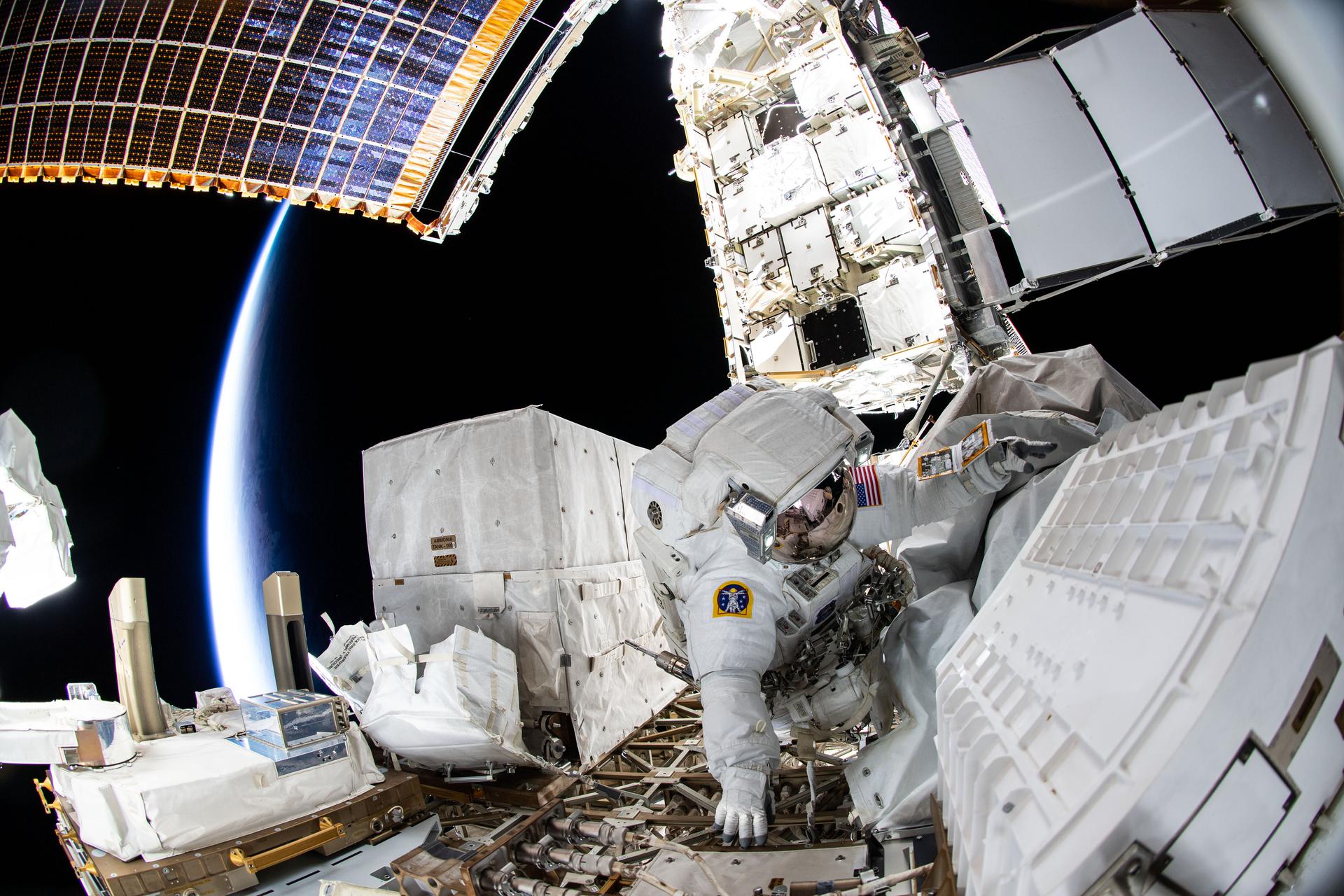
Six hours and 23 minutes is a long time to spend outside a spacecraft traveling at 17,500 miles per hour. It was not, however, quite long enough.
On August 18, 2026, NASA astronaut Anil Menon and ESA astronaut Sophie Adenot floated out of the International Space Station's airlock at 8:29 a.m. EDT with a fairly specific job: pull a broken communications antenna off the station's truss and bolt a fresh one in its place. They got through the first half. The second will have to wait for a follow-up excursion planned for the following Tuesday.
The spacewalk, which wrapped up at 2:52 p.m. EDT, was the 282nd in ISS history, pushing the station's cumulative spacewalk total to 74 days, 10 hours, and 44 minutes — nearly two and a half months of combined human time spent working in vacuum since assembly began.
A Stubborn Piece of Hardware
The target was a space-to-ground antenna, or SGANT, one of two mounted on the station that relay data from the crew down to Mission Control in Houston. One of the station's two SGANTs had failed, and Menon and Adenot were sent out to swap it for a spare.
According to Spaceflight Now's reporting, the job took longer than planned because the hardware didn't cooperate. The astronauts had to wrestle with tight power and data connectors that resisted disconnection, then work through a set of locking pins on the antenna's gimbal assembly — the mechanism that lets the dish steer itself to track satellites — before they could finally unbolt the unit from its supporting boom.
By the time the failed antenna was free, the astronauts had used up the time budgeted for the spacewalk. Rather than push into overtime to install the replacement, mission managers had them lash the old, failed antenna down near its boom on the station's Z1 truss — where, per Spaceflight Now, it will stay for good — and head back inside. NASA's Expedition 75 blog, recapping the walk the next day, confirmed the antenna was disconnected and secured but that installing the spare was deferred to a future spacewalk.
None of this leaves the station in the dark. Space.com noted that the ISS retains full communications through its remaining functional SGANT, which continues to link the crew and station systems to Mission Control Houston. Spaceflight Now added useful context: the station carries two of these antennas by design, but only one is needed for normal operations — the second exists purely for redundancy. Losing it was an inconvenience, not an emergency.
A First for France
The spacewalk carried a personal milestone alongside the mechanical one. Adenot, flying for the European Space Agency, became the first French woman to perform a spacewalk. She spent part of the excursion working the antenna alongside Menon and, once back inside, turned to more routine housekeeping: refilling the water tanks that cool spacesuits during EVAs, a necessary step before any suit can be used again.
Menon's post-spacewalk schedule pivoted just as quickly from truss hardware to human biology. He conducted blood draws and vein scans for the Venus Flow study, which investigates how microgravity affects circulation — a subject of long-standing interest given the fluid shifts astronauts experience in orbit.
The station's Russian segment kept its own pace during the EVA. Expedition 75's Roscosmos crew members — Andrey Fedyaev, Anna Kikina, and Pyotr Dubrov — spent the day on blood pressure checks, Earth photography, onboard AI testing, and fitness assessments, according to NASA's blog post. Spacewalks by their American and European crewmates don't pause the rest of the station's research schedule; they just add one more item to an already dense timeline.
Why It Matters
An SGANT swap sounds like plumbing work, but it sits at the center of how a spacecraft as complex as the ISS stays in touch with the ground. High-speed data links carry science telemetry, video, and command traffic between the station and Mission Control; losing redundancy on that system, even temporarily, narrows the margin for error if the remaining antenna ever runs into trouble of its own.
The episode is also a reminder of how spacewalk planning actually works in practice. EVAs are scripted down to the minute, but hardware — especially connectors and gimbal pins that have sat in the thermal extremes of low Earth orbit for years — doesn't always move the way a procedure manual expects. When a task runs long, mission managers have a choice: push the timeline and the crew's consumables, or bank the progress made and pick up the rest on the next attempt. Here, they chose the latter, tying down the failed hardware and deferring the install rather than rushing a delicate bolt-in with a tired crew running low on suit resources.
That decision means a second spacewalk is now on the books for the following Tuesday, adding another entry to a 282-strong tally of ISS EVAs and pushing the station's spacewalk-hours ledger a bit further past 74 days. According to Spaceflight Now, flight controllers hadn't yet decided whether that walk would finish installing the spare or stick with already-planned tasks and push the install to a still later EVA — meaning the antenna swap isn't finished until some second walk closes it out, whenever that turns out to be. It's a small, unglamorous but necessary piece of keeping a station now in its 28th year of assembly talking to home.
