
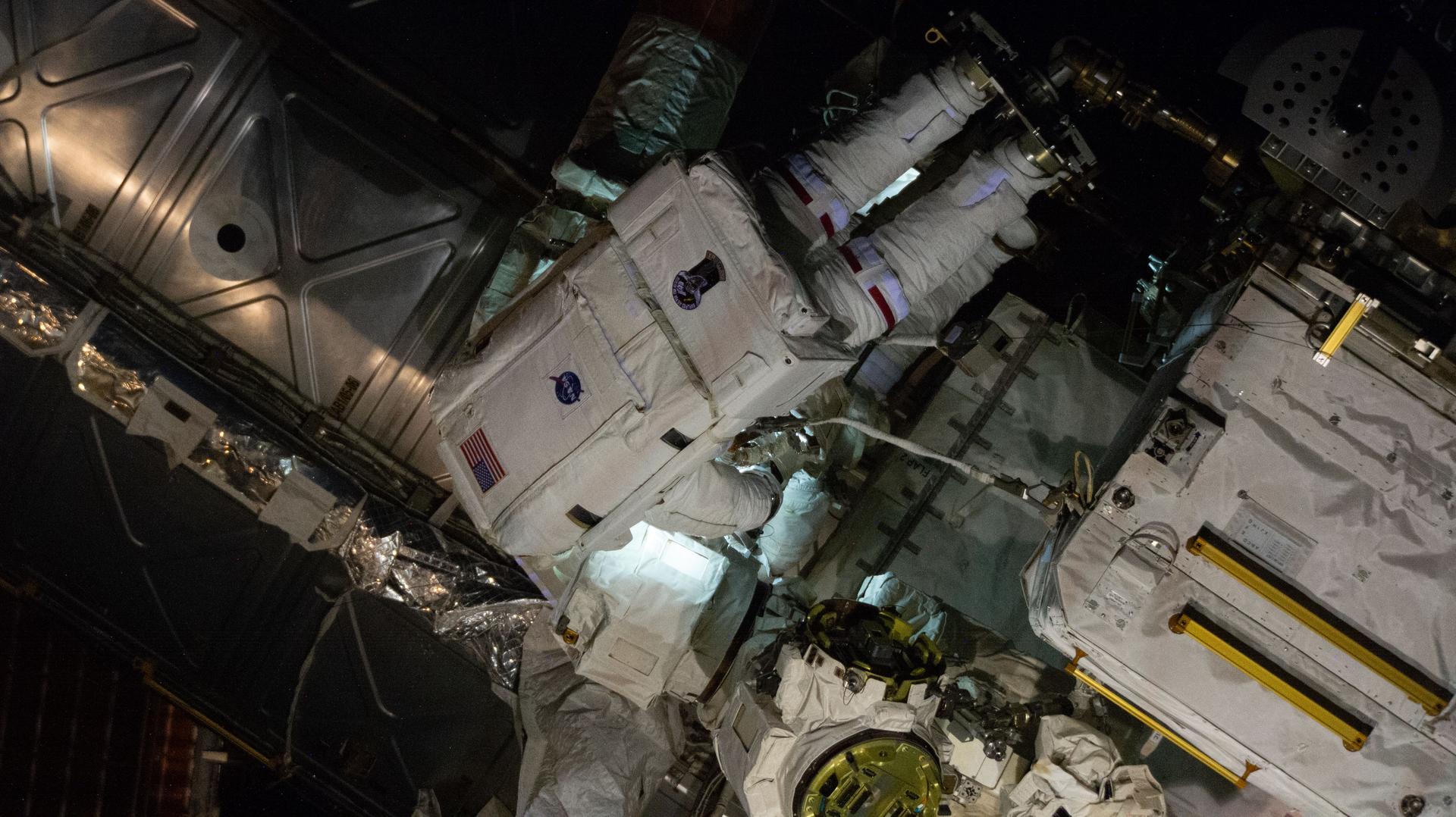
The International Space Station's seven-person crew is splitting its time this month between running microgravity experiments and prepping for a spacewalk that will send two astronauts out to replace a piece of hardware most people never think about: the antenna that keeps the station talking to the ground.
NASA said on August 10, 2026, that Expedition 75 crew members are gearing up for US Spacewalk 97, scheduled for August 18. The excursion is expected to run about six and a half hours, with NASA astronaut Anil Menon and ESA astronaut Sophie Adenot venturing outside to swap out a space-to-ground antenna mounted on the station's Z1 truss — the framework that sits atop the station's central Unity module and hosts several of its communications antennas.
It's the second spacewalk in less than two weeks for the station. A previous excursion on August 6 lasted 6 hours and 27 minutes, putting the upcoming one on almost identical footing in terms of duration and, presumably, complexity.
What's Actually Breaking (or Wearing Out)
Space-to-ground antennas are unglamorous but essential — they're part of the S-band communications system the station uses to relay voice and low-rate data to mission control when it's not routed through the higher-bandwidth Ku-band system. Components mounted externally on the Z1 truss are exposed to the same thermal cycling, atomic oxygen erosion, and micrometeoroid risk as every other piece of ISS hardware, and after decades in orbit, replacement of individual line-replaceable units is routine station maintenance rather than an emergency repair.
NASA hasn't detailed what specifically prompted this particular swap, only that the antenna is being replaced. That's consistent with how the agency typically frames planned maintenance spacewalks, as opposed to unplanned troubleshooting excursions that follow a hardware failure.
The Bigger August Picture
According to Orbital Intel, NASA has three spacewalks total on the books for August 2026 — designated EVA 96, 97, and 98. The August 6 excursion modified the station's 3B power channel to prepare for installation of a seventh roll-out solar array (iROSA); US Spacewalk 97 swaps out the space-to-ground antenna; and a third spacewalk later in the month is set to connect power-channel cabling and data-relay systems and replace a navigational aid on the Harmony module's forward port, part of longer-term maintenance tied to the station's eventual deorbit. That means US Spacewalk 97 is one piece of a busier-than-usual month of extravehicular activity, with the station's power infrastructure and communications infrastructure both getting attention in quick succession alongside that longer-range maintenance work.
Who's Doing What
Expedition 75, which began July 26, 2026, is a seven-person crew split across two space agencies plus Roscosmos: NASA's Jessica Meir (commander), Jack Hathaway, and Anil Menon; ESA's Sophie Adenot; and Roscosmos cosmonauts Pyotr Dubrov, Anna Kikina, and Andrey Fedyaev. Menon and Adenot are the designated spacewalkers for this outing, meaning the rest of the crew will handle robotics support, suit-up assistance, and the standard choreography that keeps an EVA running on schedule from inside the station.
Science Doesn't Pause for Maintenance
Spacewalk prep hasn't slowed the station's research schedule. NASA's update describes an active slate of ongoing investigations:
- Crystal growth: Crew members are continuing work on semiconductor and metal-alloy crystal growth experiments, which take advantage of microgravity to produce more uniform crystal structures than are possible under Earth's gravity — research with applications in electronics manufacturing and materials science.
- Combustion science: Solid combustion experiments are underway, part of a long-running category of ISS research that studies how fire behaves without buoyancy-driven convection, informing both spacecraft fire safety and terrestrial combustion efficiency.
- EasyMotion-2: This investigation pairs an exercise suit with muscle-stimulation technology, studying how it might help offset the muscle atrophy astronauts experience during long-duration spaceflight.
- VR balance adaptation: Crew members are using virtual reality to study how the vestibular system readapts to gravity cues, research relevant to how astronauts will handle balance and orientation during future lunar or Mars surface operations.
- AI crew-ops tools: The station is also serving as a testbed for artificial intelligence tools meant to support crew operations, though NASA's update doesn't specify which functions those tools are being evaluated for.
Why It Matters
A failed or degraded antenna doesn't ground the station the way a life-support fault would, but reliable space-to-ground communication is foundational to everything else that happens on board — from relaying real-time telemetry to mission control, to coordinating spacewalks like this one, to keeping the crew in contact with family and flight surgeons. Routine maintenance spacewalks like US Spacewalk 97 are how the ISS, now well past its original design life, keeps functioning: not through dramatic rescues, but through a steady cadence of astronauts going outside to replace parts before they fail outright.
The two-agency composition of this particular spacewalk team — one NASA astronaut, one ESA astronaut — is also a reminder of how ISS operations actually work day to day. The station's seven-person crew as a whole spans NASA, ESA, and Roscosmos, and which crew members end up outside the airlock on a given EVA depends on training and assignment rather than agency headcount. That kind of cross-agency coordination — different training pipelines, suit hardware, and mission control centers all having to sync up for a single excursion — has held up through more than two decades of continuous station operations even as terrestrial relations between the partner nations have fluctuated.
Meanwhile, the parallel research work underscores that station crews are rarely doing just one thing. The same astronauts prepping repress and depress procedures for an EVA are also tending crystal growth samples and combustion rigs, treating the station less like a single-purpose facility and more like what it actually is: a multi-agency laboratory that also happens to require ongoing upkeep at 400 kilometers up.
