
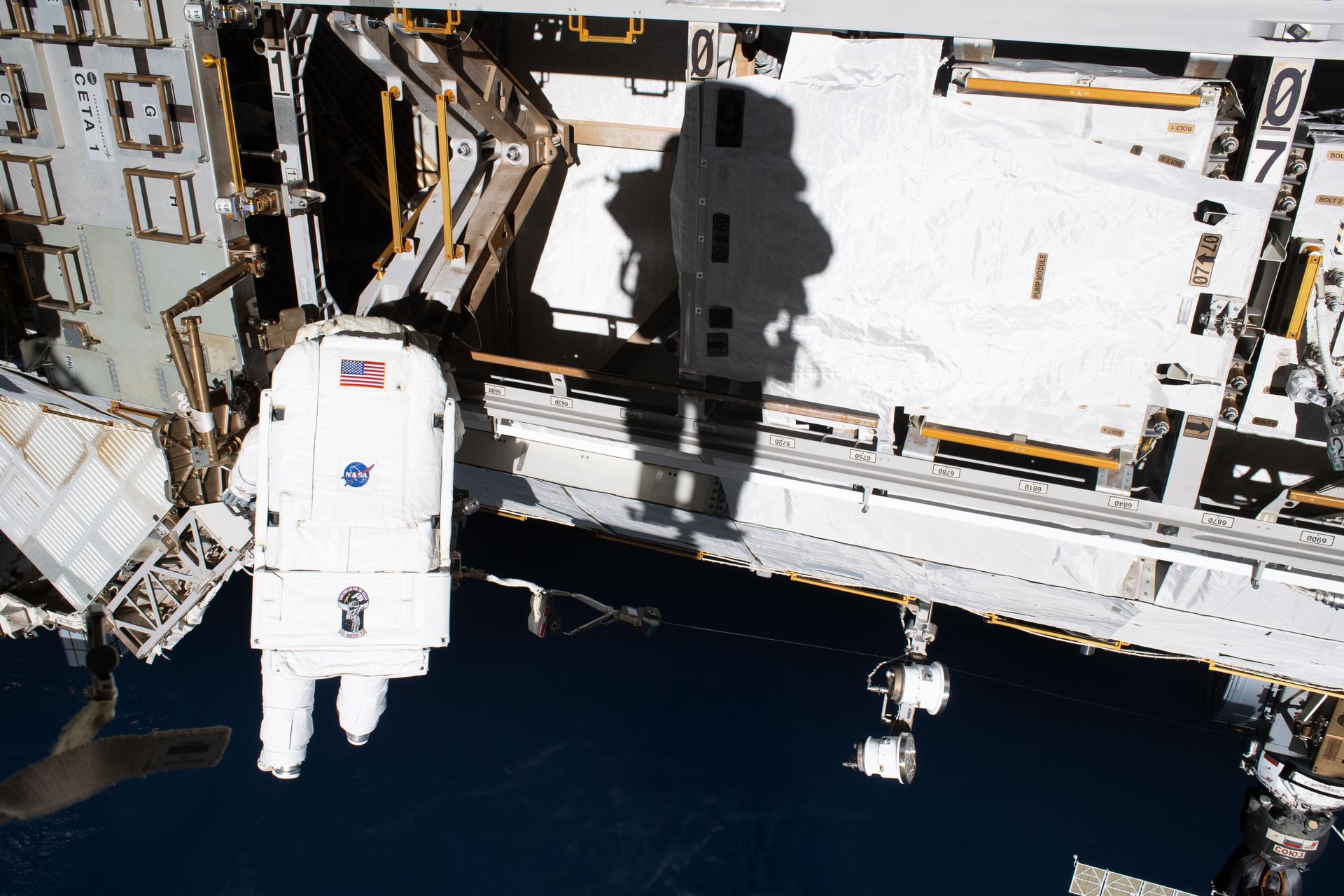
The International Space Station just had one of its busier weeks in recent memory. On Aug. 25, two astronauts wrapped up a two-part spacewalk to fix a broken communications antenna. Two days later, a cargo freighter parked at the station fired its engine for nearly 21 minutes to nudge the outpost into a higher orbit. Neither event was flashy on its own, but together they illustrate something easy to forget about the ISS: keeping a massive orbiting laboratory flying roughly 250 miles up is a constant, unglamorous engineering effort, and this week both the station's plumbing and its position in the sky needed attention.
A dish worth saving
The headline moment came from outside the station. NASA's Anil Menon and ESA's Sophie Adenot spent 6.5 hours in vacuum on Aug. 25 installing and connecting a spare Space-to-Ground antenna, restoring the high-speed data link the station uses to talk with Mission Control in Houston. It was the second half of a job that began a week earlier: an Aug. 18 spacewalk removed the failed antenna unit, and Tuesday's excursion put its replacement in place. According to Space.com's report on the spacewalk, mission control's reaction on the loop — "you just saved the video dish" — captured the stakes plainly enough.
The Space-to-Ground system isn't a luxury. It's the pipe that carries live video, high-bandwidth telemetry, and much of the routine chatter between the crew and the ground. A station can limp along on backup links, but a permanent fix restores margin the program doesn't like to live without for long.
Adenot's involvement carried its own historic marker, though the milestone traces to the week's first spacewalk rather than this one: during the Aug. 18 outing that removed the failed antenna, she became the first woman from France — and the fifth French citizen overall — to conduct a spacewalk, according to Starlust's coverage of the event. Aug. 25 was her second time working in the vacuum of space. NASA has now logged 283 spacewalks in the station's history — this was the 98th to use U.S. spacesuits — a tally that keeps climbing as the orbiting lab moves deeper into its third decade of continuous operation.
Why a cargo ship needs to fire its engine
Two days after the spacewalk wrapped, attention shifted from the station's exterior hardware to its orbit itself. On Aug. 27, Northrop Grumman's Cygnus XL cargo spacecraft — berthed at the ISS since its arrival on April 13 with more than 11,000 pounds of supplies — fired its engine for 20 minutes and 43 seconds in a scheduled reboost maneuver, according to NASA's ISS blog.
Reboosts are routine but necessary. Atmospheric drag, faint as it is at the station's altitude, steadily bleeds energy from the ISS's orbit, and periodic burns — usually from a docked Progress, a Cygnus, or the station's own Zvezda module — claw that altitude back. This particular burn raised the station's apogee by 0.2 miles and its perigee by 2.6 miles, leaving the ISS in a 266.5-by-254.9-mile orbit.
The timing wasn't arbitrary. NASA says the maneuver was calculated specifically to set up the phasing for the Progress 96 cargo launch, expected in early September. Orbital phasing determines when a chaser vehicle's launch window lines up with the station's position in its orbit — get it wrong and a resupply ship either burns extra propellant chasing the ISS down or has to wait for the next opportunity. A precisely targeted reboost keeps that rendezvous math clean.
Cygnus XL itself isn't going anywhere yet. It's scheduled to remain berthed at the station until its planned departure in October, meaning the spacecraft that just helped raise the ISS's orbit will still be on hand as still more traffic — Progress 96 among it — arrives in the coming weeks.
What comes next
With phasing set by Thursday's burn, the next major arrival is Progress 96, the Russian cargo vehicle NASA says is slated to launch and dock at the station in early September. Cygnus XL will still be parked there when it does — the Northrop Grumman freighter isn't due to depart until October, when it will be loaded with disposal cargo, unberthed, and sent on a destructive reentry through Earth's atmosphere. For a station that runs on a tight, overlapping schedule of visiting vehicles, this week's antenna fix and orbit-raising burn were both, in their own way, groundwork for the traffic still to come.
Why It Matters
None of this week's work is the kind of thing that generates dramatic headlines on its own — a fixed antenna, a routine engine burn, a cargo ship's arrival calendar. But strung together, it's a useful reminder of what actually keeps the ISS operating after more than two decades in orbit: a rotating cast of hardware fixes, orbital housekeeping, and traffic management that has to happen continuously and largely without error. A lost high-bandwidth comm link degrades the station's ability to run science and coordinate with the ground; an unmanaged orbit eventually threatens the precise choreography that lets cargo and crew vehicles dock safely. The Aug. 25 spacewalk and the Aug. 27 reboost were both, in effect, preventive maintenance — unglamorous, tightly scheduled, and essential groundwork for the busier docking traffic still ahead in the first weeks of September, Progress 96 included. It's also a reminder of how spacewalk milestones keep accumulating even this deep into station operations: Sophie Adenot becoming the first woman from France to conduct a spacewalk is a genuine first for France's astronaut corps, decades after the ISS program began.
