
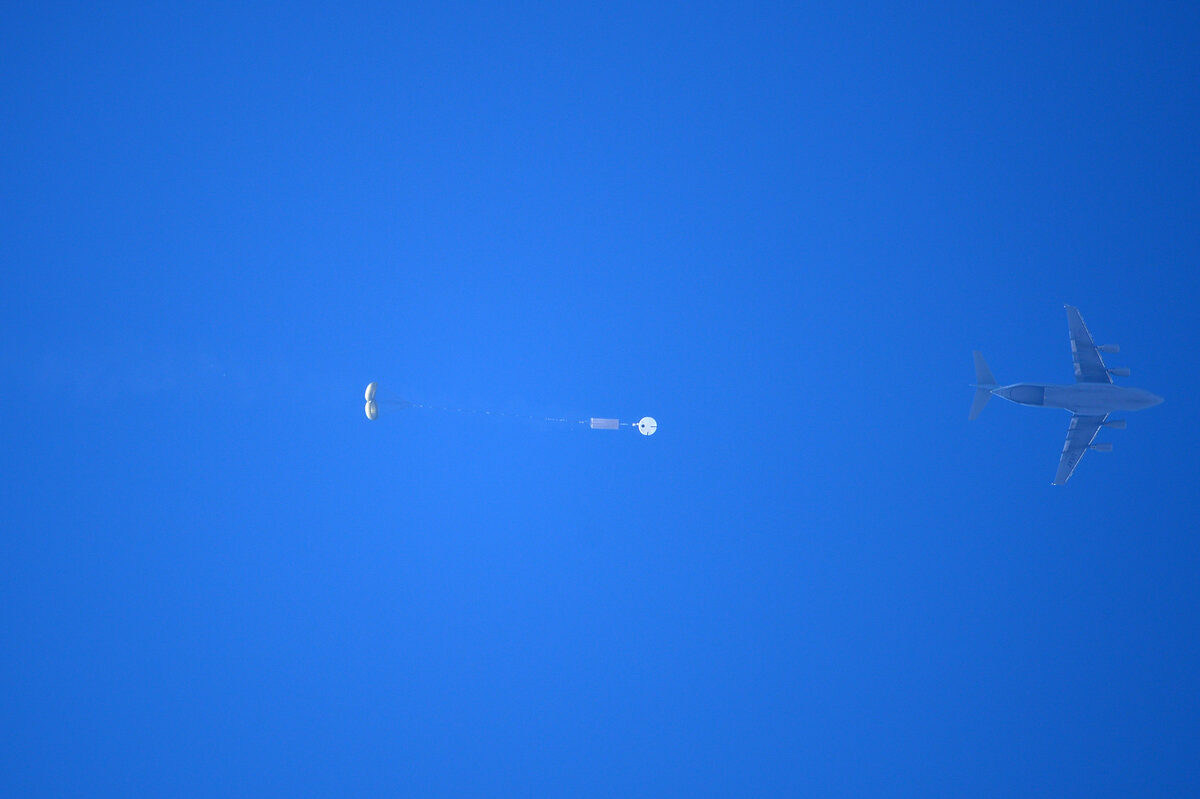
On the morning of July 7, an Indian Air Force Il-76 climbed to 2.5 kilometers over a drop zone near Sheopur, in the northern reaches of Madhya Pradesh, and released a dummy mass rigged to a single main parachute. The chute unfurled, the mass swung beneath it, and the whole assembly settled onto the test range under canopy — a mundane-sounding event that represents one more checkbox cleared on the long road to India's first crewed spaceflight.
The test, designated IMAT-05, was the fifth in a series of Integrated Main Parachute Air Drop Tests that the Indian Space Research Organisation (ISRO) has been running in partnership with the Defence Research and Development Organisation (DRDO), the Indian Air Force, and the Indian Army. Its job wasn't to look impressive — it was to load a single parachute to its structural limits and see whether it holds.
What IMAT-05 Actually Tested
Unlike a full-system rehearsal, IMAT-05 isolated one component: the main parachute itself, deployed alone and carrying a dummy mass sized to push the canopy toward its maximum expected operating loads. According to ISRO's release, the goal was to "qualify the Main Parachute for its structural integrity & design margins under the maximum expected load conditions" ahead of the first uncrewed Gaganyaan G1 mission — the kind of loading the real hardware would experience during an actual descent, but tested here in isolation, without the complexity of a multi-parachute deployment sequence.
That distinction matters. The Gaganyaan crew module doesn't rely on one parachute to bring astronauts home — it relies on ten, deployed across four separate stages: two apex cover separation parachutes that pull away the module's cover, two drogue parachutes that slow and stabilize the capsule after reentry, three pilot parachutes that extract the mains, and finally three main parachutes that handle the final deceleration before splashdown, according to reporting by Deccan Chronicle. Each stage depends on the one before it firing correctly and each individual chute has to survive loads that vary depending on descent speed, capsule attitude, and atmospheric conditions at deployment altitude.
ISRO has been testing this system piece by piece rather than all at once, and IMAT-05 continues a run of single-parachute qualification drops meant to build a statistical and engineering case that the design margins are sound before the agency commits to more complex, multi-canopy tests — and eventually to a flight with a human being under the parachute pack.
Why Sheopur, Why an Il-76
The test ran out of the ADRDE drop zone in Sheopur — ADRDE being DRDO's Aerial Delivery Research and Development Establishment, the agency's parachute and airdrop specialty lab. It's the kind of facility built for exactly this: dropping loads from aircraft and measuring what happens to them on the way down.
The Il-76 heavy transport, borrowed for the occasion from the Indian Air Force, isn't a spacecraft — it's a cargo plane repurposed as a drop platform because it can carry a dummy mass to 2.5 km and release it cleanly with a rear cargo ramp, the same basic trick used for airdropping vehicles and pallets. It's a reminder that a lot of human spaceflight qualification work happens far from any launch pad, in aircraft and drop towers and wind tunnels, long before a mission profile ever touches a rocket.
Part of a Busier Testing Calendar
IMAT-05 didn't happen in isolation. Just four days earlier, on July 3, ISRO conducted a static ground test of the solid rocket motor for SOLVE — the Sub-Orbital Launch Vehicle for Experiments — at the Static Test Facility at the Satish Dhawan Space Centre in Sriharikota, according to The Researchers. SOLVE is a companion test vehicle being developed specifically to validate Gaganyaan's parachute systems in flight-like conditions, rather than just from an aircraft. Seeing both tests land within days of each other suggests ISRO is running a compressed, parallel qualification campaign this month rather than a slow trickle of isolated milestones.
Why It Matters
Parachutes are unglamorous compared to rocket engines, but they're the part of a crewed spacecraft that has to work without any backup plan once it's committed. A crew module in trouble can often abort a launch, switch to redundant electronics, or work around a failed sensor — but if the main parachutes don't open correctly during descent, there is no second attempt. That's why ISRO is qualifying each element of the ten-parachute system individually before Gaganyaan's first uncrewed flight, G1.
ISRO has stated that IMAT-05 "has strengthened confidence in the performance and reliability of the main parachute system" ahead of that uncrewed mission. That phrasing is deliberately incremental — this is not a declaration that the parachute system is finished being tested, but evidence that another piece of it has held up under load. Given the ten-parachute, four-stage architecture the crew module depends on, each qualified component narrows the list of things that still need to be proven before India puts an astronaut inside a Gaganyaan capsule.
The uncrewed G1 mission remains the next major gate. Everything happening now — drop tests at Sheopur, motor tests at Sriharikota — is groundwork meant to make sure that when G1 flies, the descent and splashdown phase is the least uncertain part of the mission, not the most.
