
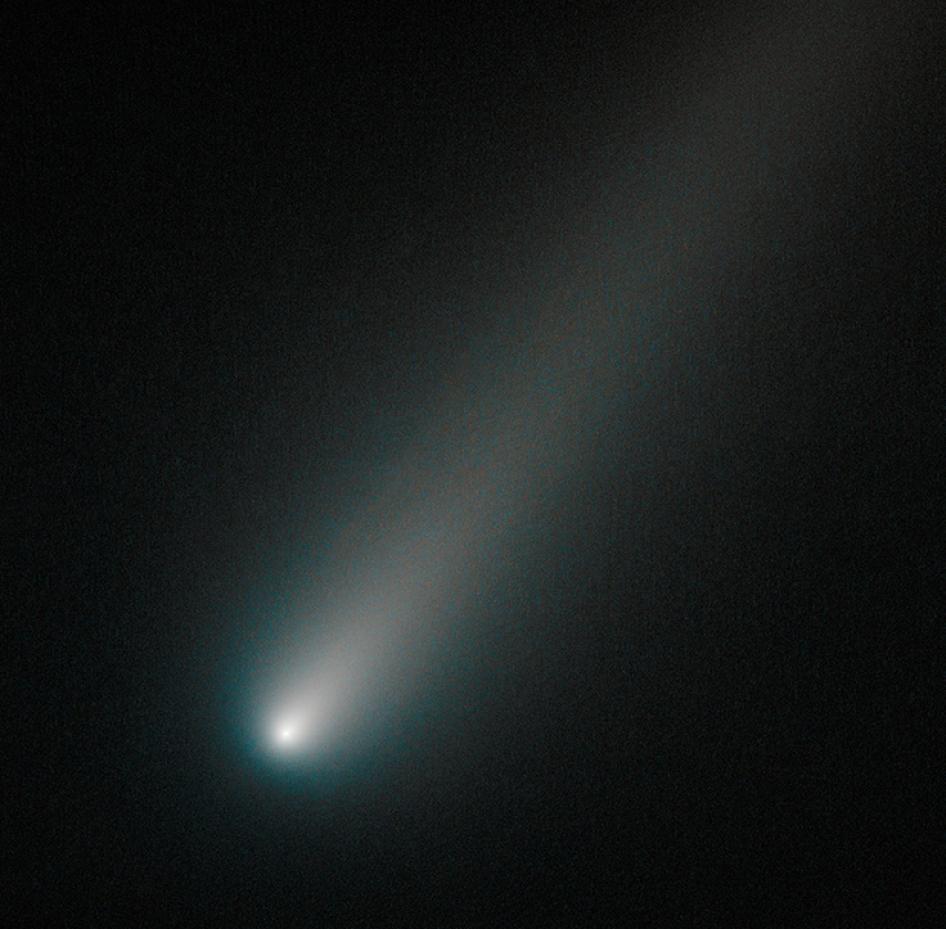
Interstellar comet 3I/ATLAS is on its way out. Having rounded the Sun at perihelion on October 30, 2025, at a distance of 1.4 astronomical units, the visitor is now retreating on a hyperbolic trajectory that will carry it out of the solar system for good. But before it goes, a sprawling international collaboration has used the object's entire visible apparition to answer a deceptively simple question: what color is it, really, and does that color change as the comet's activity rises and falls?
The answer, laid out in a paper posted to arXiv on September 18, 2026, is that 3I/ATLAS's coma is persistently red — and remarkably, stubbornly so. Despite large swings in brightness as the comet approached and then retreated from the Sun, its scattering properties barely budged.
Building the Most Complete Color Record of an Interstellar Object
The study, titled "Multiband Color Monitoring of 3I/ATLAS through Ground-Based Relay Observations," was led by Ariel Graykowski along with Bryce Bolin, Laura-May Abron, and roughly 140 co-authors. That author count is itself a signal of how the project worked: rather than relying on a single large telescope's limited observing windows, the team stitched together photometry collected between July 2025 and April 2026 from professional observatories and from a worldwide network of citizen-operated Unistellar eVscopes — compact, networked telescopes that amateur astronomers can point at a target on request.
That relay approach matters for a target like 3I/ATLAS. Interstellar objects pass through at their own pace, on their own schedule, and don't wait for a specific observatory's clear night or open slot. By distributing the observing load across time zones and instruments, the team was able to track the comet continuously in B, V, and R filters, plus the Sloan g, r, and i bands, across nine months — arguably the longest and most complete color baseline ever assembled for an object of interstellar origin.
The headline numbers are precise: mean color indices of B−V = 0.86 ± 0.06, V−R = 0.50 ± 0.03, and B−R = 1.36 ± 0.08. In plain terms, those values describe a coma that reflects noticeably more red light than blue — consistent with a dust-dominated coma whose grains are reddened relative to the Sun's own spectrum, a common signature of primitive, organic-rich material that hasn't been heavily processed by repeated solar heating.
Why the Color Barely Moved
What makes the result notable isn't just that 3I/ATLAS is red — it's that the red color held steady. Comets typically brighten dramatically near perihelion as sunlight vaporizes ices and lofts more dust, and that changing mix of gas and grain sizes can shift an object's apparent color as it evolves. The fact that 3I/ATLAS's color indices stayed tightly clustered throughout its approach, perihelion, and departure suggests the dust grains being shed were compositionally uniform, or that whatever process governs their release doesn't preferentially favor different grain populations at different distances from the Sun. Either way, it points to a coma dominated by stable, well-mixed refractory material rather than a shifting patchwork of ice and dust.
That stability sits alongside a growing body of chemical evidence about what's actually inside the coma. Separate research published in Monthly Notices of the Royal Astronomical Society found, using nitrogen-to-carbon-monoxide ratios, that 3I/ATLAS likely formed in conditions colder than −240°C — brutally frigid even by the standards of the outer reaches of a planet-forming disk. The William Herschel Telescope's WEAVE spectrograph, meanwhile, identified five distinct ion species streaming from the coma: molecular nitrogen, carbon monoxide, carbon dioxide, water, and hydrocarbons. Gemini North captured color imagery of the comet on November 26, 2025, adding a visual record to the spectroscopic one.
An Ancient Traveler
Perhaps the most striking figure attached to 3I/ATLAS doesn't come from its color or its chemistry, but from its age. JWST observations from June 2026 suggest the comet is somewhere between 10 and 12 billion years old — meaning it condensed out of its parent disk before our own Sun and solar system existed. If that estimate holds up, every photon this global relay of telescopes and eVscopes collected came from a body that has been drifting through the galaxy for the better part of cosmic history, only now making its one and only pass through a stellar system that didn't exist when it formed.
Why It Matters
3I/ATLAS is only the third confirmed interstellar object detected passing through the solar system, after 'Oumuamua in 2017 and Borisov in 2019, and by far the most thoroughly observed of the three. Consistent, well-calibrated color data across an object's entire apparition is exactly the kind of dataset planetary scientists need to compare interstellar visitors against comets native to our own solar system — and to each other, once more interstellar objects are found. A coma whose color barely changes despite dramatic swings in brightness gives modelers a cleaner constraint on dust grain composition and size distribution than sparse, single-instrument snapshots ever could.
The methodology matters almost as much as the result. Relay observing across professional and citizen-science networks proved capable of producing publication-grade, statistically tight photometry on a fast-moving, one-shot target — a template that will matter enormously as surveys like the Vera C. Rubin Observatory are expected to start flagging interstellar objects more frequently in the coming years, often with little warning and a narrow observing window before they're gone for good.
