
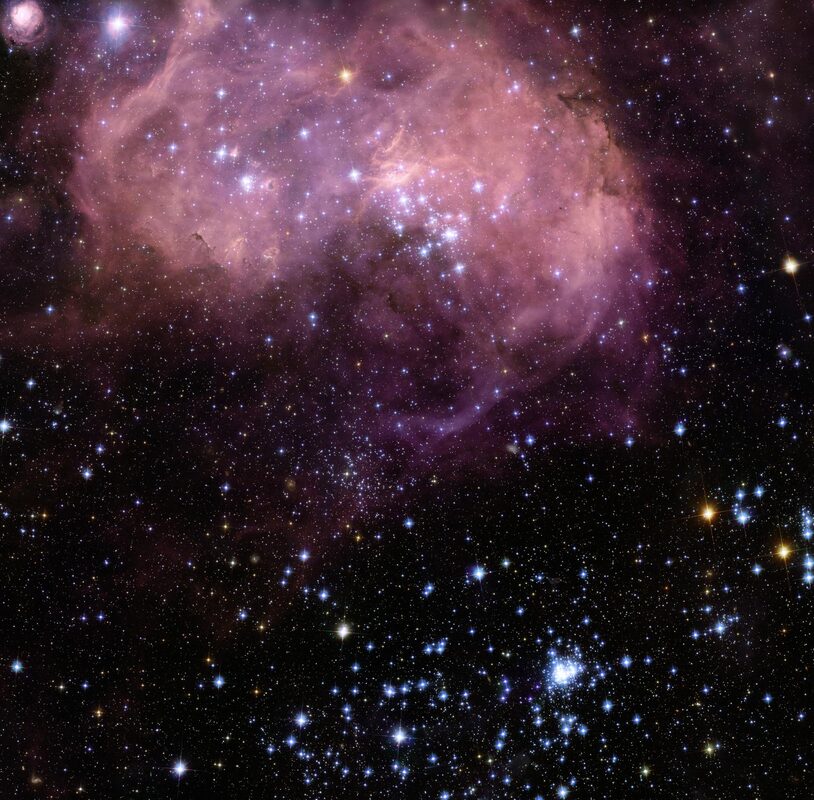
Roughly 160,000 light-years away, in the satellite galaxy known as the Large Magellanic Cloud, a cluster of massive stars has spent an unknown span of its short, violent life doing what massive stars do best: blowing things apart. A newly released Hubble Space Telescope image of the nebula LHA 120-N44 — N44 for short — shows the result in unusual clarity, a cavity roughly 210 by 140 light-years across gouged into the heart of a glowing star-forming cloud in the constellation Dorado.
NASA published the image on September 3, along with a companion release from ESA/Hubble's Picture of the Month series, and it quickly made the rounds as a "space photo of the day" pick from Space.com on September 4. All three describe the central cavity the same way: a superbubble spanning roughly 210 by 140 light-years across, carved into the dense, dusty shell that surrounds it.
What's Actually in the Picture
N44 is what astronomers call an emission nebula: a cloud of gas, mostly hydrogen, lit up by the ultraviolet radiation of hot young stars embedded within it. At its center sits a cluster of massive stars whose combined output — fierce stellar winds during their lives, and supernova explosions at the end of them — has swept the surrounding gas outward, hollowing out the superbubble and compressing the displaced material into a dense, glowing shell around the cavity's edge. NASA's release notes that N44 is a complex nebula filled with glowing hydrogen gas, dark lanes of dust, massive stars, and multiple populations of stars of different ages — consistent with a nebula that has been forming stars in waves rather than all at once.
The image itself comes from Hubble survey program #14689, led by principal investigator D. Gouliermis, which used the telescope to survey N44 and take a census of its stars. According to NASA and ESA/Hubble, that survey catalogued nearly half a million stars in and around the cluster, including foreground interlopers drifting in front of it — a number that only underscores how much stellar real estate is packed into a single star-forming complex in a neighboring galaxy. Of those, nearly 30,000 are pre-main-sequence stars: objects still in the process of forming, not yet stable enough to have ignited sustained hydrogen fusion in their cores. Astronomers use exactly this kind of population to reconstruct star-formation timelines, comparing the ages and positions of young stars to work out how — and how fast — a region like N44 built its stellar generations.
Why the Large Magellanic Cloud Keeps Showing Up in These Studies
The Large Magellanic Cloud is a small, gravitationally bound companion to the Milky Way, and at "only" 160,000 light-years away, it is one of the closest galaxies to our own. That proximity is precisely why regions like N44 keep turning up in Hubble's target list. ESA/Hubble's release describes the nebula as an ideal place to time the star-formation process from start to finish, while NASA calls N44 "an interesting target" for astronomers studying how stars form in this kind of environment, and Space.com notes the nebula "offers good conditions to study star formation and evolution." That framing lines up with a simpler underlying fact: at 160,000 light-years, the LMC is close enough for Hubble to resolve hundreds of thousands of individual stars, while sitting outside the Milky Way's own dusty disk — a vantage point that helps astronomers see the large-scale structure of a star-forming complex more clearly than they could from inside our own galaxy's crowded spiral arms.
That combination — resolvable individual stars plus a clear structural view — is plausibly what makes it possible for a single survey to catalogue half a million stars and sort tens of thousands of them by evolutionary stage. It's a kind of census that would likely be far harder to compile for a comparable nebula tucked inside our own galaxy's spiral arms, where foreground dust and crowding make individual stars much harder to separate.
Why It Matters
Superbubbles like the one carved into N44 are a visible record of how massive stars shape their environment long after they form. The winds and supernovae responsible for hollowing out the cavity don't just clear space — they compress the surrounding gas into a denser shell, and dense compressed gas is exactly the raw material that can collapse to form new stars. In other words, the same violent processes that destroy a nebula's original structure can also help trigger its next generation of star formation, which is one reason the nearly 30,000 pre-main-sequence stars catalogued in and around N44 matter beyond their sheer number: they're a snapshot of that triggered, ongoing process, close enough for Hubble to actually resolve.
More broadly, surveys like program #14689 give astronomers a working timeline for how a star-forming region evolves — from initial cloud, to burst of massive-star formation, to feedback-driven superbubble, to a fresh compressed shell seeding the next round. Because the LMC is close enough to study in this kind of individual-star detail, N44 functions as a nearby proxy for processes that play out constantly, but far less visibly, throughout the universe's star-forming galaxies — including, billions of years ago, our own.
