
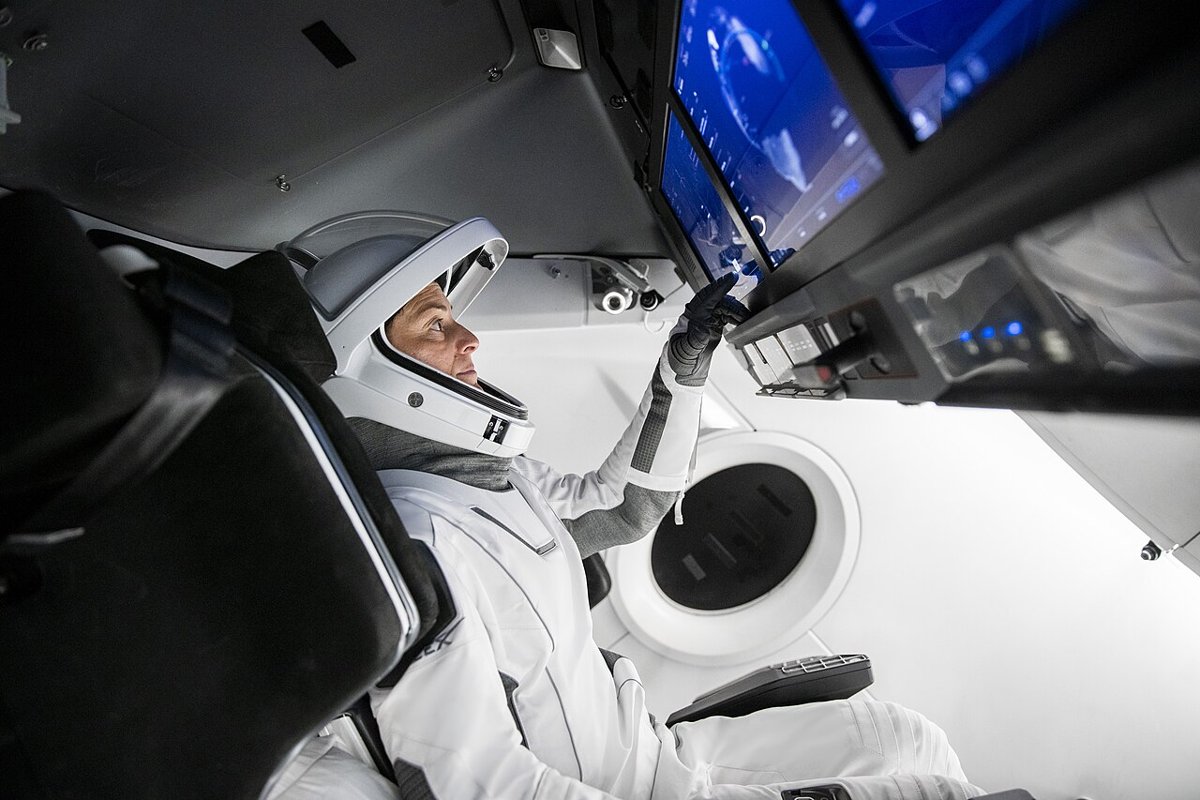
NASA opens astronaut applications roughly once every four years. When it does, thousands of engineers, scientists, physicians, and pilots flood the agency's portal — and NASA selects about a dozen. The 2017 class drew a record 18,300-plus applicants for 12 spots. The 2020 cycle attracted more than 12,000. The most recent call in 2024 received over 8,000 applications and yielded 10 selections. The acceptance rate consistently hovers below one-tenth of one percent, making this one of the most selective hiring processes on Earth — for a job that largely takes place off it.
Here is how the process actually works, what NASA is looking for, and what knocks you out of the running.
What Are the Basic Qualifications?
NASA publishes a short, unambiguous list. You must be a U.S. citizen. You must hold a master's degree in a STEM field — engineering, biological science, physical science, computer science, or mathematics — from an accredited institution. And you must have at least three years of related, progressively responsible professional experience obtained after completing that degree.
There are alternative pathways to satisfy the education requirement. Two years of work toward a doctoral program in a related STEM field counts. So does a completed Doctor of Medicine or Doctor of Osteopathic Medicine degree. Completion of a nationally recognized test pilot school program also qualifies. For pilots specifically, NASA requires at least 1,000 hours of pilot-in-command time in jet aircraft, with 850 or more of those hours in high-performance jets.
What does not qualify: a bachelor's degree alone, a degree in a non-STEM field regardless of how technical the work experience, or technology certifications without a formal degree.
What About the Physical Requirements?
Candidates must pass the NASA long-duration spaceflight astronaut physical — a battery of medical evaluations significantly more demanding than a standard flight physical. NASA does not publicly enumerate every criterion, but the exam assesses cardiovascular health, vision, blood pressure, and general fitness for extended stays in microgravity.
A common misconception is that astronauts must have perfect uncorrected vision. NASA revised its vision standards years ago, and corrective surgery — including LASIK and PRK — is now acceptable, provided the procedure was completed with sufficient time for stable healing before the physical. Height restrictions also apply: candidates must fall within a range compatible with current spacecraft and spacesuit designs, though exact thresholds have shifted as vehicle architectures evolve.
How Does the Application Process Work?
NASA accepts applications for the Astronaut Candidate Program on an as-needed basis — there is no rolling admissions window. When a call goes out, applicants submit through USAJOBS, the federal government's standard hiring portal. The application is a federal resume, transcripts, and references — not an essay contest.
From there, the NASA Astronaut Selection Board reviews the full pool and invites a small group of highly qualified candidates to the Johnson Space Center in Houston for interviews. Those interviews are intense, multi-day affairs that include medical screening, psychological evaluation, team-based exercises, and panel interviews with current astronauts and NASA leadership.
Approximately half of the first-round interviewees are invited back for a second round. Final selections are made from that group. The entire process, from application deadline to public announcement, typically spans more than a year.
What Are the Actual Odds?
Dire. NASA has selected 370 astronaut candidates since the program began with the Mercury Seven in 1959. In recent cycles, the numbers tell the story starkly: the 2017 class selected 12 from more than 18,300 applicants — an acceptance rate of roughly 0.065 percent. The 2025 class selected 10 from over 8,000.
For context, Harvard's undergraduate acceptance rate hovers around 3 to 4 percent. Getting into the astronaut corps is statistically on the order of 50 times harder. And unlike university admissions, there is no legacy advantage, no early-decision track, and no gap-year reapplication strategy that meaningfully changes the calculus. You either meet an extraordinarily high bar in a field of people who also meet it, or you do not.
Do You Have to Be a Military Pilot?
No — but it helps to understand the historical composition. Of NASA's 370 astronaut candidates, 212 have come from military backgrounds and 138 have been civilians. The pilot-to-non-pilot split is closer than most people assume: 191 pilots versus 159 mission specialists, scientists, and engineers who never logged a single hour in a cockpit as pilot-in-command.
The early astronaut classes were exclusively military test pilots — that was the literal job description for Mercury, Gemini, and much of Apollo. But as the program matured through the Space Shuttle era and into the International Space Station, NASA deliberately broadened the profile. Recent classes include physicians, geologists, marine biologists, and robotics engineers alongside fighter pilots. The 2025 class features military officers from the Army, Air Force, and Navy alongside civilian physicians and engineers with no military service.
The shift reflects what modern spaceflight actually demands. Operating the ISS requires fluency in orbital mechanics and plumbing repair in roughly equal measure. Artemis lunar surface missions will need field geologists who can troubleshoot life-support hardware under pressure. The "Right Stuff" archetype — steely-eyed test pilot, crew cut, fighter jock — is a historical artifact, not a current requirement.
What Does Training Look Like?
Selected astronaut candidates — known internally as ASCANs — enter an approximately two-year training program at Johnson Space Center. The curriculum is dense and physical.
Trainees learn spacewalking operations in the Neutral Buoyancy Laboratory, one of the world's largest indoor pools. The NBL contains full-scale mockups of ISS modules submerged in 6.2 million gallons of water, allowing astronauts to rehearse extravehicular activity procedures in simulated weightlessness. The facility supports multiple large-scale operations simultaneously using both underwater and topside assets. A single suited EVA training run can last six hours or more.
All candidates learn to fly the T-38 Talon, a supersonic jet trainer that NASA uses not primarily for transportation but as a training device for high-performance decision-making and crew coordination. Even non-pilot astronauts fly regularly in the back seat. The aircraft forces rapid, consequential decisions in a dynamic environment — precisely the cognitive skill set that spacewalks and emergency procedures demand.
The training pipeline also covers ISS systems operations, robotics — including operation of the Canadarm2 robotic arm — Russian language instruction, and survival training. Candidates train in the Space Vehicle Mockup Facility, which houses full-scale spacecraft replicas for systems familiarization and emergency egress practice.
Completion of ASCAN training does not guarantee a flight assignment. Astronauts may wait years between finishing their candidacy and receiving a specific mission role.
What Disqualifies You?
The hard disqualifiers are straightforward: non-U.S. citizenship, lack of a qualifying STEM degree, insufficient professional experience, and failure of the NASA medical examination. Beyond those bright lines, NASA does not publish a detailed list of disqualifying conditions, and the selection board retains significant discretion.
Practically, certain medical conditions — uncontrolled hypertension, certain cardiac arrhythmias, conditions incompatible with sustained microgravity exposure — will end a candidacy at the physical. A history of certain psychological conditions may also be disqualifying, though NASA evaluates these on a case-by-case basis.
What is not disqualifying, despite popular belief: wearing glasses or contacts, having had corrective eye surgery, being over 40, lacking military service, or holding a degree from a non-elite university. NASA's selection history includes candidates from state schools, community college transfer students, and people who applied multiple times before being selected.
Why It Matters
The astronaut selection process is more than a hiring procedure — it is a signal of what skills and knowledge NASA believes the next era of human spaceflight will require. When the agency shifts its qualifications or broadens its candidate profile, it is telegraphing the program's future direction. The increasing inclusion of physicians, geologists, and biologists alongside pilots reflects a transition from a program built around vehicle operation to one built around destination science — lunar geology, Mars habitability research, and long-duration human physiology.
For the thousands who apply and are not selected, the process still matters. NASA's requirements function as a de facto curriculum for careers in aerospace, and the visibility of each application cycle draws public attention to STEM career paths in a way few other government programs can match. The astronaut corps is tiny. Its aspirational footprint is enormous.
