
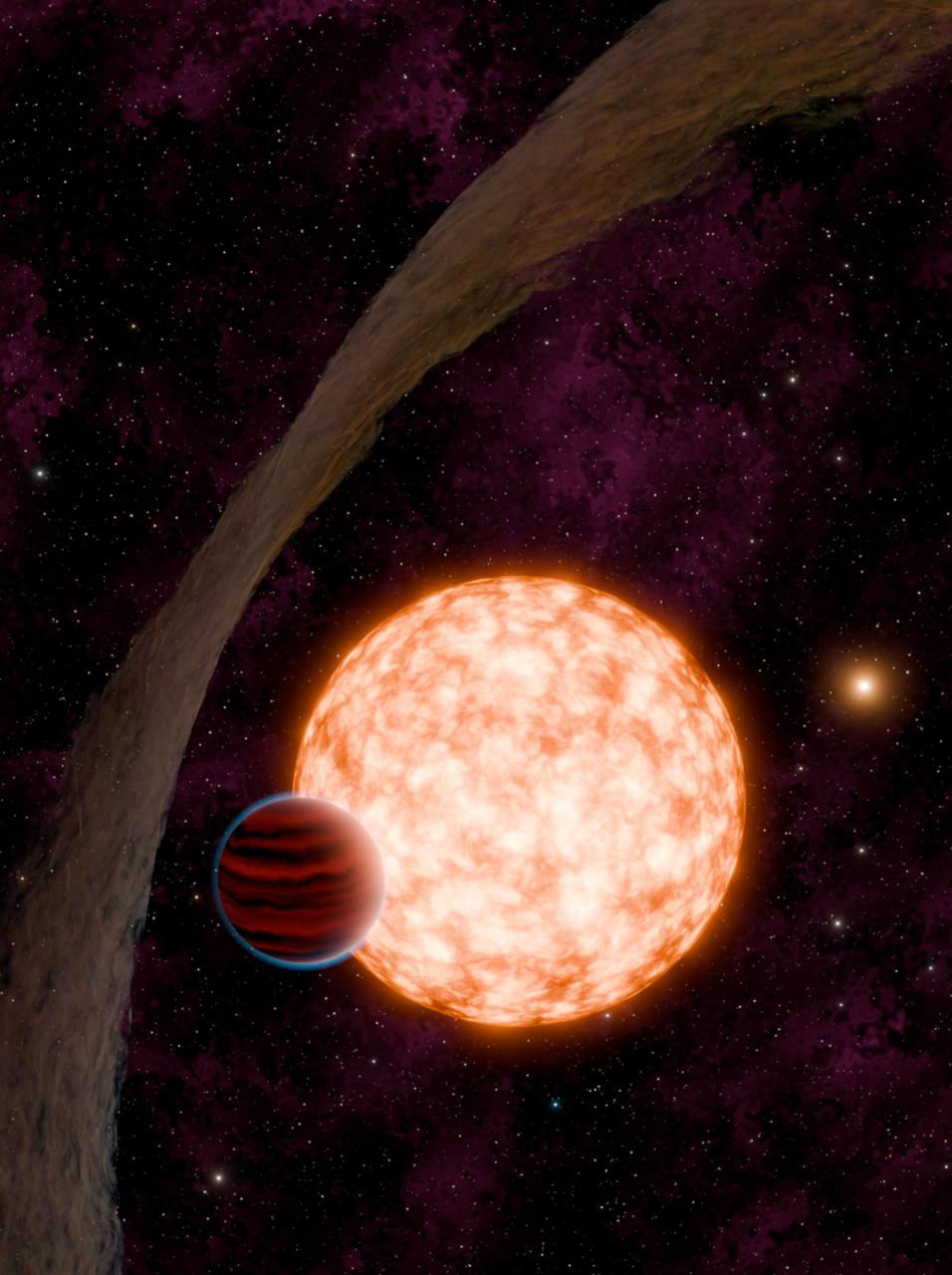
Within living memory, astronomers knew of exactly one planetary system: our own. The notion that other stars hosted planets was reasonable but unproven. Then, in 1995, Michel Mayor and Didier Queloz announced 51 Pegasi b — a Jupiter-mass planet whipping around its star in just over four days, a configuration so at odds with theory that it forced a rewrite of how planetary systems were thought to form. The discovery won a Nobel Prize and opened a field that has not slowed since. NASA's catalogue has now passed 6,000 confirmed exoplanets, with thousands more candidates awaiting confirmation. What makes the number remarkable is that almost none of these worlds have ever been seen directly. A planet is a faint object pinned beside a vastly brighter one; finding it is an exercise in inference.
The Doppler wobble
Mayor and Queloz used the radial velocity method. A planet and its star both orbit their common centre of mass, so the star traces a small reflex motion, and as it moves toward and away from us its spectral lines shift slightly blueward then redward. Measuring that periodic Doppler shift — in the best modern instruments, to a precision of around a metre per second — reveals the planet's orbital period and a lower bound on its mass. It found the first exoplanets and remains essential for confirming candidates today.
The transit revolution
The technique that turned a trickle into a flood is photometric. When a planet's orbit happens to be edge-on to our line of sight, it occults a fraction of the star's light once per orbit; the depth of that dip gives the planet's radius, and its spacing gives the orbital period. NASA's Kepler mission, which stared at a single patch of sky for years, demonstrated statistically that planets outnumber stars in the galaxy. It alone delivered more than a thousand confirmed planets — a dozen of them less than twice Earth's size and orbiting in their stars' habitable zones — and revealed populations theory had not anticipated, including abundant super-Earths and sub-Neptunes and a curious scarcity of planets at intermediate sizes now called the radius valley. The TESS mission has since extended the survey across nearly the whole sky, prioritising bright, nearby stars whose planets are the easiest to study further.
From detection to characterisation
Combining a transit-derived radius with a radial-velocity mass yields a bulk density — the first clue to whether a world is rocky, gaseous, or a volatile-rich hybrid. But the frontier has moved beyond simply counting and weighing planets to interrogating their atmospheres. During a transit, a sliver of starlight passes through the planet's atmosphere on its way to us, and different gases absorb different wavelengths, imprinting absorption features on the spectrum. This transmission spectroscopy, now being carried out by the James Webb Space Telescope, is how the search for habitability is shifting from demographics to chemistry.
The caution that comes with it
A handful of worlds have, in fact, been photographed directly — young, massive planets glowing with their own heat, far enough from their stars that their light can be isolated. But direct imaging of a small, rocky planet beside a Sun-like star remains beyond current optics, and bridging that gap is the explicit goal of the next generation of instruments: the Roman Space Telescope's coronagraph as a technology demonstration, and the proposed Habitable Worlds Observatory designed expressly to image and analyse Earth-like planets. The trajectory of the field is toward seeing these worlds, not merely inferring them.
Here restraint is warranted. The proposed biosignatures — atmospheric oxygen, or chemical disequilibrium between gases such as oxygen and methane that should not coexist without something replenishing them — all have abiotic false positives, processes that can mimic life without any biology involved. Disentangling them demands a signal-to-noise ratio at the very edge of what current instruments can deliver, and any claim of life elsewhere will face years of adversarial scrutiny before it could stand. No second Earth has been confirmed. What has changed, profoundly, is that the question is finally empirical rather than philosophical: we know other worlds are everywhere, in a riot of varieties our own system never hinted at, and for the first time we have the tools to ask, world by world, whether any of them is alive.
