
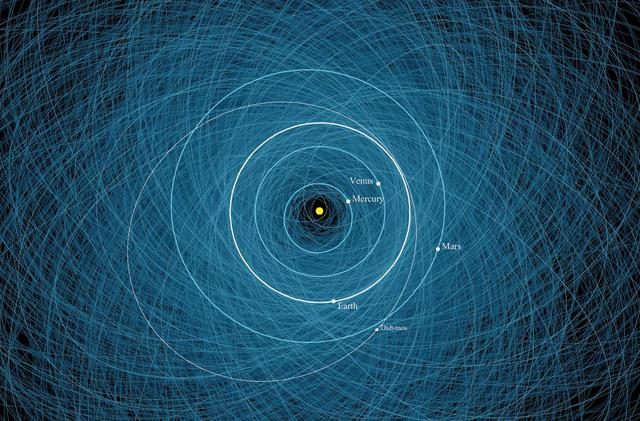
In September 2022, NASA's DART spacecraft slammed into Dimorphos at 6.1 kilometers per second and humanity notched its first deliberate alteration of a celestial body's orbit. The impact shortened Dimorphos's orbital period around its parent asteroid Didymos by 33 minutes — far exceeding the ten-minute minimum needed to claim success. But that number, impressive as it sounds, left planetary defense scientists with a deeper problem: they don't fully understand why it worked as well as it did.
Enter Hera. ESA's mission, launched in October 2024 and arriving at the Didymos system in late 2026, is the forensic follow-up that DART never had. Where DART was a proof of concept, Hera is the measurement campaign — a six-month orbital survey designed to turn a dramatic demonstration into a reproducible science.
The Mystery in the Numbers
The 33-minute orbital period change was roughly five times larger than kinetic momentum transfer alone could explain. The reason: ejecta. When DART hit Dimorphos, the impact excavated a plume of debris estimated at several million kilograms. That material, hurled away from the asteroid at varying velocities, acted as a rocket nozzle in reverse — the recoil from all that departing mass amplified the deflection far beyond the spacecraft's own momentum.
This momentum enhancement factor, denoted beta (β), is central to planetary defense modeling. Pre-impact predictions ranged from β = 1 (pure kinetic transfer, no ejecta benefit) to β = 5 or higher depending on surface composition and internal structure. The measured value landed around 2.2 to 4.9, depending on the model. That uncertainty of nearly a factor of two matters enormously: it's the difference between designing a deflection mission that needs to launch five years before a predicted impact versus ten.
Hera will constrain β by mapping exactly what DART left behind — the crater geometry, the volume of excavated material, and the mass of Dimorphos itself, which was never directly measured before the impact. Current estimates based on ground-based photometry put Dimorphos at roughly 4.3 billion kilograms, but the uncertainty spans a factor of two in either direction.
What Hera Is Actually Carrying
The spacecraft's instrument suite is designed around the problem of characterizing a small, irregularly shaped body with minimal fuel expenditure. The TIRA framing camera will build centimeter-scale stereo maps of Dimorphos's surface, while the PALT laser altimeter provides topographic profiles. A thermal infrared imager will reveal surface conductivity — a proxy for whether the asteroid is a solid rock or a loosely bound rubble pile, which dramatically affects how deflection forces propagate through the body.
Two CubeSats — Milani and Juventas — deploy from Hera for closer inspection. Juventas carries a low-frequency radar designed to probe Dimorphos's interior to depths of up to 100 meters, giving scientists their first direct look at what lies beneath a small asteroid's surface. If Dimorphos is a rubble pile (the current leading hypothesis), the radar return will show a chaotic jumble of voids and boulders. If it's more cohesive, the signal will be cleaner.
Milani, meanwhile, hosts a dust detector and a visual spectrometer to characterize the surface mineralogy. Its data will help answer whether the impact exposed fresh material from depth or simply redistributed existing surface regolith.
The Crater
Hubble Space Telescope images taken after the DART impact revealed a spectacular ejecta plume stretching tens of thousands of kilometers, but ground-based telescopes couldn't resolve the crater itself — Dimorphos, at 151 meters across, subtends an angle far too small for any Earth-based imager. Hera's close approach will get cameras within a few kilometers of the surface, close enough to image individual boulders and directly measure the crater's diameter and depth.
Pre-impact predictions put the crater somewhere between 10 and 50 meters across. The actual result will reveal how efficiently kinetic energy was transferred into excavation — a parameter that feeds directly into the design of future deflection spacecraft.
Planetary Defense's Next Problem
Hera's scientific return doesn't exist in isolation. The mission's data will feed into NASA's Center for Near Earth Object Studies and ESA's Space Situational Awareness program, both of which maintain the catalogs and impact probability estimates that would trigger a real deflection campaign. Currently, roughly 2,350 near-Earth asteroids are classified as "potentially hazardous" — meaning their orbits bring them within 7.5 million kilometers of Earth and they're large enough to cause regional damage. None of them have meaningful impact probabilities in the next century, but the catalog is incomplete, particularly below 140 meters.
The 2023 discovery of 2023 DW briefly attracted attention when initial observations gave it a 1-in-600 chance of hitting Earth in 2046 before follow-up data ruled it out. That episode illustrated both the power of modern detection systems and the need for rapid deflection modeling. Hera is building that modeling capability — not just scientifically, but institutionally, establishing the collaboration between NASA, ESA, and national agencies that a real planetary defense response would require.
If everything goes well, Hera will complete its prime mission in mid-2027 and possibly maneuver into orbit around Dimorphos itself for an extended phase — a feat never before accomplished at such a small body. By the time it's done, Dimorphos will be the most thoroughly characterized small solar system body in existence, and the kinetic impactor will be a calibrated tool rather than a hopeful experiment.
