
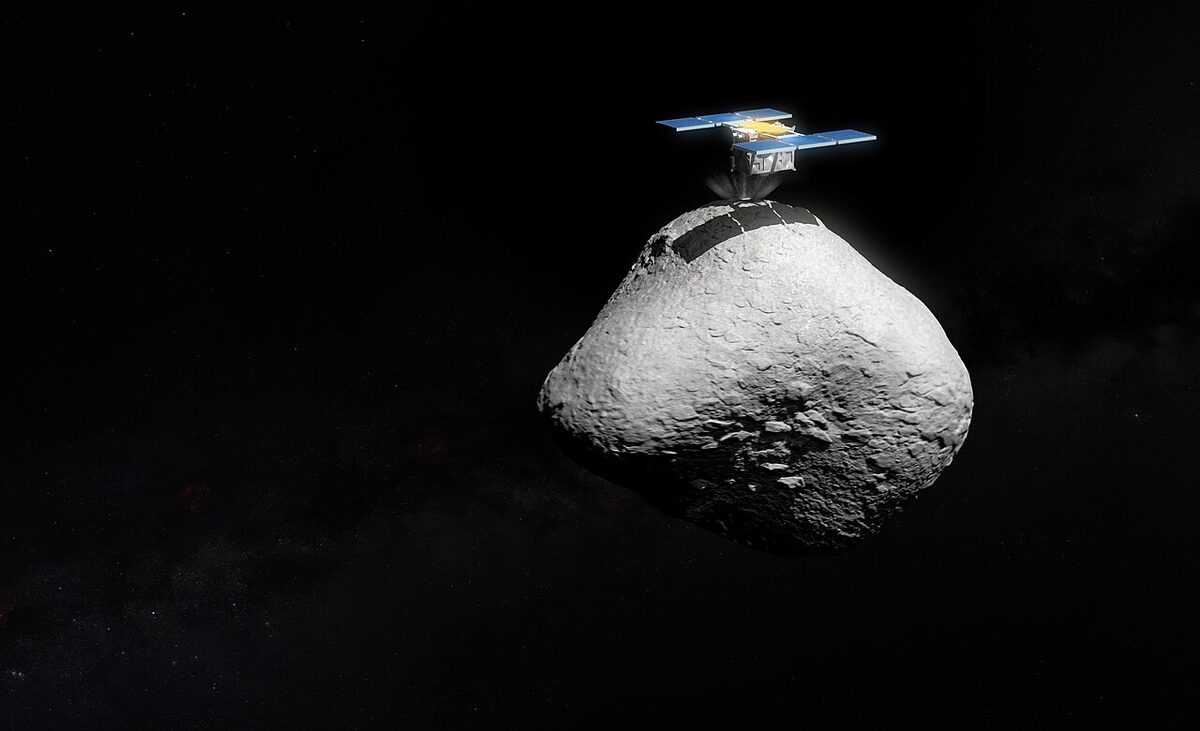
Some spacecraft refuse to retire. Hayabusa2, the Japanese probe that famously snatched samples from the asteroid Ryugu and parachuted them back to Earth in December 2020, never came home itself. Instead, with fuel to spare and instruments still healthy, it was sent off on an extended mission — and that mission is about to deliver one of the most demanding maneuvers of its long career.
On July 5, 2026, according to Japan's space agency JAXA, Hayabusa2 will fly past a near-Earth asteroid named Torifune, formally designated (98943). It will not be a gentle pass. The spacecraft is set to scream by at roughly five kilometers per second — about 18,000 kilometers per hour — threading extraordinarily close to the asteroid, with a planned approach distance measured from the asteroid's center of just one to ten kilometers.
The challenge of a high-speed flyby
A flyby that fast and that close is hard for the same reason a sharp photograph of a passing race car is hard: the target whips through the field of view in moments. The spacecraft's cameras and guidance system must track and image Torifune during a window that lasts only seconds, all while the geometry changes at blistering speed. Pulling it off requires high-precision orbital guidance — autonomously pointing instruments at a small, fast-moving rock the spacecraft has never seen up close.
Torifune itself is a worthwhile target. Estimated at about 450 meters across, it may be elongated in shape, and a close pass would deliver the first detailed look at a body that until now has been little more than a point of light and a set of orbital numbers. But the deeper purpose is to practice. The flyby is designed to demonstrate and refine the navigation techniques needed to approach asteroids precisely — capabilities that feed directly into planetary defense.
Rehearsing to deflect
The extended mission carries a fitting nickname: Hayabusa2#, where the "#" is pronounced "SHARP," standing for Small Hazardous Asteroid Reconnaissance Probe. The framing is intentional. The same skills required to guide a spacecraft to a precise rendezvous with a small asteroid are the skills required to one day intercept — and potentially nudge — an asteroid on a collision course with Earth. Practicing high-precision guidance now, against a harmless target, builds the toolkit for a future emergency.
It helps to remember what this spacecraft already pulled off. At Ryugu, a diamond-shaped, rubble-pile asteroid, Hayabusa2 didn't just collect dust — it fired a projectile to blast an artificial crater, dropped small rovers onto the surface, and returned just over five grams of pristine material to Earth. Analysis of those grains has since turned up water-bearing minerals, a rich inventory of organic molecules, and even amino acids, lending hard evidence to the idea that asteroids could have delivered the chemical building blocks of life to the early Earth. The probe now lining up the Torifune flyby is the same machine that delivered one of the most scientifically valuable samples ever brought back from deep space.
Torifune is a waypoint, not the destination. The probe's final goal is a rendezvous in 2031 with 1998 KY26, a tiny object only a few tens of meters across — the kind of small, fast-spinning body that is both a scientific curiosity and, in the sizes that actually threaten populated areas, a planetary-defense priority. Reaching it will require everything the mission learns at Torifune and more.
There is something quietly remarkable about a spacecraft that already accomplished a historic sample return now serving as a testbed for the next generation of asteroid missions. Hayabusa2 has become a flying rehearsal: every maneuver in its extended life is both science and practice, sharpening the techniques humanity may someday need when the asteroid in the crosshairs is not a chosen target but an incoming one.
