
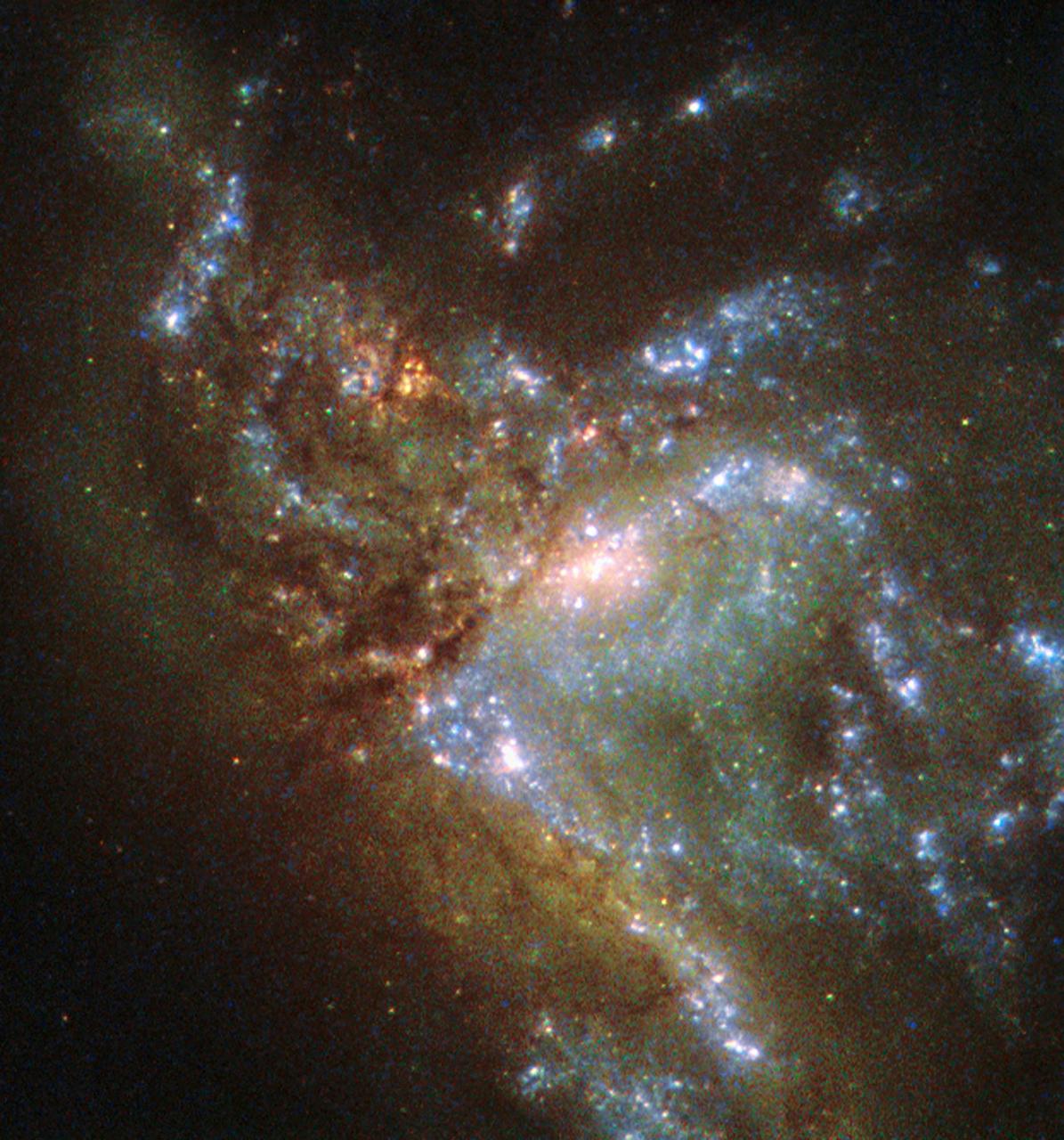
On September 1, 2026, NSF NOIRLab released a new portrait of two spiral galaxies caught mid-collision more than 200 million light-years away in the constellation Pegasus. The image, captured by the Gemini North telescope on Maunakea, is the kind of thing observatories publish regularly — a swirl of dust lanes and star-forming knots, gravitationally tangled and slowly becoming one. What sets this release apart is who got to name it, and what they called it.
The object is NGC 7253, also cataloged as Arp 278: a pair of interacting spirals, NGC 7253A and NGC 7253B, first spotted on September 9, 1863, by astronomer Albert Marth. It's been sitting in catalogs under that clinical designation for 163 years. This year, a cohort of high school students from Hawai'i Island gave it a name that actually means something: Nā ʻUhane Māhoe Huki Pū i ke Ola — "The Twin Spirits Pulling Together Creating Life."
Who did the naming, and how
The name came out of Project Hōkūlani, an internship partnership between the International Gemini Observatory and the University of Hawaiʻi at Mānoa. Work on this particular image began in October 2025, when three students from Waiākea High School and the Volcano School of Arts and Sciences — Raiyan Rahman, Rafan Rahman, and Alia Tamanha — spent a week at Gemini North's Hilo Base Facility and chose NGC 7253 as the object for the telescope to image. A second cohort joined in June 2026: Mylin Wilson of Keaʻau High School, and Manu Silva-Sampaio and Samantha Silva-Sampaio of Kamehameha Schools, who built on that groundwork and are credited, per NOIRLab's release, with creating the Hawaiian name itself.
"NGC 7253 is a fascinating object because it's two galaxies that are merging into one over billions of years," Rahman said, describing the pair in terms that double as a decent summary of what makes the image worth looking at in the first place.
That framing — two spirits pulling together to create life — isn't just poetic dressing on a science photo. Merging galaxies are, in a very literal sense, life-giving events in cosmic terms: the gravitational disruption compresses gas clouds and triggers waves of new star formation, seeding regions that will eventually host their own planetary systems. Whether the interns had that mechanism specifically in mind or were drawing on Hawaiian cosmological tradition, the metaphor holds up under the astrophysics.
What Gemini North actually captured
NGC 7253A and 7253B lie more than 200 million light-years from Earth and are separated by roughly four million light-years, per NOIRLab's release — a pairing distant enough that the merger will play out over a timescale of billions of years rather than anything observable within a human lifetime. As the two galaxies' spiral arms interact, their gas and dust clouds collide and compress, triggering bursts of star formation; the bright pink knots scattered through the image are HII regions, pockets of hydrogen gas ionized by radiation from the newly formed stars, according to both NOIRLab's release and Sci.News's coverage of it.
Image credit for the release goes in part to T.A. Rector of the University of Alaska Anchorage. The observatory catalogs the release under the internal ID noirlab2621.
Why It Matters
Public astronomy imagery usually arrives pre-packaged with institutional framing: a telescope, a target, a press office. Project Hōkūlani inverts part of that pipeline by handing naming authority — not just outreach copy, but the actual public-facing identity of a deep-sky object — to Hawai'i Island students working from a research telescope built on land, Maunakea, that carries deep and often contested cultural significance in Hawaiian tradition. That's a genuinely different model from the usual "here's a pretty picture, here's what NASA calls it" release, and it matters for two reasons.
First, it's a small but concrete example of indigenous knowledge systems and scientific naming conventions coexisting rather than competing — a Hawaiian name standing as the primary public label for a cataloged NGC object, not a footnote appended to it. Second, it's a pipeline: NOIRLab says six local high school students on Hawai'i Island get to contribute to the selection, imaging, and naming of a new Gemini North image every year through this program, which is a meaningfully different on-ramp into the field than a classroom poster of the Hubble Deep Field. Maunakea's observatories have spent years negotiating their relationship with the Native Hawaiian community that considers the mountain sacred; programs like this one are part of how that relationship gets worked out in practice, one internship cohort and one named galaxy pair at a time.
The bigger picture
NGC 7253 will keep merging long after this news cycle ends — that's the nature of a billion-year process. What changes this week is smaller and more immediate: a 163-year-old NGC catalog number now has a public-facing name rooted in the language and worldview of the people whose mountain hosted the telescope that took the picture. Gemini North will keep imaging targets like this one regularly; whether future releases keep following this naming model is worth watching.
Sources
- Nā ʻUhane Māhoe Huki Pū i ke Ola | NOIRLab
- Gemini North Telescope Captures Stunning Portrait of Merging Spiral Galaxies | Sci.News
- Galaxies tangled in science and spirit | Space photo of the day for Sept. 7, 2026 | Space.com
- Hawai'i high school students name image of glittering galaxy pair | Phys.org
