
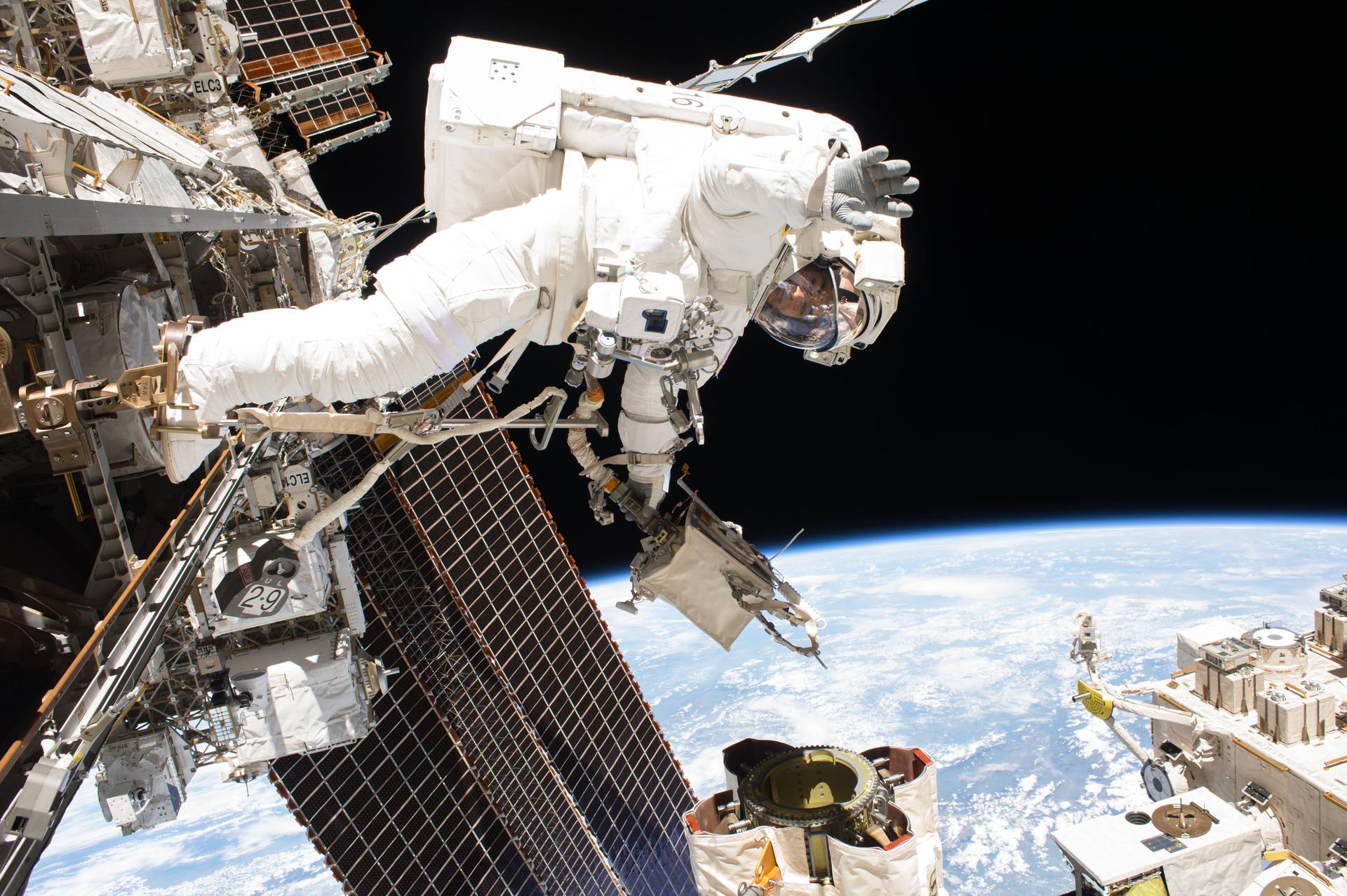
On Tuesday, June 30, two NASA astronauts will float out of the International Space Station's Quest airlock and spend the better part of a workday doing something the station has needed for a quarter-century to do well: keep its robotic arm alive. U.S. Spacewalk 95 is scheduled to begin around 8:35 a.m. EDT and run roughly six and a half hours, and its single headline task is a joint replacement on Canadarm2 — the long, multi-jointed arm that has become indispensable to how the orbiting laboratory receives cargo and maintains its own exterior.
The crew for the excursion is Chris Williams and Jessica Meir. For Meir it will be a fifth spacewalk; for Williams, a second. Guiding them from Houston will be Canadian Space Agency astronaut Jenny Gibbons, a reminder that Canadarm2 is a Canadian-built piece of hardware and that the agency that built it stays in the loop when it needs surgery. NASA plans live coverage starting at 7 a.m. EDT on NASA+.
What actually broke
The problem traces back to May 27, when Canadarm2 was being operated as normal and one of its wrist joints stopped behaving. According to NASA, the arm drew elevated motor current and then did not move as expected — the kind of symptom that points to a mechanical or electrical fault inside the joint rather than a software hiccup. The component at issue is a wrist joint, and rather than nurse a degraded arm along, the program elected to swap it out.
That is where the spacewalk comes in. The plan, as described by the Canadian Space Agency and confirmed by independent outlets, is to remove the malfunctioning wrist joint and install a spare. It is a tidy illustration of how the ISS was designed to be serviced: critical mechanisms are built as orbital replacement units so that, when one fails, astronauts can physically exchange it on orbit instead of writing the whole system off.
Why Canadarm2 is worth a spacewalk
Canadarm2 is not a convenience. It is one of the load-bearing pieces of the station's day-to-day operations. The arm is used to capture and berth visiting vehicles — the cargo spacecraft that bring up food, water, experiments, and hardware — and to support external maintenance work. When a free-flying cargo ship arrives and parks itself within reach, it is Canadarm2 that reaches out, grapples it, and walks it in to a berthing port. Lose the arm, and you lose a primary path for getting supplies aboard.
That operational weight is why a single balky joint is enough to justify sending two people outside for the better part of a day. The arm has been in service for roughly 25 years, and like any machine of that age, it is now reaching the point where individual components wear out and need replacing. The June 30 EVA is, in effect, scheduled maintenance forced by an unscheduled failure.
A numbered milestone
NASA is logging this as the 280th spacewalk performed in support of station assembly, maintenance, and upgrades — a running tally that captures just how much of the ISS's longevity is a product of hands-on human labor in vacuum. Spacewalk 95 in the U.S. EVA series is one more entry in a long ledger of repairs, swaps, and upgrades that have kept the station functional far longer than its original design life implied.
The choreography is familiar by now: a guiding astronaut on the ground in Houston talking the two spacewalkers through each step, a tightly scripted timeline built around the roughly six-and-a-half-hour window, and a spare component staged and ready to go in. None of it is improvised. The value of a 280-spacewalk track record is precisely that this kind of joint replacement has become a known quantity rather than a gamble.
Why It Matters
The ISS is old, and keeping it running is increasingly a story about repair rather than expansion. Spacewalk 95 is a clean case study in how that works: a critical, 25-year-old robotic arm throws a fault during routine operations, and within weeks the program has staged a spare part and scheduled two astronauts to go install it. Canadarm2's health is not an abstract engineering concern — it is the mechanism that captures and berths the commercial and cargo vehicles the station depends on for resupply. A wrist joint that draws too much current and won't move is, downstream, a threat to the flow of cargo traffic to and from low Earth orbit. The fact that the fix is a planned, six-and-a-half-hour EVA rather than a crisis is itself the point: the station was built to be serviced, and after 280 spacewalks, that servicing is routine enough to put on a livestream.
Sources
- NASA to Cover US Spacewalk 95, Host Preview News Conference — NASA
- NASA and CSA prep for spacewalk to replace key joint on the Canadarm2 — SpaceQ
- Canadarm2 Repair Spacewalk Set for June 30: ISS Robotic Arm Gets New Wrist Joint — Tech Times
- NASA to cover US Spacewalk 95 to repair Canadarm2 wrist joint — Space & Defense
