
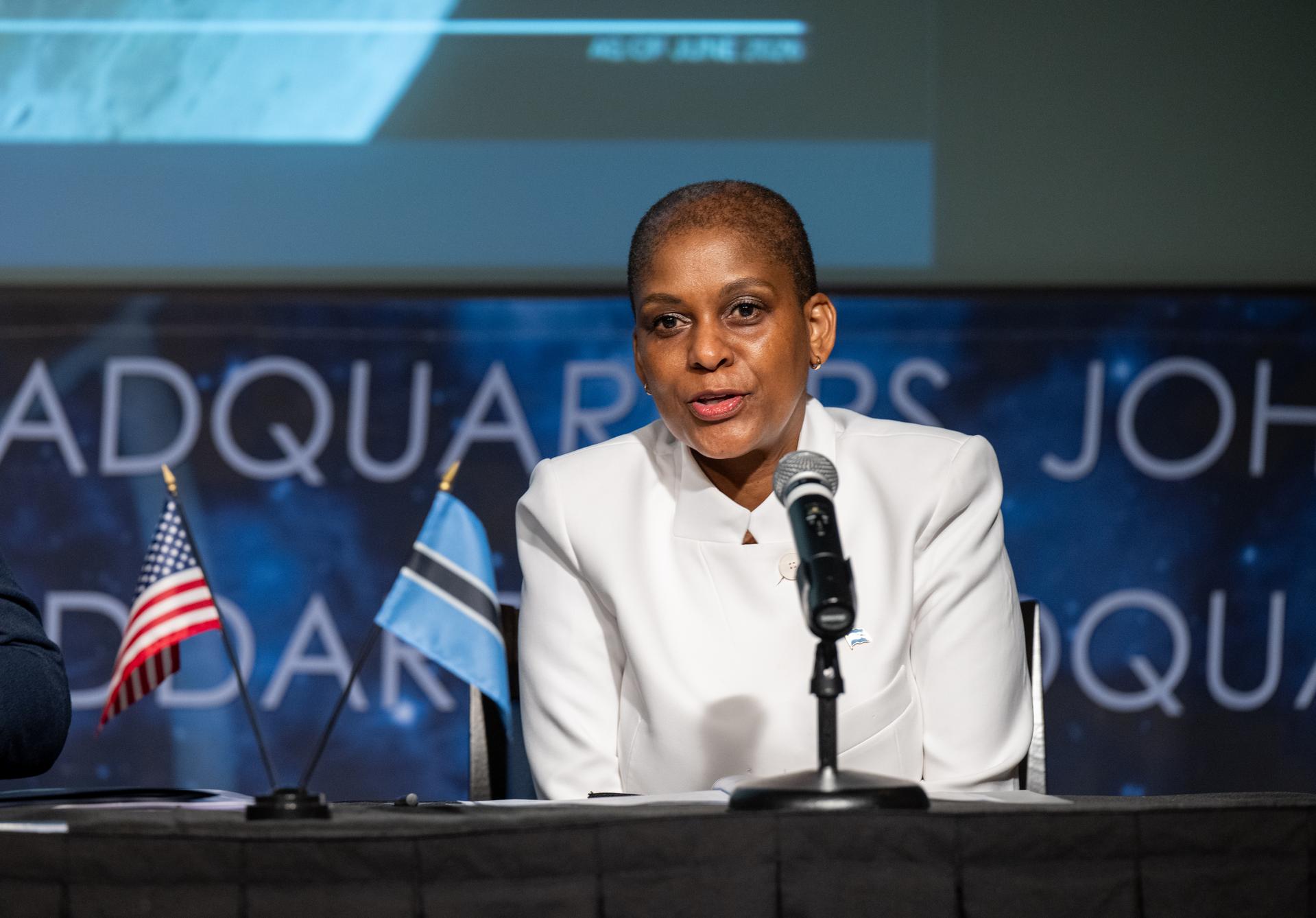
On June 25, 2026, a relatively short ceremony at NASA Headquarters in Washington added another name to a list that has been growing at a conspicuous pace. Botswana’s Minister of Communications and Innovation, David Tshere, signed the Artemis Accords on behalf of his country, making the southern African nation the 68th signatory to the framework and the sixth African country to join it. NASA Deputy Administrator Matt Anderson and State Department Senior Advisor for Space Greg Autry hosted the signing.
On its own, a single signature on a non-binding set of principles is the kind of event that generates a press release and little else. But the timing is what makes Botswana’s accession worth a closer look: it is the ninth country to sign the Accords in 2026 alone, and it caps a steady broadening of the agreement’s membership across the developing world. The diplomatic scaffolding around lunar and Mars exploration is being built faster than the hardware that will actually go there.
What the Accords actually are
The Artemis Accords were established in 2020 as what NASA describes as the first practical set of principles for the safe and transparent civil exploration of the Moon, Mars, and beyond. They are not a treaty in the formal sense; they are a statement of shared norms — commitments to transparency, interoperability, the peaceful use of space, and the responsible handling of activities on and around other worlds. Countries sign on as a declaration of intent rather than a binding legal obligation, which is part of why the roster has been able to expand so quickly.
That structure also explains why a nation does not need a crewed space program, or even a large satellite fleet, to participate. The Accords are about governance and posture as much as engineering. For a country like Botswana, signing is a way of securing a seat at the table where the rules for the next era of exploration are being negotiated, well before any of that exploration touches its borders.
Botswana’s space credentials
Botswana is not a newcomer to space activity, even if its profile is modest. The country participated in NASA’s Landsat program back in the early 1970s, using the Earth-observation satellites to survey its own territory — a practical application for a large, sparsely populated nation with significant land-management and resource needs.
More recently, Botswana launched Botswana Satellite 1 aboard a SpaceX rocket in March 2025. That launch put the country among the growing cohort of African states with an orbital asset to their name, and it gives the Accords signature a concrete backdrop: this is a nation actively investing in its own space capability rather than signing a document in the abstract.
A pattern of African accession
Botswana joins a growing group of nations on the continent that have been formalizing their participation in the U.S.-led framework over the past several years; its June signature makes six African signatories in total.
The clustering is not coincidental. Across the continent, governments are standing up space agencies and Earth-observation programs aimed at agriculture, disaster response, climate monitoring, and resource management. The Accords offer those programs a framework to align with the largest civil-exploration coalition currently operating, and they slot neatly into broader ambitions around satellite data and the institutional machinery of space governance.
Why It Matters
The headline number — 68 signatories — is easy to wave away as diplomatic accumulation. But the rate matters more than the total. Nine countries signing in a single year, with African nations making up a steady share of recent additions, suggests the Accords are becoming a default reference point for states entering the space arena, much the way other international frameworks accrete members once they reach a critical mass.
For Botswana, the practical payoff is access and alignment: a voice in how norms for lunar and Martian activity take shape, and closer ties to the partners and programs that will define the coming decade of exploration. For the Accords themselves, each accession from the developing world widens the agreement’s geographic and political base — which is exactly what a U.S.-led framework competing to set the terms of off-world conduct needs if it wants to claim broad legitimacy. The hardware is still mostly on the ground, but the rule-writing is well underway, and an increasing number of nations want their names on it.
