
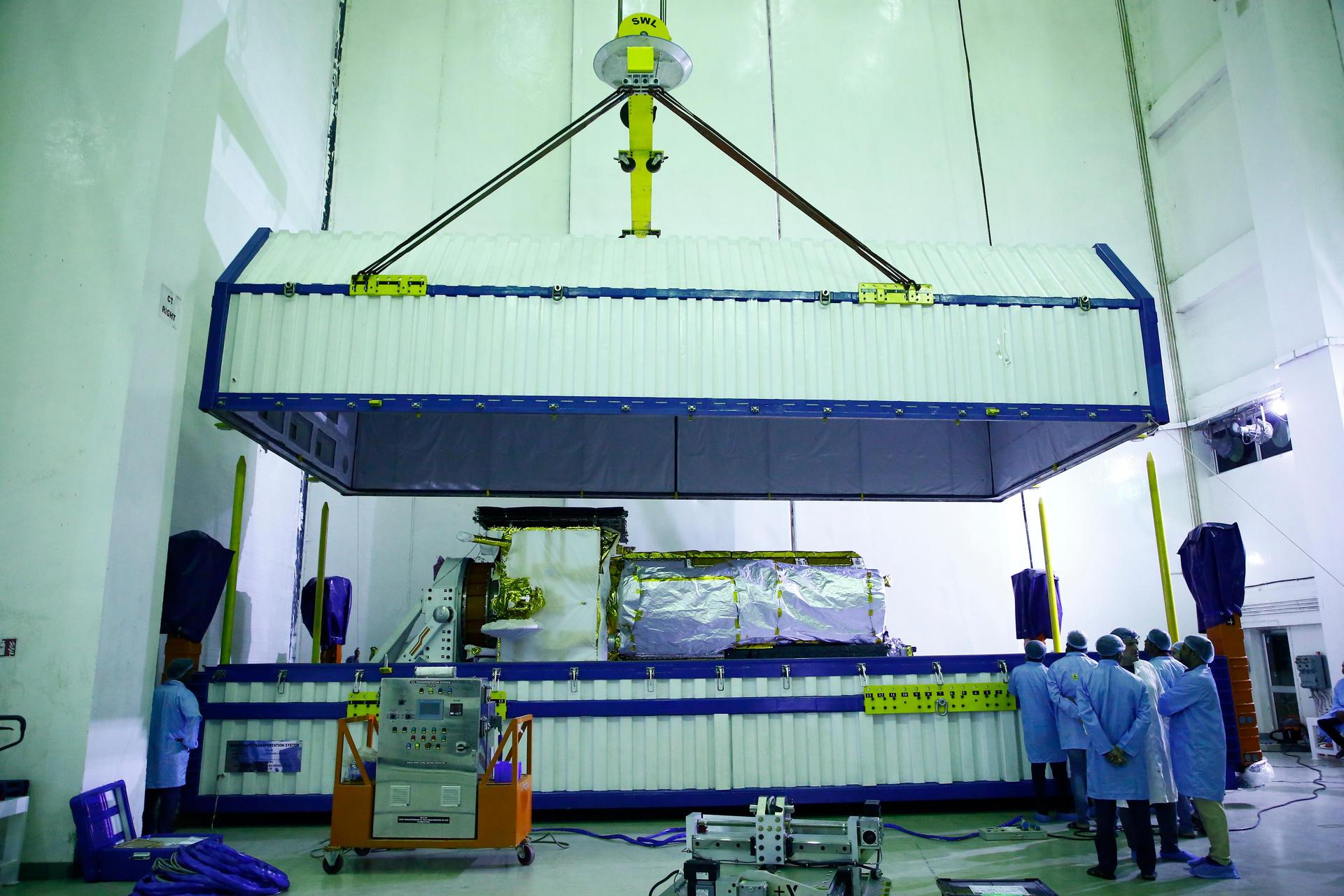
India's space agency broke a long silence on its launch pad early on September 4, 2026. At 02:55 AM IST, a Geosynchronous Satellite Launch Vehicle designated GSLV-F17 lifted off from an Indian spaceport carrying EOS-05, an Earth observation satellite, into its planned transfer orbit. In a flash update, the Indian Space Research Organisation (ISRO) declared simply that "GSLV-F17 has successfully accomplished its mission, placing EOS-05 into the intended orbit."
The announcement was terse, but the significance was not: SpaceNews reported this as ISRO's "first launch since a failure in January," making GSLV-F17 not just the end of a quiet stretch on the pad but the agency's official return to flight after a setback roughly eight months earlier.
A Familiar Rocket, Back in Action
The GSLV Mk II is not a new vehicle. It has flown for years as India's workhorse for medium-to-heavy geosynchronous and Earth-observation payloads, complementing the smaller Polar Satellite Launch Vehicle (PSLV) that handles many of ISRO's sun-synchronous missions. GSLV-F17's job on this flight was to carry EOS-05 — part of ISRO's ongoing series of Earth Observation Satellites used for imaging and remote sensing — away from the pad and onto a trajectory that would carry it toward its working orbit. SpaceNews covered the launch under the headline "GSLV launches Earth imaging satellite in first ISRO launch since January," and its lede is direct about why the gap existed: ISRO "successfully launched an imaging satellite in its first launch since a failure in January." The report does not specify, in the portion available, which January mission failed, what caused the failure, or how it was resolved. But the framing itself is significant — this was a return-to-flight mission, not simply a scheduling lull. Neither ISRO's flash statement nor the accessible portion of the SpaceNews report spells out the technical cause of the January failure. What both sources agree on is the outcome of this flight: GSLV-F17 flew, and it delivered its payload where it was supposed to go.
What the Tracking Data Shows
ISRO's own announcement confirms the mission succeeded, but it doesn't spell out the orbital mechanics involved. That detail comes from independent tracking. Jonathan's Space Report, a respected source for satellite catalog and orbital data compiled from observational tracking, logged the launch under a slightly different date and satellite name than ISRO's own release — noting the liftoff as occurring on September 3, with EOS-05 tracked under the designation GISAT-1A. (The date difference is a time-zone artifact rather than a discrepancy: 02:55 AM IST on September 4 converts to September 3 in UTC, the time standard tracking networks use.) That naming detail is worth pausing on: GISAT-1A appears to be an alternate or developmental name associated with the EOS-05 spacecraft, and its appearance in independent tracking data alongside the EOS-05 designation used by ISRO suggests the two names refer to the same payload, tracked by two different sources using two different labeling conventions. The tracking report describes the satellite as having been placed into a "subsynchronous transfer orbit" — an elliptical parking orbit lower than a full geosynchronous transfer orbit — with a perigee (closest approach to Earth) of 154 kilometers and an apogee (farthest point) of 30,963 kilometers, inclined 19.3 degrees to the equator. The spacecraft has been assigned the international designation 2026-202A, the standard catalog identifier used by tracking networks worldwide to log new objects placed in orbit. A subsynchronous transfer orbit is a common intermediate step for satellites headed toward geosynchronous or near-geosynchronous operational orbits: the spacecraft's own propulsion, rather than the rocket, handles the remaining orbit-raising maneuvers over the following days or weeks. ISRO's flash statement that EOS-05 was placed into its "intended orbit" is consistent with this description — the transfer orbit was the target for the launch vehicle itself, not necessarily EOS-05's final operational orbit.
Why It Matters
A single successful launch might not sound like headline news for a space agency with a long flight history. But the reason for the eight-month gap is the real story here. SpaceNews's framing — "first launch since a failure in January" — means this wasn't a routine pause between missions; it was the length of time ISRO needed to work through the aftermath of a launch failure before flying again. Launch failures typically force an agency to ground its manifest while it investigates the root cause, implements corrective fixes, and requalifies the vehicle or process involved, and the length of that pause is one of the clearest external signals of how serious the underlying problem was. By successfully returning to flight with GSLV-F17, ISRO has demonstrated that its medium-lift capability is operational again and that its Earth observation program — which EOS-05 extends — is moving forward. Earth observation satellites like EOS-05 support a wide range of applications, from environmental and disaster monitoring to agricultural and resource assessment, making a steady cadence of these launches directly relevant to the practical, everyday value India draws from its space program. For an agency balancing ambitious future plans against the day-to-day discipline of getting satellites into orbit reliably, a clean launch after a failure-driven pause is exactly the kind of result that starts to restore confidence in the pipeline. It signals that the pad is active again, and that the rest of 2026's manifest, whatever it holds, has a working vehicle behind it — though neither cited source addresses what, specifically, went wrong in January or whether the underlying issue has been fully resolved beyond this one successful return-to-flight mission.
