
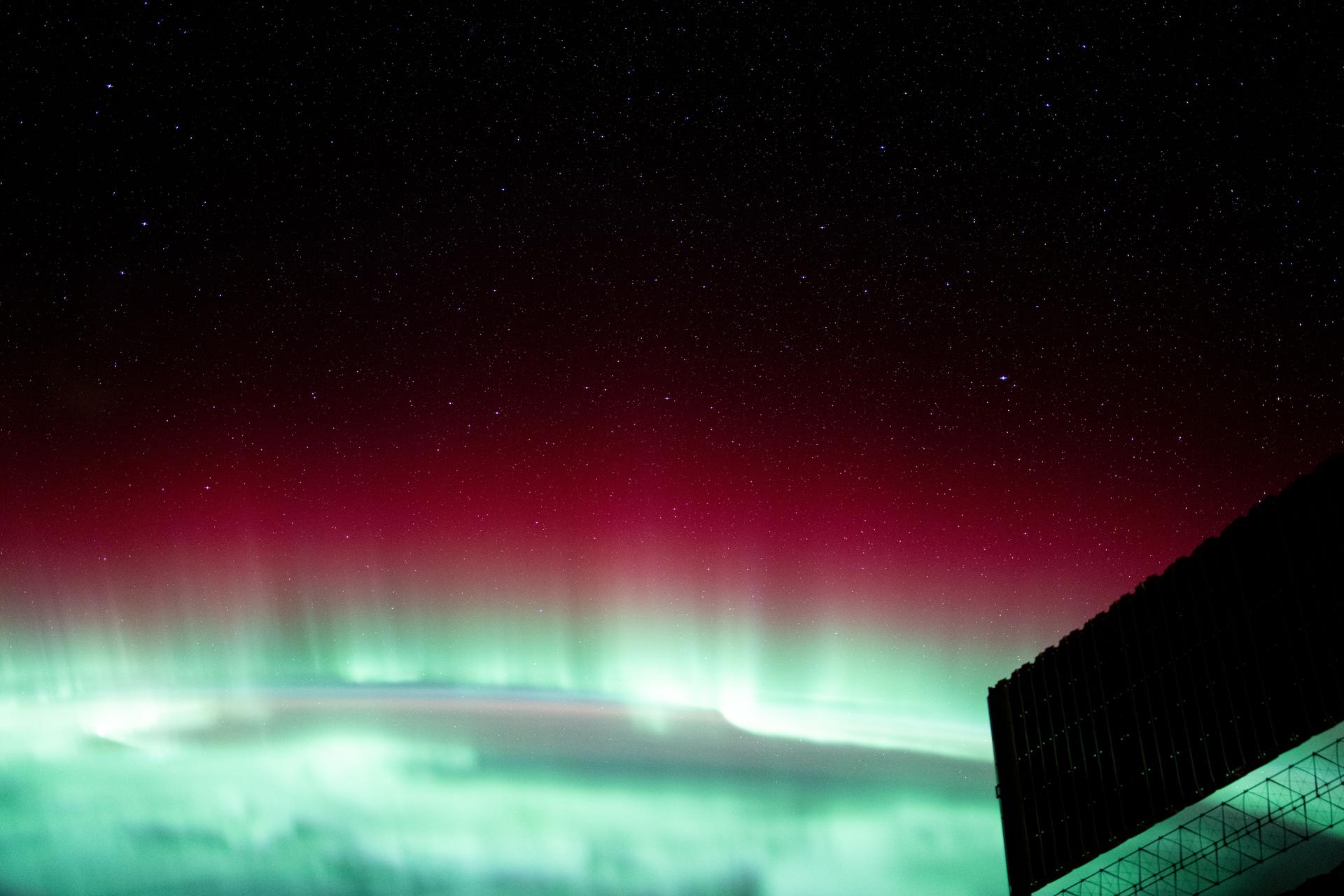
The Sun has picked an interesting week to get busy. Early on August 8, a coronal mass ejection launched four days earlier slammed into Earth's magnetosphere and pushed geomagnetic activity to G2 (moderate) storm levels, with the planetary K-index reaching 6 during the 18–21 UTC interval. Auroras became possible as far south as Edinburgh and northern England, while an all-sky webcam at Davis Station in Antarctica caught dramatic Southern Hemisphere displays overnight on August 8–9, according to EarthSky's rolling sun-news coverage.
That storm has since subsided — conditions on August 10 were downright quiet, with spaceweather.com reporting a sunspot number of 41, solar wind at 415.4 km/s, a planetary K-index around 1.67, and nothing stronger than B- and C-class flares. But the lull may not last. Two more CMEs left the Sun on August 8, and NOAA's Space Weather Prediction Center now expects storming from anticipated CME activity on one of the most crowded days on the 2026 sky calendar: August 12, the date of the Greenland–Iceland–Spain total solar eclipse and the ramp-up toward the Perseid meteor shower's peak.
What NOAA's forecast actually says
The SWPC 3-day forecast issued August 10 at 0030 UTC is specific. The greatest expected Kp for the August 10–12 window is 4.67 — NOAA Scale G1 (Minor) — landing in the 03–06 UT window on August 12. The rationale, verbatim: "G1 (Minor) geomagnetic storming is likely on 12 Aug due to anticipated CME activity."
The build-up is gradual. August 10 was forecast quiet, with Kp no higher than 2.67. August 11 ticks up to Kp 3.67 late in the day as the leading edge of the disturbance approaches. Then comes the G1 window in the early hours of August 12 UTC. The chance of a solar radiation storm — the kind that matters for polar aviation and satellites — sits at just 1 percent each day, so this is an aurora story, not a hazard story.
Spaceweather.com frames the ceiling slightly higher: the incoming CME could spark G1–G2 geomagnetic storms and high-latitude auroras during the Perseid meteor shower. G2 is the same level reached during the August 8 event, when the lights became possible over Edinburgh-latitude skies. Whether the August 12 arrival matches that performance depends on details no model can fully pin down in advance — the CME's density, speed at arrival, and above all the orientation of its embedded magnetic field.
The eclipse coincidence
Here is the angle that has space-weather watchers doing double takes. The August 12 total solar eclipse tracks from Greenland across Iceland to Spain — and the northern portion of that path, over Greenland and Iceland, sits inside the auroral zone, the band around Earth's magnetic pole where auroras appear most often. Space.com raised the question directly in an August 10 piece: could observers along the high-latitude Greenland and Iceland stretch of the totality path conceivably see auroral activity during the darkened minutes of totality?
The honest answer, per Space.com's own headline, is "maybe." Totality briefly dims the sky to roughly civil-twilight brightness, and sufficiently bright auroras can remain visible at twilight — but the experts Space.com consulted are frank about the odds. Totality falls in the afternoon over Greenland and Iceland, putting observers under the daytime portion of the auroral oval, and they estimate a realistic chance of seeing auroras during the eclipse would require a severe G4 or G5 geomagnetic storm — far above anything in the current forecast — plus clear weather. Nobody should book travel on the strength of it. But eclipse chasers already positioned along the northern path have a genuine, nonzero reason to keep one eye off the Sun.
The Perseids are already flying
The other beneficiary of a storm-dark sky would be the Perseids. The shower is ramping toward its peak, and it is already producing: NASA's fireball network logged 34 fireballs on August 9, including 19 Perseids, per spaceweather.com. For observers at mid-to-high northern latitudes, the night of August 11–12 could plausibly offer meteors overhead and auroral glow on the northern horizon at the same time — the kind of double feature that usually exists only in composite photographs.
What the Sun does next
The source region driving much of the recent flaring is a newcomer. Sunspot AR4505 emerged on August 9 and promptly produced 14 of that day's 18 flares, the strongest a modest C1.8 at 16:30 UTC, EarthSky reports. Forecasters expect its flaring to decline as the region rotates out of view beyond the Sun's limb. Current odds stand at 25 percent for an M-class flare and just 1 percent for an X-class event — meaning the week's story is the CMEs already in transit, not fresh eruptions.
Why It Matters
Geomagnetic storms are common; geomagnetic storms forecast for the exact day of a total solar eclipse and the build-up to a major meteor shower are not. The August 8 G2 event demonstrated that this solar cycle can still push auroras toward Edinburgh-latitude skies with only moderate storming, and NOAA's forecast puts a likely repeat — at G1, possibly G2 — squarely on August 12. For the thousands of observers converging on the Greenland–Iceland–Spain eclipse path, and for everyone planning a Perseid watch this week, the practical takeaway is simple: the sky may be doing more than one thing at a time. Check the Kp index alongside the cloud forecast, face north during the dark hours of August 11–12, and if you are standing in the Moon's shadow over Iceland when the sky goes dark — look up, and then look around.
