
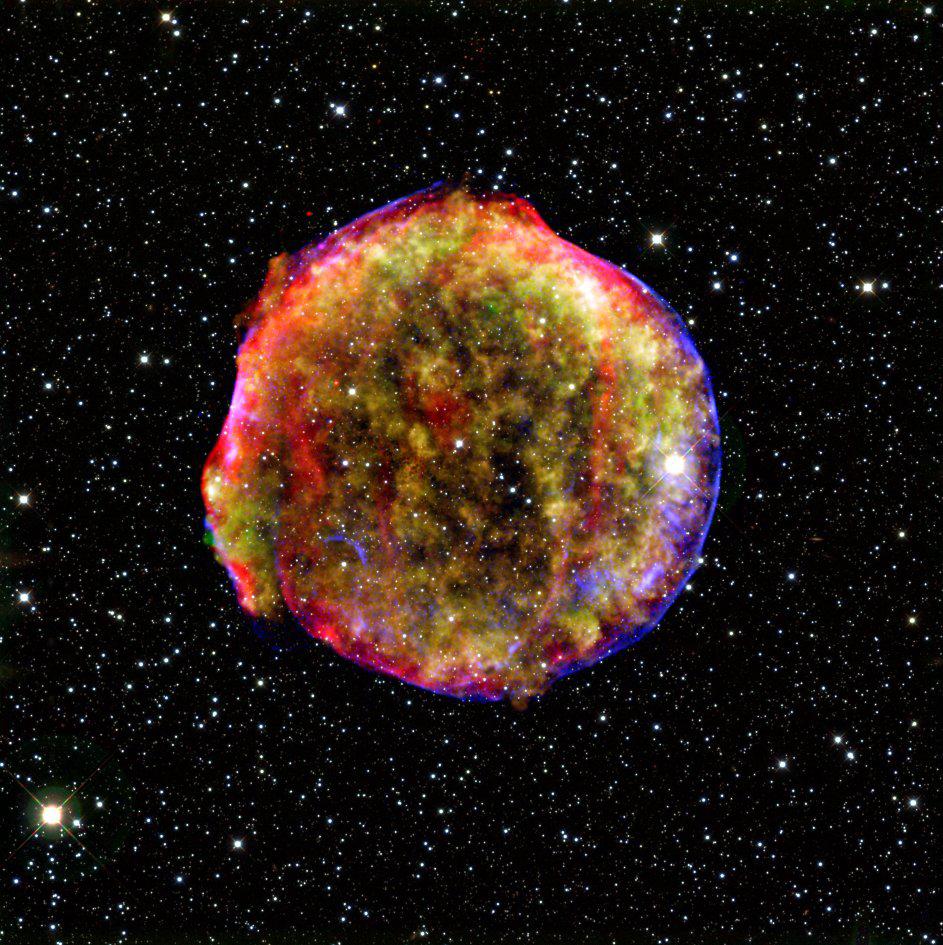
Some astrophotography projects take an evening. This one took roughly 200 hours of exposure time and covered a patch of Moroccan sky big enough to swallow 1,000 full moons. The payoff, published as NASA's Astronomy Picture of the Day for September 24, 2026, is a portrait of a stretch of the constellation Auriga that turns out to be considerably more violent than it looks to the naked eye: five separate, ancient supernova remnants, tangled together like wreckage from five different car crashes on the same stretch of highway.
The image comes from astrophotographers Stephane Vetter and Yann Sainty, shot at the Oukaimeden Observatory in Morocco's High Atlas Mountains. The accompanying text was written by Cecilia Chirenti of NASA's Goddard Space Flight Center, the University of Maryland, College Park, and CRESST II. Between them, the two imagers logged roughly 200 hours of exposure to cover a field of view equal to 1,000 full moons.
What's actually in the frame
Auriga, the Charioteer, is a fixture of northern winter skies and hosts several well-known open star clusters. This image captures one of them, M37, along with the small emission nebula popularly known as the Tadpole Nebula. But the real subject is the wispy red and blue filamentary structure that threads through the frame — the visible remains of five stars that exploded long before recorded history.
NASA's original APOD page names all five: G181.1+9.5, G182.4+4.3, G179.0+2.6, G180.0-1.7, and G178.2-4.2. Those designations are galactic coordinates, not names a headline writer would choose, but one of the five has a nickname that has stuck for decades — G180.0-1.7, also catalogued as Sh2-240, is better known as the Spaghetti Nebula, for the tangled strands of gas that give it its shape.
The color coding in the image isn't decorative. Astrophotographers doing this kind of narrowband imaging typically isolate specific wavelengths emitted by specific elements, then assign them colors in post-processing. Here, the red and blue filaments mark shocked hydrogen and oxygen gas — material from the outer layers of the progenitor stars, plus swept-up interstellar gas, that was violently compressed and heated when each star's expanding blast wave slammed into it. That shock heating is what makes supernova remnants visible at all, sometimes for tens of thousands of years after the initial explosion has otherwise faded from the sky.
Why five remnants in one patch of sky?
It isn't that this region of Auriga is unusually explosion-prone. It's a matter of geometry and distance. Supernova remnants like these are relics of massive stars, the kind that live fast, burn through their fuel in a few million years, and end in a core-collapse explosion. Massive stars tend to form in clusters and associations along the spiral arms of the galaxy, so their remnants tend to accumulate in the same general neighborhoods long after the stars themselves are gone. The five remnants captured in this image sit at various distances from Earth, some reaching out several thousand light-years, and range up to tens of thousands of years in age — old enough that their expanding shells have grown large and faint, but young enough that they haven't yet dissipated entirely into the surrounding interstellar medium.
That combination of size and faintness is exactly why it took 200 hours of integration time to render them clearly. Supernova remnants at this stage of their lives are diffuse and dim, spread across large swaths of sky at low surface brightness. Capturing them cleanly means stacking enormous amounts of exposure time and filtering out light pollution and atmospheric noise, as Vetter and Sainty did to cover an area equivalent to 1,000 full moons.
Why It Matters
Supernova remnants are the galaxy's material recycling bins. When a massive star explodes, it seeds its surroundings with the heavy elements forged inside it — oxygen, carbon, iron, and more — while also compressing nearby interstellar gas into shocks that can trigger the formation of new stars. The red and blue filaments in this image aren't just pretty; they're a snapshot of that process in action, showing exactly how shocked hydrogen and oxygen glow as the blast waves plow outward.
There's also a human dimension. As the reporting on this image notes, early human observers watching this same patch of sky tens of thousands of years ago may have seen these explosions firsthand — as sudden "new stars" appearing where none had been before, then slowly fading over weeks or months. What we now resolve as faint, sprawling gas structures through hundreds of hours of modern telescope time, ancient skywatchers might have briefly seen as brilliant points of light, bright enough to notice without any equipment at all. The image is, in that sense, a very long-exposure photograph of an event some distant ancestor might have looked up and seen with unaided eyes.
Images like this one also matter for how astronomers catalog and study the remnant population of the Milky Way. Many supernova remnants are so faint and extended that they go undetected in standard sky surveys, which are often tuned to find compact, bright objects rather than sprawling low-surface-brightness shells. Deep, wide-field amateur imaging projects like this one — while not a substitute for professional survey instruments — can help confirm and refine the visual extent of known remnants, and occasionally turn up structure that wasn't well characterized before.
The takeaway
None of the five remnants in this image are new discoveries. What's new is seeing them together, in context, rendered with enough depth and field of view to show how they relate to each other and to the surrounding stellar population, including M37 and the Tadpole Nebula. It's a reminder that even a well-trodden constellation like Auriga still has room for a genuinely ambitious amateur imaging project to reveal something most observers have never seen laid out in one frame: five separate death scenes from stars that stopped shining as active nuclear furnaces long before human civilization began keeping records.
