
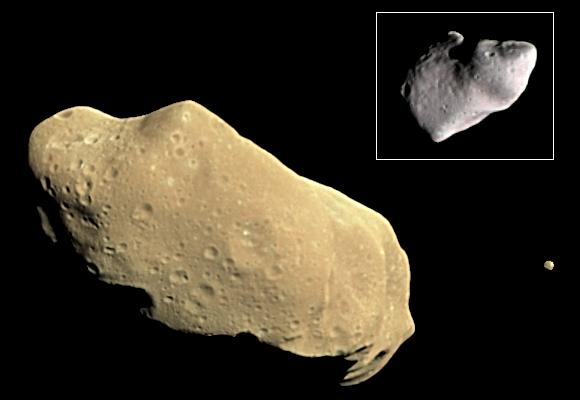
Asteroid (44) Nysa has been sitting in astronomers' catalogs since 1857, bright enough that hobbyists can pick it out of the sky with a pair of 7x50 binoculars. For 169 years, it was just another main-belt object — notable mainly for being an unusually reflective E-type, or enstatite-rich, asteroid. Now a new imaging campaign has turned it into something far stranger: a candidate for the first known "trinary" asteroid, a single body apparently built from three distinct lobes pinched together by two neck-like indentations. And as if that weren't enough for one object, the same observations turned up a moon nobody knew was there.
The findings come from a team led by Kate Minker of Lowell Observatory, in a study titled "Unmasking (44) Nysa: Evidence for a Trilobate Structure," now accepted for publication in Astronomy & Astrophysics and posted as a preprint (arXiv:2607.25786). "The images reveal a remarkably unusual object," Minker said in a statement announcing the results.
How do you even see the shape of an asteroid?
Nysa is roughly 75 km (46 miles) across — respectably large by main-belt standards, but still far too small and distant to resolve as anything but a point of light through most telescopes. Getting an actual look at its shape required pairing two of the sharpest imaging instruments currently pointed at the sky.
The team combined data from SHARK-VIS on the Large Binocular Telescope in Arizona with SPHERE/ZIMPOL on the European Southern Observatory's Very Large Telescope in Chile. The LBT's contribution alone is a serious piece of engineering: its twin primary mirrors each measure 27 feet (8.4 meters) across, and its adaptive optics system uses 672 actuators to flex the mirror surface in real time, correcting for atmospheric blurring fast enough to sharpen the view of a rock hundreds of millions of kilometers away.
"For the first time, we can directly investigate whether those clues point to a deeply indented body or to a true multi-lobed structure," said Al Conrad, an associate staff scientist at the Large Binocular Telescope Observatory, in a statement from the University of Arizona.
Three lobes, two necks, one puzzle
What the combined imaging turned up was not a simple potato-shaped rock, nor even the classic peanut or dog-bone silhouette seen in some other asteroids and comets. Instead, Nysa appears to be split into three separate lobes connected by two narrow "necks" — a structure astronomers are calling trilobate, and which several outlets have more colorfully described as "three-headed."
The team's own explanation, as reported in coverage of the findings, lays out two competing possibilities: Nysa is either a contact trinary — three formerly separate bodies that drifted together and stuck, rather than the two-body "contact binaries" seen elsewhere in the solar system — or it's a single coherent object with an extremely irregular shape unlike anything previously observed and resolved. Distinguishing between those two scenarios will likely require follow-up observations, additional shape modeling, or possibly radar data, none of which the current study claims to resolve definitively.
A moon hiding in plain sight
The same observing run also delivered a second discovery: Nysa has a moon. Designated S/2026 (44) 1, the newfound satellite is just over 1 km wide and orbits its much larger parent at a distance reported as roughly 170 km (about 106 miles) — with some outlets citing a slightly more conservative figure of around 160 km (100 miles), and the original press materials describing the orbit as "at least" 170 km out. The precise orbital parameters will presumably be refined as the peer-reviewed paper and any follow-up work firm up the numbers.
Small asteroid moons are not themselves rare — many known asteroids across the main belt and near-Earth population have satellites. What makes this one notable is the company it's keeping: a moon around a primary this geometrically strange, potentially itself a merger of multiple bodies, adds a new data point to an already puzzling picture of how such systems assemble and survive over billions of years of collisions and gravitational nudges.
Why It Matters
Asteroid shapes are not just curiosities — they're records of how small bodies form, collide, and sometimes merge over the history of the solar system. Contact binaries, where two lobes fuse after a slow collision, are already well documented among asteroids and comets. A confirmed contact trinary would push that story further, suggesting that three-body mergers — or at least three-lobed coherent structures — are also part of the asteroid belt's assembly history, and that current models of how rubble-pile and contact objects form may need to account for more complex outcomes than a simple two-body handshake.
The discovery also matters as a demonstration of capability: resolving fine structural detail and a kilometer-scale moon around a 75 km object hundreds of millions of kilometers away is a genuine test of ground-based adaptive optics, achieved here without a dedicated spacecraft flyby. If Nysa's trilobate structure and its new moon hold up under further scrutiny, they'll offer astronomers a rare natural laboratory for studying how such improbable-looking bodies stay gravitationally bound — and how many more might be hiding among the thousands of other asteroids we've only ever seen as points of light.
Sources
- Press Release: Asteroid (44) Nysa May Be the First-Known Three-Lobed World — Lowell Observatory
- Three-lobed asteroid is a world unlike any other — University of Arizona News
- Does asteroid Nysa have 3 lobes and a moon? — EarthSky
- The 1st 'three-headed' asteroid — Space.com photo of the day, Aug. 3, 2026
