
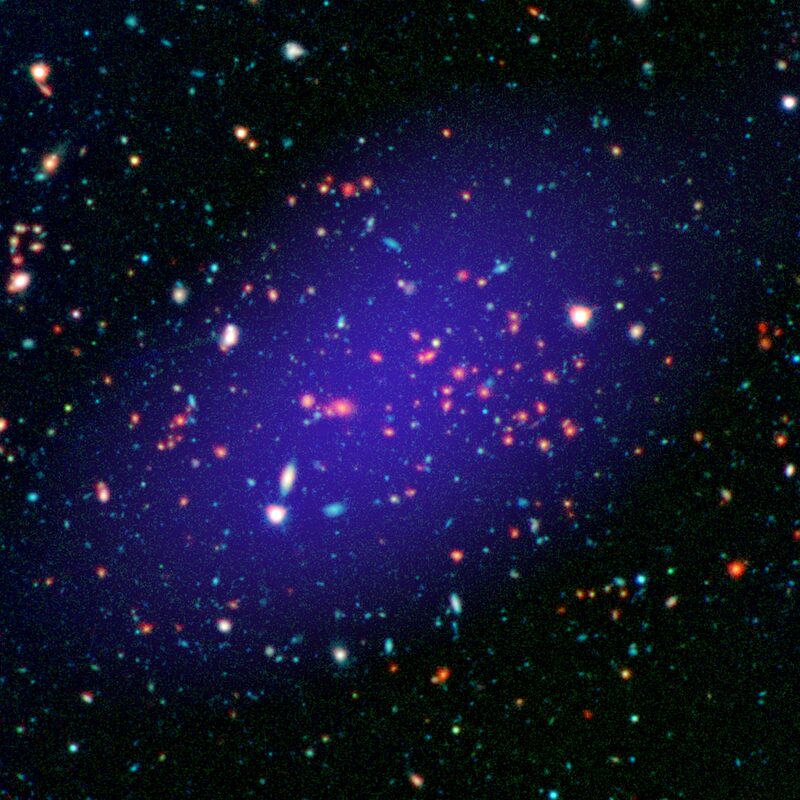
Astronomers have a long-standing accounting problem. Add up all the ordinary matter — protons, neutrons, the stuff that makes stars, planets and people — implied by the universe's early conditions, and you get a number. Add up the matter astronomers can actually see in galaxies and clusters today, and you get a smaller number. The gap isn't dark matter, which is a separate mystery entirely; it's ordinary baryonic matter that has gone missing, thought to be smeared out as thin, hot gas strung along the filaments of the cosmic web, too diffuse and too faint to image directly.
For years the best tools for finding it have been indirect: X-ray telescopes catching the faint glow of hot gas in cluster outskirts, or maps of the kinematic Sunyaev-Zel'dovich (kSZ) effect, a subtle distortion imprinted on the cosmic microwave background as it passes through moving electrons. Both work, but both are blunt instruments for a specific question researchers actually want answered — not just "is the gas there," but "how has it been pushed around by galaxies themselves."
A new approach reported by Universe Today on September 14, 2026, leans on a different cosmic messenger: fast radio bursts, the millisecond-long flashes of radio emission from distant galaxies whose origins are still debated but whose usefulness as cosmic probes is not. Caltech's Kritti Sharma and professor Vikram Ravi, working with the team behind the Deep Synoptic Array-110 (DSA-110), have used FRBs to directly measure how galactic feedback — the outflows and winds driven by supernovae and supermassive black holes — redistributes gas across intergalactic space.
How a Millisecond Flash Becomes a Gas Detector
The trick relies on dispersion measure, a property of every FRB. As a burst's radio waves travel across billions of light-years, they pass through free electrons in intervening gas, and lower frequencies get delayed relative to higher ones. The amount of that delay — the dispersion measure — scales with how much ionized gas the signal crossed. An FRB that happens to pass near a foreground galaxy or galaxy cluster will show a slightly larger dispersion measure than one that takes a more empty path, because it plowed through more of that galaxy's surrounding gas halo.
That only works, though, if you know exactly where each FRB is and how far away it is — otherwise there's no way to tell which foreground structures a given burst passed near. DSA-110 was purpose-built to localize bursts precisely enough to pin them to a host galaxy. In the new study, described in an arXiv preprint submitted August 11, 2026 by Samuel McCarty, Sharma, Ravi and collaborators, the team cross-correlated dispersion measures from 130 localized FRBs against the positions of galaxies in the DESI Legacy Survey's Bright Galaxy Sample. Where galaxies cluster, dispersion measures should tick upward if those galaxies are surrounded by extended gas halos — and that's exactly what the team found, detecting the correlation at 6.5-sigma significance, comfortably past the threshold physicists use to call a result a discovery.
More telling than the detection itself is what it rules out. The team compared the data against a "no-feedback" scenario, in which gas simply sits gravitationally bound close to galaxies rather than being blown outward into the surrounding cosmic web. That bare-bones model is disfavored at roughly 9-sigma — a strong statistical rejection — meaning the gas really has been redistributed, smoothed outward by the very galaxies it once fell into. The same paper reports a first joint analysis combining the FRB signal with kSZ measurements, effectively cross-checking one baryon-tracing method against another.
Why It Matters
Galactic feedback isn't just a bookkeeping detail — it's one of the biggest uncertainties in models of how galaxies grow. Supernovae and active black holes are thought to blast enough gas out of galaxies to regulate star formation, preventing galaxies from simply converting all their available material into stars in a runaway process. But translating that idea into a testable prediction about where the gas actually ends up has been difficult, because the gas in question is too diffuse for direct imaging. A method that can trace it statistically, across large volumes and without needing to detect individual gas clouds, gives theorists something concrete to check their simulations against. It also matters because FRB dispersion measures are, in effect, free: once a burst is detected and localized, the measurement comes along with it, at a scale traditional X-ray or kSZ campaigns can't easily match.
A Method Built to Scale
What makes this more than a one-off measurement is the trajectory of FRB detection itself. The Canadian CHIME telescope is already finding thousands of fast radio bursts. A companion paper from the same Caltech-led team, submitted to arXiv on August 31, 2026 and led by Liam Connor along with Ravi, Sharma and others, lays out forecasts for DSA-110's successor: the planned Deep Synoptic Array, a 1,650-antenna interferometer sited in Nevada. Once complete — a timeline the team pegs to 2029 — the array is projected to detect on the order of 100,000 FRBs over a five-year survey, expressly designed to map cosmic baryons and feedback at that scale.
That's a jump of roughly three orders of magnitude from the 130-burst sample behind the current 6.5-sigma detection. If the statistical power of a cross-correlation study scales anywhere near the way larger galaxy surveys have historically scaled, tens of thousands of well-localized bursts wouldn't just sharpen this particular measurement — they'd turn FRB dispersion-measure mapping into a routine cosmological probe, sitting alongside X-ray and kSZ studies rather than trailing them. The current results, formally published in Nature Astronomy per Universe Today's report, read less like a final word on missing baryons and more like a proof that the method works — with the hardware to scale it already on the drawing board.
Sources
- Tens of Thousands of Fast Radio Bursts Could Help Solve the Greatest Cosmic Mysteries — Universe Today
- A new measurement of the FRB DM-galaxy cross correlation and a first joint analysis with the kinematic SZ effect — arXiv
- The DSA/Chronoscope fast radio burst survey: forecasts and science overview — arXiv
