
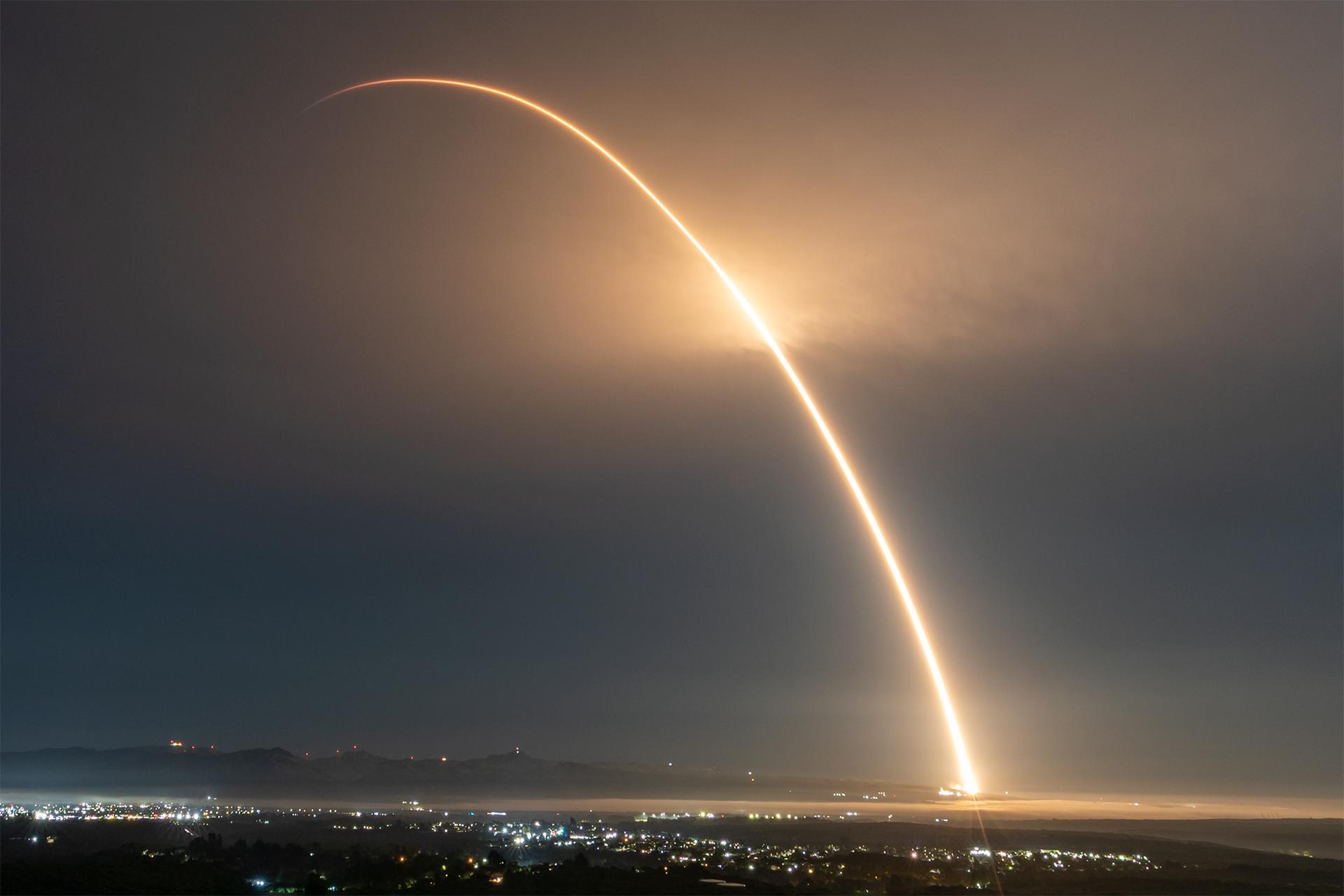
For seven years, the rhythm of Cape Canaveral was set by one vehicle carrying one payload. A Falcon 9 would lift off from Space Launch Complex 40, drop another few dozen Starlink satellites into low Earth orbit, and land its booster on a droneship in the Atlantic before most of Florida had finished breakfast. That rhythm stopped on Aug. 25. The mission that ended it looked like every one before it, which was the point.
The next data point in the story is not in Florida at all. SpaceX's 80th Starlink mission of 2026, designated Starlink 15-24, is targeting Sunday, Sept. 6, at 7:26 a.m. PDT (10:26 a.m. EDT, 1426 UTC) from Space Launch Complex 4 East at Vandenberg Space Force Base in California, according to Spaceflight Now's Sept. 5 preview. As of that preview, the launch had not yet flown, and SpaceX had already adjusted the launch time once. Readers should treat the schedule as a target, not a result.
What ended on Aug. 25
The final Florida Falcon 9 Starlink launch left SLC-40 at 05:33 EDT on Aug. 25 carrying 29 Starlink satellites, per Aerospace Global News. The booster was B1067, a first stage that entered service in 2021 and was making its 37th flight, a fleet record. It landed on the droneship "A Shortfall of Gravitas" roughly eight and a half minutes after liftoff.
The mission carried several milestones at once. It was the 100th Falcon 9 launch of 2026. It was, by SpaceX's own count as reported by Spectrum News 13, roughly the 260th Starlink mission from Cape Canaveral since the first on May 23, 2019. And it capped a year in which, to that date, the Cape had hosted 54 orbital launches, 33 of them Starlink.
Kiko Dontchev, SpaceX's vice president of launch operations, made the change official the same morning. "This morning's SpaceX mission from pad 40 was the last planned Falcon 9 Starlink launch from Florida," he said, adding a message to the launch team: "You've made Falcon 9 the most reliable launch vehicle in history." The forward-looking line was blunter: "From here on, Starlink missions out of Florida will fly on Starship. The West Coast team will continue regularly launching Starlink from Vandenberg."
SpaceX chose the same day to announce "Starbase, Louisiana," a separate expansion that underscored how much of the company's attention is now on the next vehicle rather than the current one.
Vandenberg picks up the cadence
That leaves the West Coast carrying Falcon 9's Starlink load. Starlink 15-24 is the third Starlink mission since Dontchev's announcement, and with Florida off the table for Falcon 9 Starlink flights, all of them have been West Coast launches.
The booster assigned to it, B1088, is on its 19th flight. Its history reads like a cross-section of the Falcon 9 manifest: three national security missions, the Transporter-12 rideshare, NASA's SPHEREx astrophysics observatory, and 13 previous Starlink batches. If the landing goes to plan, it will touch down on the Pacific droneship "Of Course I Still Love You," which would be the 223rd landing on that vessel and the 659th Falcon booster recovery overall.
Those numbers matter because they show what SpaceX is walking away from in Florida. A booster on its 37th flight and a fleet closing in on 659 recoveries are the product of years of iteration, much of it at the Cape. Vandenberg now inherits that operational tempo for Starlink, at least until Starship is ready.
The Starship bet
The plan is not to stop launching Starlink from Florida. It is to launch it on a much larger rocket, and soon.
SpaceX is building three Starship launch towers in Florida: one at Kennedy Space Center's Launch Complex 39A and two at Cape Canaveral Space Force Station's Space Launch Complex 37. The company's stated target is a first Florida Starship launch before the end of 2026. Aerospace Global News reports that Elon Musk said in August he expects Starship eventually to fly "at least one flight a day, possibly more" from Florida.
The regulatory groundwork at LC-39A is already in place. On Feb. 3, 2026, the Federal Aviation Administration published a Federal Register notice announcing the availability of its Final Environmental Impact Statement and Record of Decision for Starship-Super Heavy operations at the pad, prepared under the National Environmental Policy Act and FAA Order 1050.1F.
The Record of Decision itself is the more revealing document. It supports FAA launch licenses allowing SpaceX to build infrastructure and operate Starship-Super Heavy at LC-39A, including testing, launches, and landings of both stages. The approved envelope is up to 44 launches and 88 landings per year, split as 44 for each stage, Starship and Super Heavy, with ocean landings included. The ROD also covers up to 220 static fire, launch, and landing events annually, and specifies that launches and reentries would occur 88 times per year and be scheduled in advance to limit disruption to ship traffic.
The document quantifies the costs of that activity in unusual detail. Operational nitrogen oxide emissions are estimated at 374.55 tons per year. Water use is projected at roughly 297 million gallons per year. Airspace and road closures could total up to 396 hours per year for tests and 462 hours per year for launches. Cooperating agencies on the review included NASA's Kennedy Space Center, the Department of the Air Force through the U.S. Space Force, the National Park Service for Canaveral National Seashore, the U.S. Fish and Wildlife Service for Merritt Island National Wildlife Refuge, and the U.S. Coast Guard. The FAA lists support for Artemis and the Human Landing System among the stated purposes.
Whether the vehicle is ready to use that envelope is a different question. Spectrum News 13 reports that Starship's most recent test deployed 20 real Starlink V3 satellites that successfully connected to the constellation, the first hard evidence that Starship can do the job Falcon 9 just gave up in Florida. The next test, Flight 14, is slated for mid-September from Texas. Flight 15 is expected to fly from Florida if the prior tests succeed. No date has been announced for a first operational Florida Starship-Starlink mission.
What we know and what we don't
Known: Falcon 9 has flown its last planned Starlink mission from Florida. Roughly 260 Cape Starlink launches are in the books. The constellation stands at more than 11,000 satellites in orbit. Vandenberg will continue regular Starlink launches on Falcon 9. The FAA has authorized up to 44 Starship-Super Heavy launches per year at LC-39A.
Not yet known: Whether Starlink 15-24 lifted off and landed on schedule. Whether Flight 14 succeeds and clears the path for a Florida debut. When the first operational Starship-Starlink mission from Florida will fly. Whether SpaceX can compress the gap between "target before end of 2026" and an actual Florida Starship launch into the four months that remain.
Why It Matters
Starlink has been the single largest driver of Florida launch counts for years. Of the 54 orbital launches from the Cape in 2026 through Aug. 25, 33 were Starlink, more than 60 percent. Remove those flights and Florida's launch statistics change character overnight, from a Starlink-dominated manifest to one built around crew, cargo, national security, and commercial customers. Until Starship begins flying operationally from LC-39A or SLC-37, the Cape's launch count is likely to fall, with Vandenberg carrying the Starlink load in the meantime.
The deeper story is about risk. SpaceX is retiring a proven system from its busiest pad, one that just flew a booster on its 37th flight, in favor of a vehicle that has so far deployed 20 real satellites on a test flight and has no announced date for its first operational Florida mission. The FAA paperwork is done, the towers are rising, and the company has said the first Florida Starship launch will come before year-end. Between now and then, the West Coast is the workhorse, and every Vandenberg Starlink launch is a reminder of how much is riding on the timeline holding.
Sources
- Live coverage: SpaceX to launch 80th Starlink mission of 2026 (Spaceflight Now, Sept. 5, 2026)
- SpaceX to only launch Starlink satellites from Florida on Starship (Spectrum News 13, Aug. 25, 2026)
- SpaceX ends Falcon 9 Starlink launches from Florida as Starship takes over (Aerospace Global News, Aug. 25, 2026)
- FAA Record of Decision: SpaceX Starship-Super Heavy Launch Vehicle at Launch Complex 39A, Kennedy Space Center (FAA)
- Notice of Availability of the Final EIS and Record of Decision for SpaceX Starship-Super Heavy at LC-39A (Federal Register, Feb. 3, 2026)
