
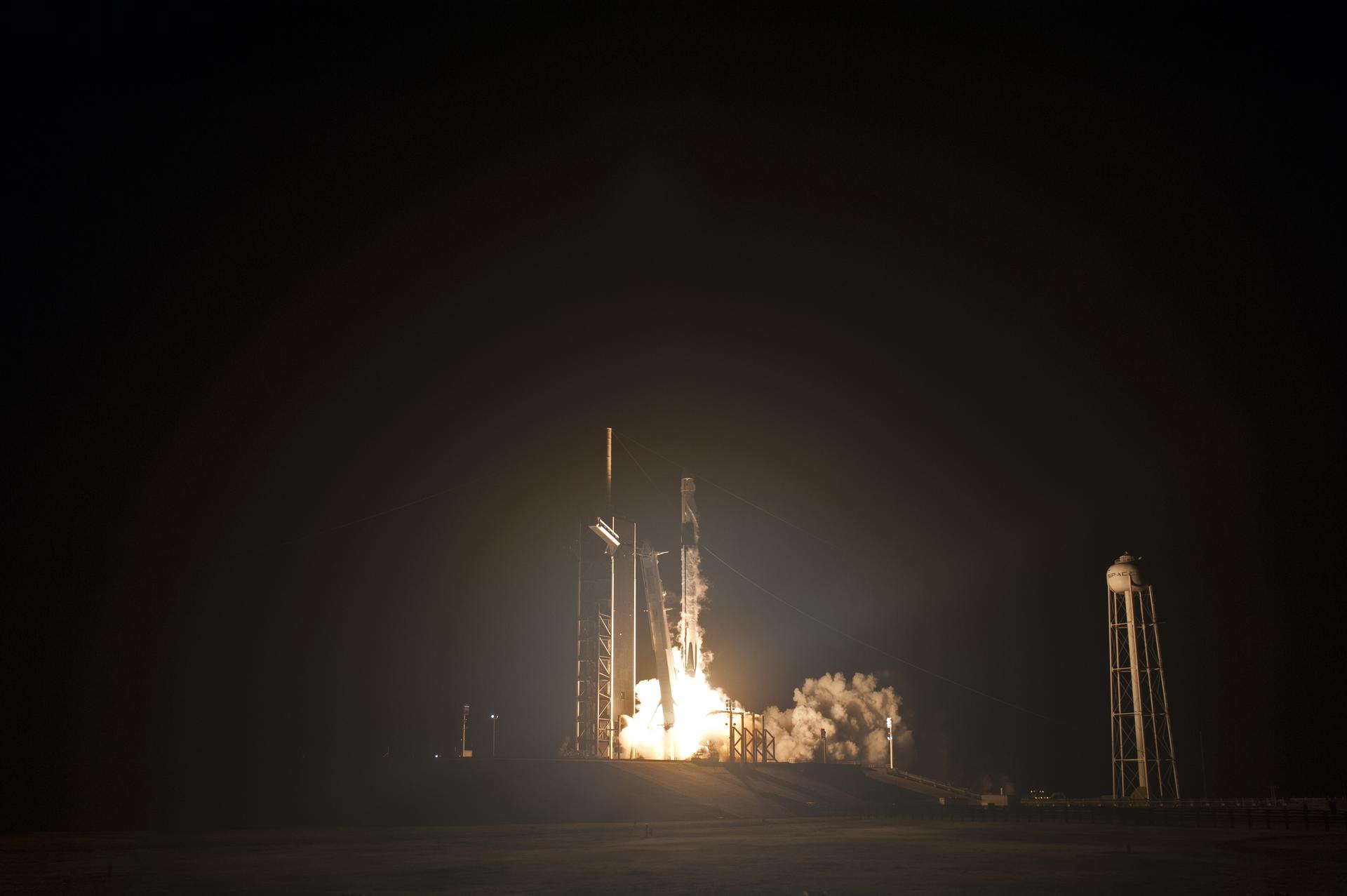
A Falcon 9 lifted off from Space Launch Complex 40 at Cape Canaveral Space Force Station at 2:49 p.m. EDT (1849 UTC) on September 13, 2026, carrying three Boeing-built satellites into orbit for SES. The payloads — designated F11, F12, and F13 — were the last pieces of a medium-Earth-orbit broadband constellation SES has been assembling for years. But the mission's milestone value ran in two directions at once: it was also the 700th flight of the Falcon rocket family, a tally spanning 687 Falcon 9 missions and 13 Falcon Heavy flights.
The booster flying the mission, B1080, was on its 29th trip to space. About nine minutes after liftoff it settled onto the droneship "A Shortfall of Gravitas" stationed in the Atlantic — the 166th landing on that particular droneship, and the 661st successful Falcon booster landing of any kind since SpaceX began recovering first stages. The three satellites separated from the upper stage roughly 34 minutes after liftoff, each one weighing about 1,900 kilograms.
SLC-40 also hit a number of its own: the September 13 launch was the pad's 400th orbital launch. SpaceX has flown 345 of those 400 missions, with the remainder reflecting other operators' use of the pad before Falcon rockets became its dominant tenant.
What O3b mPOWER Actually Is
O3b mPOWER is SES's second-generation medium-Earth-orbit (MEO) broadband system, built as a successor to the original O3b constellation. Where geostationary satellites sit roughly 35,786 kilometers above the equator and low-Earth-orbit constellations like Starlink and Kuiper fly at a few hundred kilometers, MEO systems split the difference — typically around 8,000 kilometers up — trading some of the latency advantage of LEO for far more coverage per satellite and a much smaller fleet size.
That smaller fleet size is the point. Rather than launching thousands of small satellites, SES's approach uses 13 much larger, more capable spacecraft to deliver high-throughput, low-latency connectivity aimed at government, maritime, aviation, and telecom customers who need guaranteed bandwidth rather than best-effort consumer broadband. With F11, F12, and F13 now in orbit, all 13 satellites in the constellation have been launched, joining the 10 O3b mPOWER satellites already operating on-orbit.
The newly launched trio isn't ready for service yet. Like their predecessors, they'll spend the coming months raising their orbits and going through on-orbit checkout before entering commercial service, which SES expects by mid-2027. That timeline pushes the full 13-satellite constellation's "fully operational" milestone out by roughly nine months from launch — a reminder that even after the last rocket flies, a MEO constellation isn't switched on overnight.
The Regulatory Backdrop
Missions like this one fly under a consolidated licensing framework the FAA has been refining for several years. SpaceX's Falcon 9, Falcon Heavy, and Dragon vehicles all operate under Part 450, a single commercial launch-and-reentry license structure that replaced a patchwork of mission-specific approvals. According to the FAA, it has issued 14 Part 450 licenses since the rule took effect in March 2021. The agency doesn't tie that licensing structure to any specific operator's flight rate, but a framework built to reduce the number of times a company needs individual launch approvals is the kind of regulatory backdrop that aligns with sustaining a cadence like the one that produced a 700-launch total for the Falcon family and a 400th orbital launch from a single pad.
Why It Matters
Numbers like "700th Falcon launch" and "661st booster landing" can read as odometer trivia, but they mark something structural: reusable rocketry has moved from experimental proof-of-concept to the default mode of getting large, expensive payloads to orbit. A booster flying its 29th mission carrying a trio of nearly two-ton communications satellites is no longer a novelty — it's routine enough to barely make news on its own, which is itself the story.
For SES, completing the O3b mPOWER constellation closes out a launch campaign that has stretched across several years and multiple Falcon 9 missions. A finished 13-satellite MEO fleet gives the company a full-scale alternative to both traditional geostationary broadband and the sprawling LEO mega-constellations now filling the sky, aimed squarely at customers — militaries, cruise lines, airlines, telecom backhaul providers — who need committed, high-throughput links rather than shared consumer bandwidth. Whether that business case pays off will play out over the following months as the new satellites are raised into their operational orbits and put through their paces, with commercial service targeted for mid-2027.
