
Beneath the cracked, frozen shell of Jupiter's moon Europa, scientists are fairly confident, lies an ocean of liquid saltwater — and not a small one. Estimates suggest Europa may hold more than twice as much water as all of Earth's oceans combined, sloshing in the dark beneath a crust of ice. Wherever we find liquid water, energy, and the right chemistry on Earth, we find life. Europa appears to have at least the first two. NASA's Europa Clipper is on its way to find out whether the conditions for the third are there too.
A spacecraft built for a hostile place
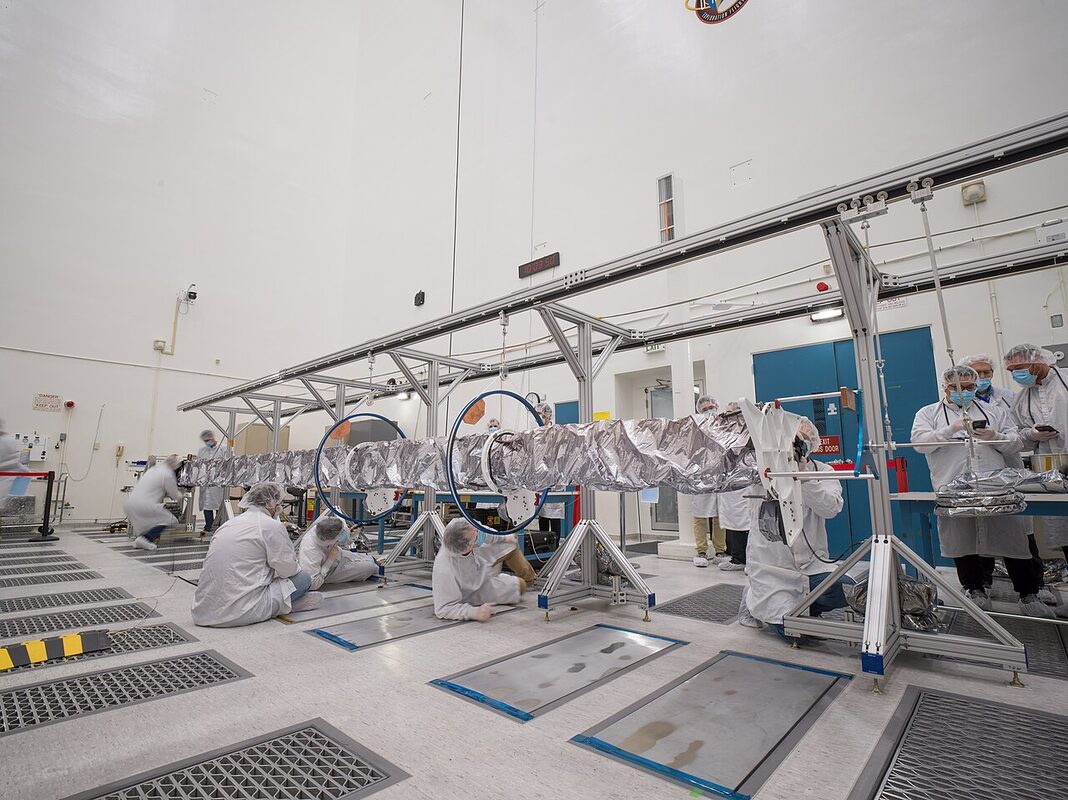
Europa Clipper launched in October 2024 atop a Falcon Heavy rocket and is the largest spacecraft NASA has ever built for a planetary mission. With its solar arrays unfurled it spans more than 30 metres, wingtip to wingtip — a size driven by necessity, because at Jupiter's distance sunlight is roughly 25 times fainter than at Earth, and the spacecraft needs vast panels to gather enough of it. It carries nine science instruments: cameras, spectrometers, an ice-penetrating radar, a magnetometer, and instruments to taste the thin wisps of gas and dust around the moon. Together they are designed to map Europa's ice shell, probe the ocean beneath, and analyze the chemistry of the surface and any plumes venting from below.
Getting there is a feat of celestial choreography. Jupiter is far, and a spacecraft cannot simply fly in a straight line and afford the fuel to slow down. Europa Clipper is instead taking a looping path that borrows energy from planets along the way: it swung past Mars in March 2025, and on December 3, 2026, it will pass close by Earth, using our planet's gravity to fling it onward. It will reach the Jupiter system in April 2030 — nearly six years after launch — and settle into an orbit around Jupiter itself rather than Europa, a deliberate choice.
The confidence that an ocean exists at all rests on decades of indirect evidence. NASA's Galileo spacecraft, which orbited Jupiter in the 1990s and 2000s, detected a telltale magnetic signature at Europa: the moon distorts Jupiter's powerful magnetic field in exactly the way a layer of salty, electrically conductive liquid would. Europa's surface adds visual corroboration — it is among the smoothest in the solar system, crisscrossed by ridges and broken into jumbled "chaos terrain" that looks unmistakably like ice that has shifted, cracked, and refrozen over something fluid beneath. Hubble has even glimpsed possible plumes of water vapor venting from the surface. None of it is proof on its own, but together it builds a strong circumstantial case — and confirming and characterizing that ocean is exactly what Europa Clipper is built to do.
Why orbit Jupiter instead of Europa
The reason is radiation. Jupiter is wrapped in belts of charged particles so intense they would fry a spacecraft's electronics within weeks if it lingered in close orbit around Europa. Europa Clipper's solution is to loop around Jupiter on a wide, elliptical path and dart in for roughly 49 close flybys of the moon, each one a quick pass that gathers data and then retreats to safer distance to recover and transmit. The most sensitive electronics ride inside a thick-walled metal vault that shields them from the worst of the bombardment. It is a strategy of repeated raids rather than occupation.
One point deserves emphasis, because it is easy to misstate: Europa Clipper is not a life-detection mission. It will not dig through the ice or sample the ocean directly. Its job is to assess habitability — to determine whether Europa has the ingredients and conditions that life requires, and to scout the most promising locations for some future mission that might one day look for life itself. That is the patient, honest way the search for life beyond Earth actually proceeds: not a single dramatic verdict, but a sequence of missions each answering a narrower question. Right now Europa Clipper is in the long, quiet cruise phase, checking out its instruments across the gulf between worlds. The hard questions wait at Jupiter, and the answers are still four years away.
