
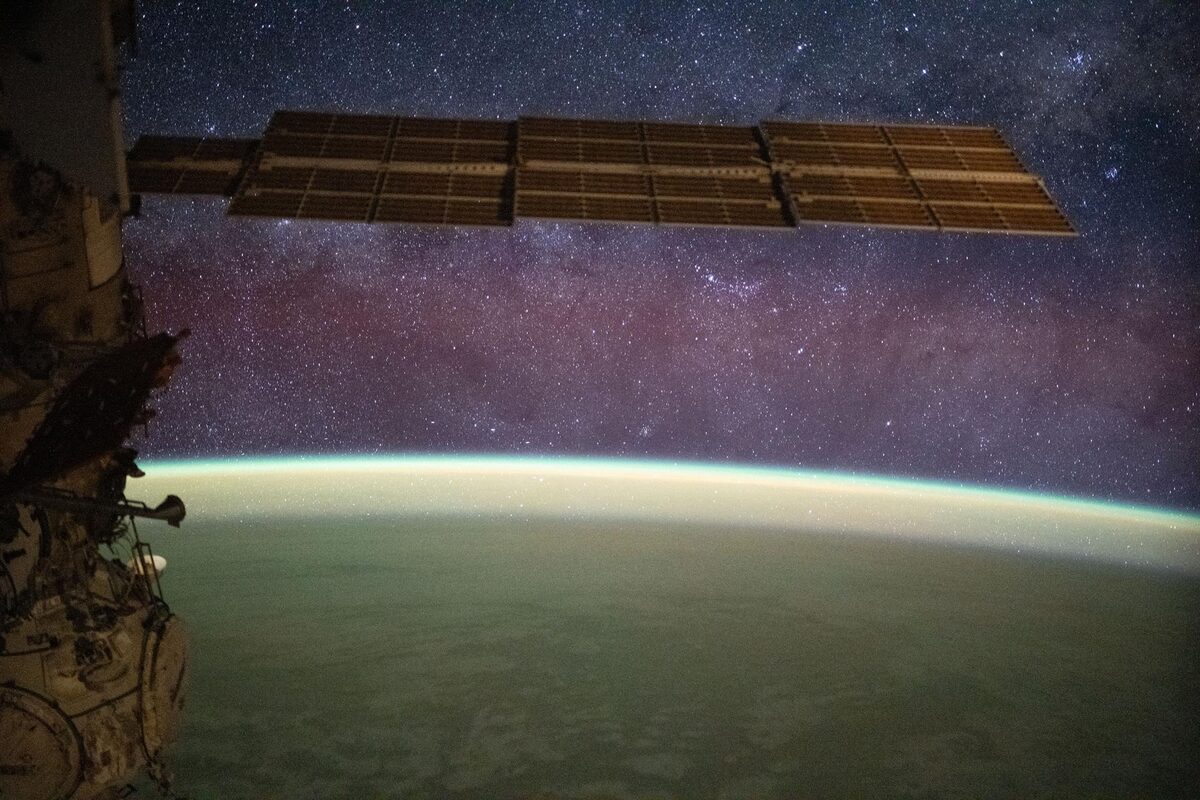
The European Southern Observatory took one day to respond. On 25 November, the US Federal Communications Commission said it had authorised SpaceX to deploy Starmind, a constellation of up to one million satellites meant to work as data centres in orbit. On 26 November, ESO published a formal statement saying the decision would "not only have profound consequences for astronomy, but also fundamentally alter the night sky for everyone on the planet."
That line comes from ESO Director General Andreas Kaufer, and astronomers will quote it for a long time. The more useful part of ESO's response is the numbers behind it. They come from a peer-reviewed technical analysis led by ESO expert Olivier Hainaut, and they make a strong case that this is a different kind of problem from the satellite streaks astronomers have spent the past few years learning to work around.
From nuisance to permanent condition
For context, Space.com reports that only about 28,000 satellites have been launched since Sputnik in 1957. SpaceX's current Starlink network has about 11,000 spacecraft. Starmind would be roughly 36 times the number of satellites ever launched, and about 90 times today's Starlink fleet.
Hainaut's analysis was published in Astronomy & Astrophysics (vol. 712, A241) in March 2026, months before the FCC acted. Universe Today summarises its findings. The paper finds a threshold. Constellations of up to about 60,000 satellites have an effect it calls "negligible but not imperceptible." Above that, things change sharply. With a mega-constellation of 106 satellites, trails become pervasive in most long exposures.
The paper also gives specifics:
- Long spectroscopy is hit hardest. For a 300-second exposure with a spectrograph on ESO's Very Large Telescope, more than half the sky is affected 1.3 hours after astronomical twilight ends.
- Several trails per frame is normal. Images taken at zenith would average more than eight satellite trails each, and some would have more than 20.
- Short exposures don't escape. A 15-second exposure from the Rubin Observatory's Legacy Survey of Space and Time is affected to a similar degree. Rubin's short survey frames get no protection from their brevity.
- The naked-eye sky changes too. In the simulation, about 1,867 satellites are brighter than magnitude 7 and 247 are brighter than magnitude 5. For comparison, roughly 3,000 to 4,000 stars are that bright.
The last point is why Kaufer's "everyone on the planet" is a literal claim and not a figure of speech. If hundreds of moving points of light are about as bright as the stars people can see, the sky looks different to everyone who looks up.
Why dimmer satellites won't save it
The usual answer to satellite brightness has been engineering: darker coatings, sunshades, changes to spacecraft attitude. ESO's statement says that approach runs out at this scale. Even if each satellite is dimmer, the sheer number pushes streaks beyond what can be mitigated. A fainter streak is still a streak, and the sheer number of satellites means the total number of streaks goes beyond what can be mitigated.
ESO also named what gets lost first. The faintest targets are the most exposed: distant galaxies, some Earth-like exoplanets, and potentially hazardous asteroids. Potentially dangerous asteroids on that list mean the damage isn't only to basic science.
The analysis also points to a worse case. Universe Today notes that Hainaut's work treats bright reflector-type constellations, like the one Reflect Orbital has proposed, as a more severe threat than Starmind-style data centres.
Not just an optical problem
ESO's statement lists effects beyond streaks in images:
- Radio noise. A million satellites would add radio emissions that impact radio astronomy.
- Atmospheric pollution. Launches and reentries at this scale would put material into the atmosphere. Space.com's figures give a sense of the launch rate: Starship can carry a maximum of 60 V3 Starlink satellites per launch, so SpaceX's planned 100,000-satellite next-generation Starlink network (a figure Musk has given) needs about 1,700 launches. Starmind is ten times that number of satellites.
- Orbital crowding. ESO warns that packing low Earth orbit this densely risks chain-reaction collisions, which would threaten every operator in those orbits.
The FCC's view, and the competition
The FCC sees it very differently. Chairman Brendan Carr said the decision "opens a bold new frontier for the computing infrastructure needed to power America's leadership." SpaceX plans to launch the first Starmind satellites on Starship in the third quarter of 2027.
SpaceX isn't the only company pursuing orbital data centres. Space.com lists Cowboy Space, Starcloud, Blue Origin and Google as working on the idea, and Starcloud and Google have already launched AI pathfinder satellites. Starmind is the largest proposal so far, but it probably won't be the only one, and the Hainaut thresholds apply to the total number of satellites in orbit, not to any single company.
Why It Matters
The main point of ESO's statement is about governance. Kaufer said the approval "highlights the urgent need for international mechanisms." One national regulator has approved a project whose effects reach every observatory and every person on Earth who looks up. ESO did raise objections through the usual process: it responded to the FCC consultation together with the Royal Astronomical Society and the International Astronomical Union. That submission did not stop the approval, so the astronomy community is now arguing that the decision shouldn't belong to one country.
The Hainaut paper changes the debate. Earlier arguments about satellite streaks mostly asked how bright a satellite should be allowed to be, and better engineering could answer that. This analysis says that at a million satellites, brightness matters less than the count. If that's right, the fix has to address how many satellites go up, and that decision rests with regulators and international agreements, not satellite designers.
The first launches are planned for the third quarter of 2027. Whether international bodies can set rules before then is an open question. The astronomy community has now put its case on record with peer-reviewed numbers.
Sources
- ESO statement on approval of launch of one million space data centres (ESO, eso2614, 26 November 2026)
- Green light for Starmind: SpaceX gets approval to deploy 1 million AI satellites (Space.com, 25 November 2026)
- The ESO is Deeply Concerned About Space Data Centers, and the Rest of Us Should Be Too (Universe Today, 27 November 2026)
