
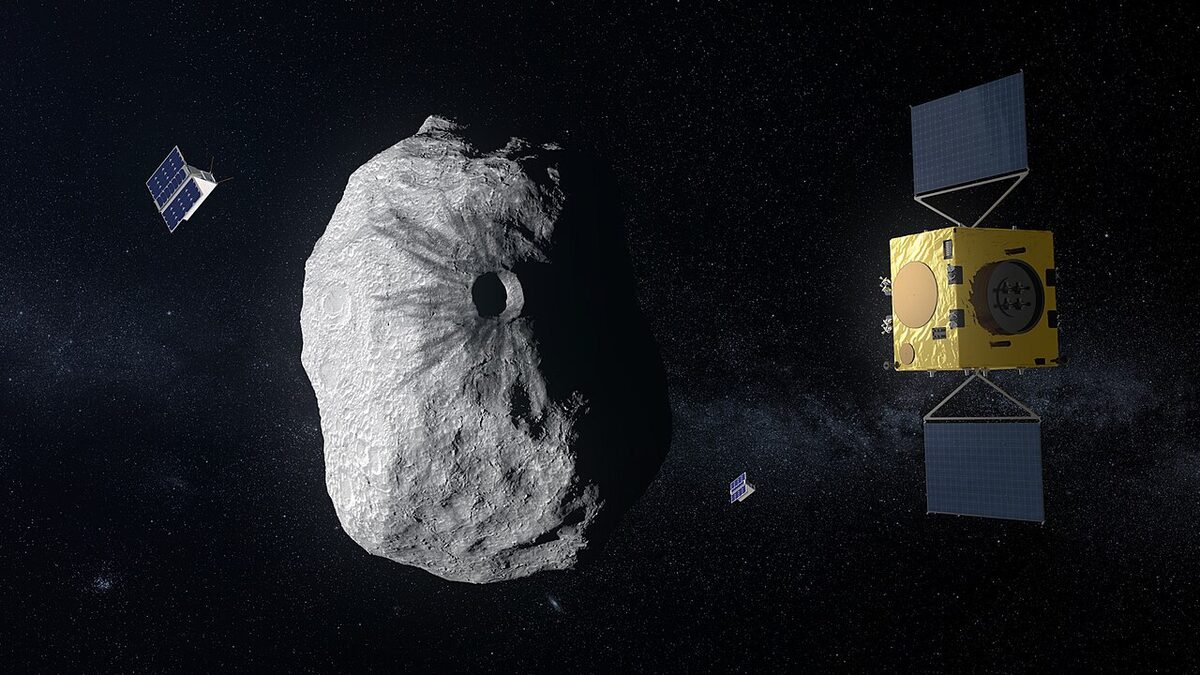
In September 2022, NASA deliberately crashed a vending-machine-sized spacecraft into Dimorphos, the small moon of the asteroid Didymos, and measurably shortened its orbit. The DART mission was the first full-scale test of planetary defense by kinetic impact, and by the only metric available at the time — did the orbit change? — it succeeded, and by more than expected. But a single number is not an engineering capability. To deflect a future hazardous asteroid on purpose, you need to know not just that an impact worked, but exactly how and why. That is what ESA's Hera spacecraft is flying out to determine.
Closing the loop
Hera launched in October 2024, slingshot past Mars in March 2025, executed a deep-space maneuver in February 2026, and is now on track to reach the Didymos system in November 2026 — about a month ahead of its original schedule. When it arrives, DART's impact will be four years cold, the debris settled, and the system available for the kind of patient, close-up survey DART itself could never perform: it was, after all, destroyed on arrival.
The questions Hera will answer are the ones that turn a demonstration into a tool. How much does Dimorphos actually weigh? DART's deflection depended on the moonlet's mass, which was only estimated; without it, the efficiency of the impact can't be pinned down. What is Dimorphos made of, and how is it held together — a solid body, or a loosely bound rubble pile that absorbed the blow differently than a rock would? What crater, if any, did DART leave, and how much of the deflection came from the impact itself versus the plume of ejected material rocketing off the surface? Hera will measure the moonlet's mass, map its shape and the impact site in detail, and establish the precise new orbital state of the pair.
DART's headline result hints at why those details matter. The impact shortened Dimorphos's orbit around Didymos by roughly half an hour — far more than a simple billiard-ball collision would predict. The excess came from the plume of rubble blasted off the surface: as that debris flew outward, it shoved back on the asteroid like exhaust from a rocket, multiplying the momentum delivered by the spacecraft itself. That multiplier, which physicists call beta, is the single most important quantity in kinetic deflection — and it depends entirely on the target's structure, which is exactly what DART could not stay around to measure. Hera's job is to pin it down.
The payoff is a model you can trust
Each of those measurements feeds the same goal: a validated model of momentum transfer. If planetary defense ever has to be used for real, mission planners will not get a practice run. They will have to calculate, in advance, how hard to hit an incoming object and where, and trust the answer. Hera's data is what makes that calculation defensible — it converts DART's encouraging result into numbers engineers can extrapolate to a different asteroid, a different size, a different composition.
Hera is not traveling alone. Two suitcase-sized CubeSats, Milani and Juventas, ride along and will be released for their own close passes — Juventas carrying a radar to probe Dimorphos's interior, a first attempt to see inside a small asteroid. The mission is also a marker of how planetary defense has matured into an international, multi-stage discipline: NASA threw the punch, and ESA is arriving to take the careful measurements. The threat Hera addresses is, in any given century, low-probability. The cost of being unable to respond is total. That asymmetry is the entire argument for sending a spacecraft to read a four-year-old bruise on a harmless asteroid. If Hera does its job, the next time humanity faces a genuinely dangerous rock, the response can rest on measurement rather than hope.
