
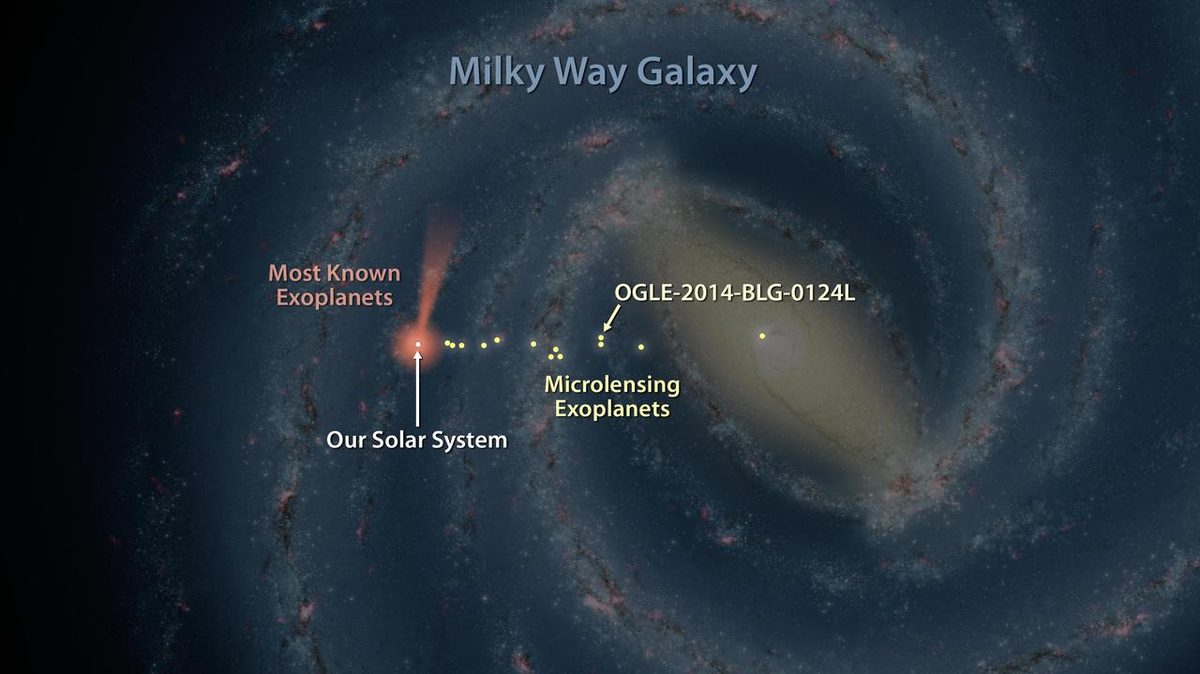
The history of exoplanet science has been, at its core, a history of counting. Since 1992 — when Aleksander Wolszczan and Dale Frail confirmed the first planets beyond our solar system orbiting a pulsar, and then 1995 when Michel Mayor and Didier Queloz found the first planet around a sun-like star — the field has been obsessed with the census. How many planets are out there? What are their orbital periods? How big are they? The Kepler mission alone added thousands of confirmed worlds to the catalog. The TESS mission continues today, discovering dozens more each month.
But knowing a planet exists is not the same as understanding it. A radius measurement tells you a planet's size. A radial velocity measurement tells you its mass. What neither tells you — what neither was designed to tell you — is what that planet is actually made of, what floats in its sky, whether its atmosphere contains water vapor or methane or carbon dioxide, and whether those molecules are distributed in patterns that suggest chemistry driven by something more than geology. That question has largely been answered planet by planet, target by target, using instruments designed for other purposes. The James Webb Space Telescope has demonstrated just how powerful dedicated atmospheric observation can be. But Webb was built for cosmology and general astrophysics. Atmospheric spectroscopy is something it does magnificently on the side.
ESA's Ariel mission — the Atmospheric Remote-sensing Infrared Exoplanet Large-survey — was built to do nothing else.
The Logic of a Dedicated Survey
Ariel is scheduled for launch in 2029 aboard an Ariane 6 rocket, destined for the L2 Lagrange point — the same gravitational parking spot occupied by Webb and the earlier Herschel space observatory, roughly 1.5 million kilometers from Earth in the Sun's anti-direction. From there, shielded from solar interference, it will spend four years staring at transiting exoplanets and pulling their chemical fingerprints out of starlight.
The technique itself is not new. When a planet passes in front of its host star, a tiny fraction of the starlight filters through the planet's atmosphere before reaching the telescope. Different molecules absorb different wavelengths. Water vapor has a distinctive absorption signature. So does carbon dioxide, methane, ammonia, and dozens of other compounds. By comparing the spectrum of the star alone to the spectrum of star-plus-atmosphere, astronomers can determine what molecules are present and, with sufficient data, at what altitudes and abundances. The same logic applies during secondary eclipse — when the planet passes behind the star — allowing measurement of the planet's own thermal emission.
What makes Ariel different from every preceding instrument is not the technique but the scale and the intent. While Webb studies a handful of atmospheres per cycle, competing with proposals for galaxy formation, black hole accretion, and stellar nurseries, Ariel will survey somewhere between 500 and 1,000 exoplanet atmospheres over its operational lifetime. That number is the point. Individual atmospheric detections are impressive scientific achievements. A statistically robust dataset of hundreds of atmospheres — sorted by planetary mass, temperature, host star type, orbital distance — is something qualitatively different. It is the raw material for a chemistry of planetary formation.
What Ariel Is Actually Looking For
The science case for Ariel rests on a set of questions that cannot be answered with a handful of data points. Why do some planets have thick hydrogen-dominated atmospheres while others — at similar masses and temperatures — appear to have lost their envelopes almost entirely? What determines the carbon-to-oxygen ratio in a planetary atmosphere, and does that ratio carry information about where in the protoplanetary disk the planet formed? Are there systematic differences between planets around metal-rich stars and those around metal-poor ones? Do tidally locked hot Jupiters show predictable day-night temperature contrasts, and if so, do those contrasts follow theoretical wind models?
These are not questions that can be approached anecdotally. They require population-level data — the kind of data that only a dedicated survey instrument can generate.
Ariel will operate across a wavelength range of 0.5 to 7.8 micrometers, spanning visible light through the near- and mid-infrared. This range was chosen deliberately to capture the absorption features of the most cosmically abundant molecules: water, carbon dioxide, carbon monoxide, methane, ammonia, and hydrogen cyanide. The spacecraft carries a primary mirror of roughly 1.1 by 0.7 meters — not Webb-class, but appropriately sized for bright, well-characterized host stars that are observable at high signal-to-noise. The mission's targets are not the dim, distant stars favored by deep-field cosmology. They are nearby systems with known, bright transiting planets — systems where repeated observations can accumulate the signal necessary to beat down noise.
The instrument suite includes AIRS, the Ariel InfraRed Spectrometer, which handles the longer wavelength range where most of the critical molecular signatures appear, and FGS, the Fine Guidance System, which doubles as a photometer and lower-resolution spectrometer in the visible and near-infrared. The two systems work together, with FGS providing both pointing stability and complementary wavelength coverage.
Standing on Webb's Shoulders
The timing of Ariel's development was not entirely planned, but it turned out to be fortunate. The James Webb Space Telescope launched in December 2021 and began returning atmospheric spectra of unprecedented quality within months of reaching full operation. Webb's observations of WASP-39b — a Saturn-mass hot Jupiter some 700 light-years away — produced the first unambiguous detection of carbon dioxide in an exoplanet atmosphere and revealed a chemical complexity that surprised even optimistic theorists. Subsequent observations of TRAPPIST-1b and TRAPPIST-1c hinted at thin or absent atmospheres on those rocky worlds. Webb showed, definitively, that exoplanet atmospheric science had left the realm of proof-of-concept.
Ariel inherits that context. The mission's target list will be shaped in part by what Webb reveals over its own operational lifetime. Systems that prove chemically rich or dynamically unexpected will receive priority attention. Systems that appear bland or featureless may be observed more quickly and in less depth, maximizing the survey's statistical reach. The European Space Agency has described this as a tiered observation strategy — a first reconnaissance tier for broad characterization, a second tier for higher-resolution follow-up, and a third tier reserved for the most scientifically compelling targets.
What Ariel will not do is replace Webb. The two missions are complementary in the deepest sense. Webb's extraordinary sensitivity allows it to push toward smaller, cooler, potentially habitable worlds — rocky planets in the temperate zones of nearby stars. Ariel's broader survey capability allows it to map the chemical landscape of the broader exoplanet population, providing the statistical context that individual Webb observations lack. A single data point is a curiosity. A thousand data points is a theory.
The Bigger Picture
There is a tendency, in writing about exoplanet science, to reach immediately for the question of life — to ask whether any of these atmospheres might harbor biosignatures, whether the oxygen or methane or nitrous oxide detected might hint at biology. Ariel is not designed to answer that question, and its scientists are careful not to oversell it. The planets on Ariel's primary target list are mostly hot Jupiters and warm Neptunes — gas-dominated worlds at short orbital periods, where the equilibrium temperatures run to hundreds or thousands of Kelvin. These are not habitable worlds. They are chemical laboratories, extreme environments where atmospheric physics is pushed to limits that no solar system planet approaches.
But understanding extreme cases is how science builds intuition. Before physicians understood the chemistry of human metabolism, they studied metabolic disorders — the edge cases where something went wrong and made the machinery visible. Ariel's hot Jupiters are exoplanet science's edge cases: worlds where the processes of planetary formation, atmospheric evolution, and stellar irradiation are written in large, legible script across their infrared spectra. Once those processes are understood in the extremes, the quieter chemistry of cooler, smaller worlds becomes more interpretable.
Ariel will launch into a field that has already transformed beyond recognition in a single generation. The first confirmed exoplanet around a sun-like star is thirty years old. The first confirmed atmospheric detection is barely twenty. Ariel represents the field's maturation into something closer to a systematic science — one with enough data to test theories rather than just inspire them. That is what a dedicated survey instrument does. It turns a collection of astonishing individual discoveries into the foundation of actual knowledge.
