
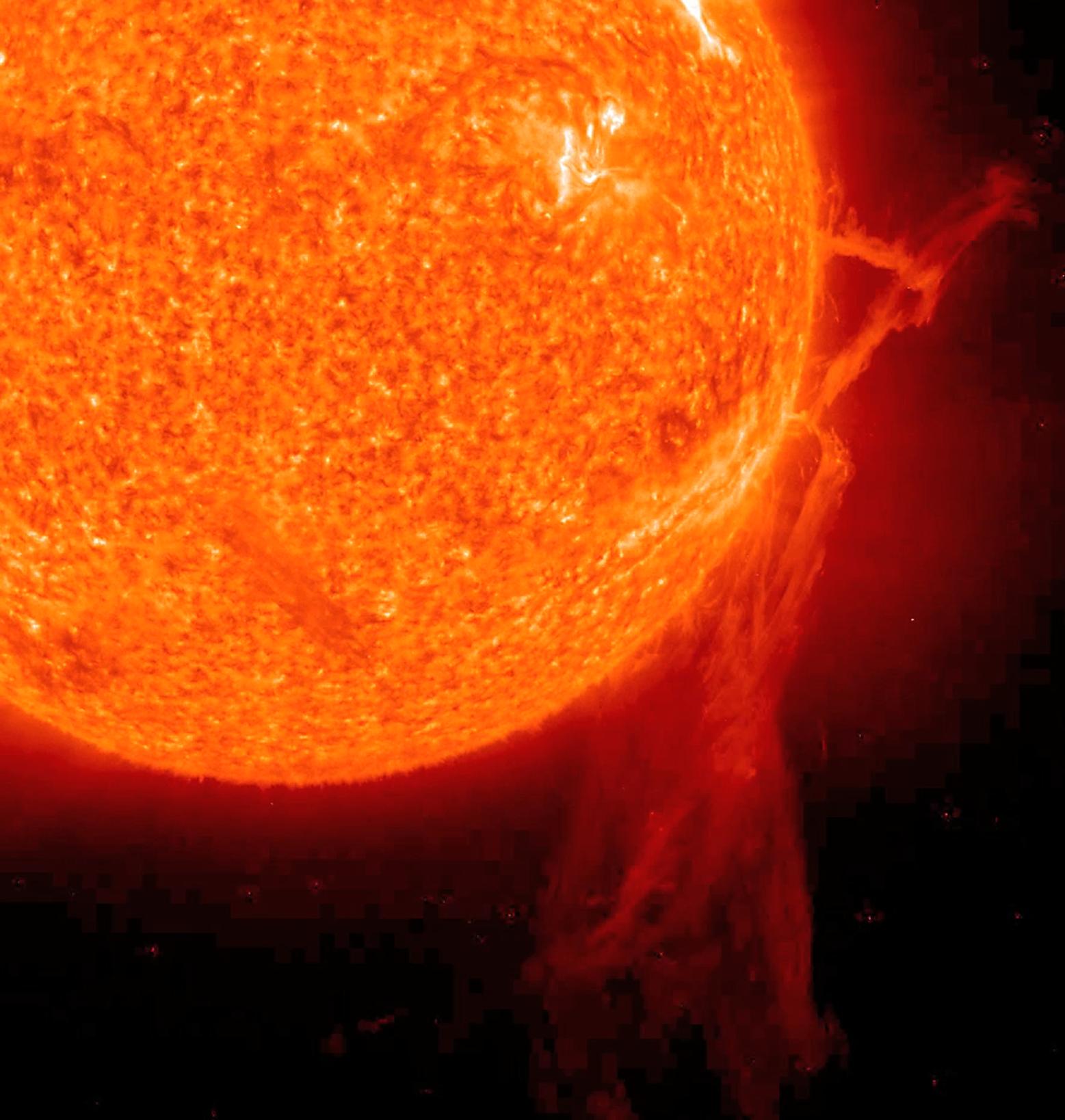
The Sun has been quiet for days, with a single sunspot region left on the disk and a calm geomagnetic field. Then a long strand of magnetic material lifted off the northwest quadrant, and the forecast for the first days of October changed. NOAA's Space Weather Prediction Center (SWPC) now has a G1 (minor) geomagnetic storm watch in place for Oct. 2, tied to a coronal mass ejection (CME) launched on Sept. 28.
What Happened
According to SWPC's forecast discussion issued Sept. 29 at 1230 UTC, a filament eruption was observed near 1300 UTC on Sept. 28, centered near N04W44. It was associated with a partial halo CME. A partial halo means the expanding cloud appeared to surround a good part of the Sun's disk in coronagraph images, rather than shooting off cleanly to one side. Such clouds are not automatically aimed at us, but they are worth watching.
The CME had two main components. Both were first seen off the West limb in the LASCO C2 coronagraph, at 1448 UTC and 1524 UTC on Sept. 28. SWPC says modeling of both suggests a flanking arrival near Earth on Oct. 2. EarthSky, in its Sept. 29 report, describes the source as a filament in the northwest that began lifting plasma at about 13 UTC on Sept. 28. It says the Earth-directed part could arrive by Oct. 2, with storming up to G1 and possible auroras at northerly latitudes.
SpaceWeather.com's front page for Sept. 29 carries the same picture: a magnetic filament erupted on Sept. 28, and a NASA model predicts a glancing blow on Oct. 2 that could spark a G1-class storm, with high-latitude auroras likely.
The Watch, Explained
At 13:01 UTC on Sept. 29, SWPC issued alert code WATA20 (serial 1127): "WATCH: Geomagnetic Storm Category G1 Predicted," with G1 (Minor) for Oct. 2, nothing at G1 or above for Sept. 30 or Oct. 1, and the comment "28 Sep CME inbound." A watch is a heads-up about a possible event, not a report that one is under way. G1 is the lowest rung of NOAA's five-step geomagnetic storm scale.
The word "flanking" is doing real work here. It means Earth is expected to pass through the edge of the cloud rather than its core. Edge encounters tend to be weaker and less certain than direct hits, which fits a modest G1 watch rather than something higher. Arrival time and strength for CMEs are hard to pin down, and a glancing blow can also miss or underperform.
The Rest of the Sun
The eruption is the main event in an otherwise unremarkable stretch. SWPC lists only one remaining sunspot region, 4535, at N11W39, with a beta-gamma magnetic configuration. That is a complex layout that can, in principle, produce larger flares, and SWPC keeps a slight chance of an M-class flare through Oct. 1.
Flaring so far has been modest. SWPC logged a C2.5 flare at 1519 UTC on Sept. 28 and a C1.1 at 2144 UTC. EarthSky counted eight faint flares over the previous 24 hours, three C-class and five B-class, with the strongest C2.5 attributed to AR4536 at 15:19 UTC. It also notes that AR4535 grew but produced no flares. (The two reports differ in which region they credit for the C2.5, and SWPC's discussion lists only 4535 as remaining on the disk.)
The greater-than-2 MeV electron flux at geostationary orbit peaked at 4,128 pfu at 1440 UTC on Sept. 28. Solar wind speed ran from about 350 to 300 km/s, which is slow, and the geomagnetic field was quiet, with EarthSky reporting Kp between 0 and 2. SWPC expects mostly quiet conditions from Sept. 29 through Oct. 1, so nothing is expected until the CME arrives.
Why It Matters
A G1 storm is minor. SWPC's own text for this event stops there, and this article has no basis to claim more. For most people, the practical effect is nothing at all. The interest is for aurora watchers: a storm at this level can push the northern lights toward high latitudes, and both EarthSky and SpaceWeather.com say aurora is possible or likely there.
It also makes a useful case study in how forecasters work. The CME was seen by a coronagraph on the West limb, modeled by more than one group, and turned into a dated watch within roughly a day. The uncertainty is built into the language: "flanking," "could," "up to G1."
If you want to look, check SWPC's updates as Oct. 2 approaches, since the arrival estimate may shift. A quiet sky until then is the forecast, and after that it depends on what the edge of the cloud does when it reaches Earth.
