
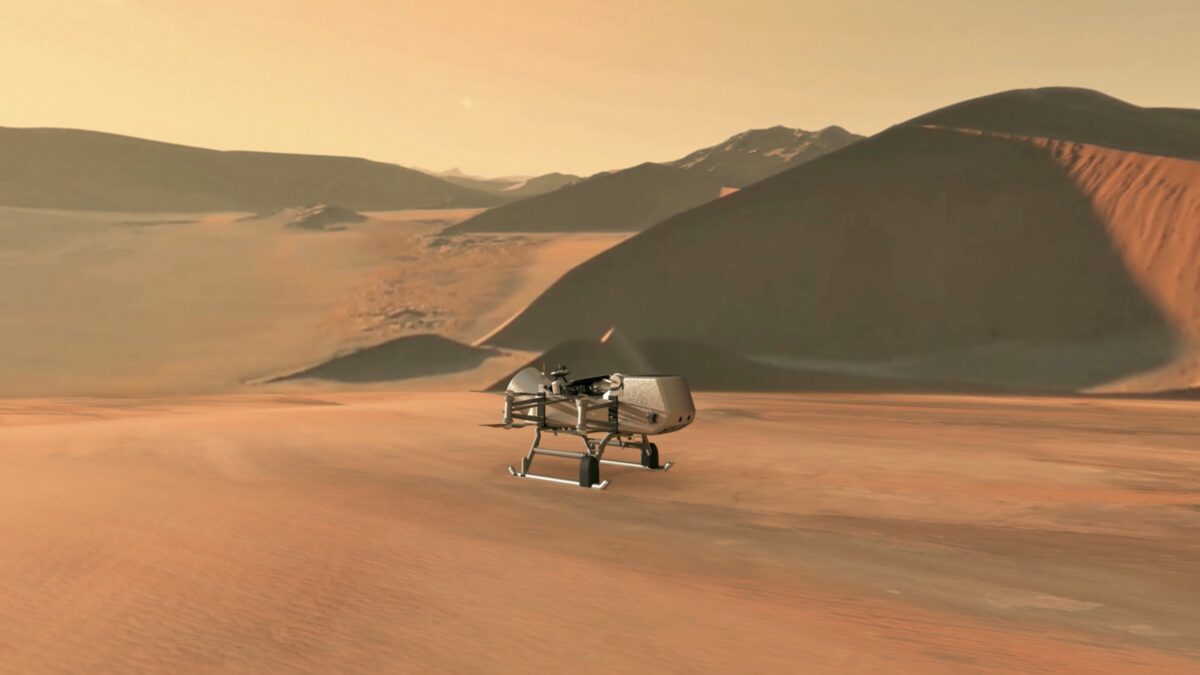
The most extraordinary aircraft NASA has ever designed will never fly in Earth's skies. Dragonfly is a rotorcraft — an eight-bladed drone roughly the size of a small car — built to fly across the surface of Titan, the largest moon of Saturn. When it arrives in the next decade, it will become the first vehicle ever to fly sustained, powered, controlled flights through the atmosphere of another ocean world, hopping from one scientifically rich location to the next across a landscape no spacecraft has explored on foot.
Why Titan, and why a drone
Titan is one of the strangest and most evocative places in the solar system. It is the only moon with a thick atmosphere — denser than Earth's — and the only world besides our own known to have standing liquid on its surface. But those liquids are not water; Titan is so cold, around minus 179 degrees Celsius, that methane and ethane fall as rain, carve river channels, and pool into lakes and seas. Beneath its icy crust lies a vast ocean of liquid water. And its atmosphere and surface are awash in complex organic molecules, the carbon-rich compounds that are the raw material of life's chemistry. Titan is, in effect, a planet-sized natural laboratory running prebiotic chemistry on a scale and over a timescale no lab on Earth could match.
The choice of a flying vehicle is what makes the mission audacious. A rover crawls; it might cover a few dozen kilometres over a whole mission. Dragonfly can leap. Titan's dense atmosphere and low gravity make flight far easier there than on Earth — a given set of rotors generates far more lift — so Dragonfly can take off, cruise tens of kilometres, and land at an entirely new site in a single flight, then do it again. Over its mission it is designed to range across hundreds of kilometres of dunes and impact craters, sampling the surface composition at each stop. It is part aircraft, part field geologist, part chemistry lab.
Flying on Titan also means flying alone. Saturn is so distant that a radio signal takes well over an hour to cross each way, which makes joystick control impossible — Dragonfly cannot be flown from Earth in real time. It will navigate autonomously, using cameras and sensors to survey a landing zone, choose a safe spot, and set itself down without human help, much as a self-driving aircraft would. Each flight will be planned and uploaded in advance, then executed by the craft on its own, with controllers learning hours later whether it worked. Autonomy here is not a convenience but a requirement of the distance.
The power source for a sunless world
Sunlight at Saturn is feeble, and Titan's haze dims it further, so solar panels are useless. Dragonfly will instead draw its power from a radioisotope thermoelectric generator — the same nuclear technology that has powered the Voyagers, Cassini, and the Curiosity and Perseverance Mars rovers, converting the heat of decaying plutonium into electricity. The generator will charge a battery that powers the energy-hungry bursts of flight, while the steady trickle of heat also keeps the electronics warm in the brutal cold. It is a power system chosen for a place where the Sun is little help and the nights last eight Earth days.
Dragonfly is one of NASA's New Frontiers missions, and it is targeted to launch around 2028 and reach Titan in the mid-2030s — the long timelines that outer-solar-system exploration always demands. It belongs to a broader shift in how NASA thinks about where life might exist: away from the old focus on Mars alone and toward the "ocean worlds," the surprising number of icy moons — Europa, Enceladus, Titan and others — that appear to harbor liquid water beneath their shells. Each is being approached with its own kind of mission, and Titan's is the boldest in form: a nuclear drone, flying through orange haze, sampling the chemistry of a world that may resemble the young Earth before life arose. It will be years before it flies. But the fact that it is being built at all is a measure of how far the search for habitable places has expanded beyond the planets we can see with the naked eye.
