
Most cargo spacecraft end their careers as garbage trucks. They get loaded with whatever the International Space Station crew no longer needs, cut loose, and steered into the atmosphere to burn up. Northrop Grumman's latest Cygnus XL is doing that too, but this time a dozen small science payloads are riding along. They are built to survive the fall long enough to report what it was like.
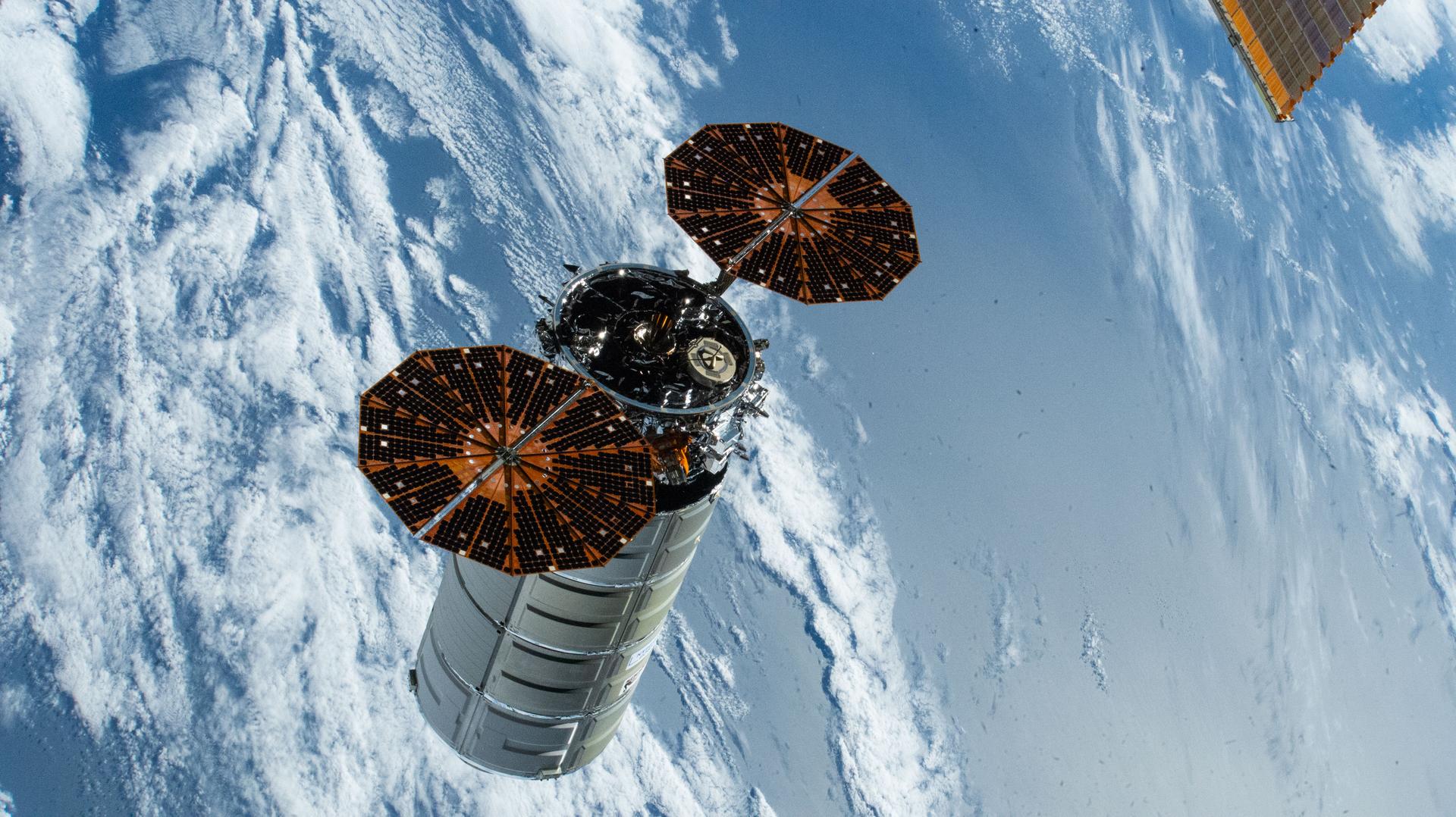
The spacecraft, named the S.S. Steven R. Nagel, was released from the station by Canadarm2 at 12:44 p.m. EDT on Oct. 9. It left from the Earth-facing port of the Unity module while the station was flying about 260 miles over the Pacific Ocean. Inside are 12 capsules built by University of Kentucky students for the third Kentucky Reentry Probe Experiment, known as KREPE-3. Each one carries a sample of an experimental heat-shield material.
A six-month stay ends
The NG-24 mission was the second flight of the stretched Cygnus XL variant and, according to Space.com, the 24th Cygnus of any type to haul cargo to the station. It launched on a SpaceX Falcon 9 on April 11. NASA says it arrived nearly six months ago with about 11,000 pounds of cargo.
Cygnus doesn't dock the way crew capsules do. The station's robotic arm grabs it and berths it to a port, and for departure the same arm unberths it and lets go. Space.com reported that astronaut Luke Delaney monitored the release from the station.
NASA says controllers will command the deorbit on Monday, Oct. 12, sending the spacecraft and several thousand pounds of disposal items into the atmosphere, and that the agency won't provide coverage of it. Space.com reported the reentry date as Sunday, Oct. 11. We're going with NASA's date because NASA runs the station side of the mission. Interesting Engineering also reports an Oct. 12 reentry, planned as a controlled breakup.
What the capsules are testing
The experiment works because Cygnus is going to be destroyed anyway. NASA describes KREPE-3 as the third in a series of low-cost missions that use the final moments of the cargo spacecraft's life to gather data. When Cygnus breaks apart, the capsules eject and begin collecting data on how each set of experimental heat-shield materials performs. As Ames materials engineer Keith Peterson put it, the team is "essentially hitching a ride on a vehicle that's already coming back to Earth."
According to NASA Ames, the students fitted each capsule with sensors that measure temperature, pressure, motion, magnetic field, and light during reentry. Satellite signals transfer the data live to researchers.
The heat-shield materials cover a broad range:
- Shuttle-style ceramic tile. NASA calls this proven technology, so it gives the other samples a known reference to compare against.
- A 3D-printed heat shield from NASA's Additive Manufacturing of Thermal Protective Systems project, developed by Johnson Space Center with Oak Ridge National Laboratory. It is one of the new options being tested in flight.
- Needled carbon/phenolic materials called MERINO (Materials Engineered for Re-entry using Innovative Needling Operations) from NASA Ames. NASA says they are made from layers of carbon and phenolic fibers stitched together like felt, and are more flexible, faster to produce, and less expensive than traditional protective substances. Two capsules fly MERINO.
NASA says the larger goal is heat shields that can keep astronauts safe as they return from missions to the Moon and Mars. Twelve capsules in a single event give engineers many materials to compare under the same reentry.
Who built it
KREPE-3 is the third experiment in the series. NASA describes it as a collaboration among the University of Kentucky, the state of Kentucky, NASA's Established Program to Stimulate Competitive Research (EPSCoR), several NASA centers, and other federal and commercial partners.
David Berger, EPSCoR program manager at NASA Headquarters, called KREPE-3 "a great example of the goals of NASA's EPSCoR program," saying the program supports the next generation of scientists and engineers as they develop unique projects. For the Kentucky students, that meant hardware that actually flies.
Why It Matters
Every spacecraft that returns to Earth or enters another planet's atmosphere depends on its heat shield, and new thermal protection materials need flight data to back them up. KREPE-3 collects that data cheaply by putting the test on a cargo ship that was going to burn up anyway. Peterson called it "a smart way to get flight data on materials that are still in development."
The 3D-printed Johnson/Oak Ridge sample is the one to watch, since it is a new manufacturing approach that still needs real reentry data. Flying it alongside a shuttle-style tile and the Ames carbon/phenolic materials means the results can be compared directly.
The approach depends on the satellite links working, the capsules ejecting cleanly, and the sensors surviving long enough to transmit useful data. That's a lot that can go wrong. Still, the capsules are riding on a spacecraft that was headed for a fiery end regardless, which keeps the cost of each test low.
Sources
- NASA Demonstrates Next-Generation Heat Shield Technologies (NASA Ames)
- Cygnus XL Cargo Spacecraft Released from Station by Canadarm2 (NASA)
- Private Cygnus XL cargo spacecraft departs the International Space Station after 6-month stay (Space.com)
- NASA tests 12 next-gen heat shields aboard trash-filled spacecraft (Interesting Engineering)
