
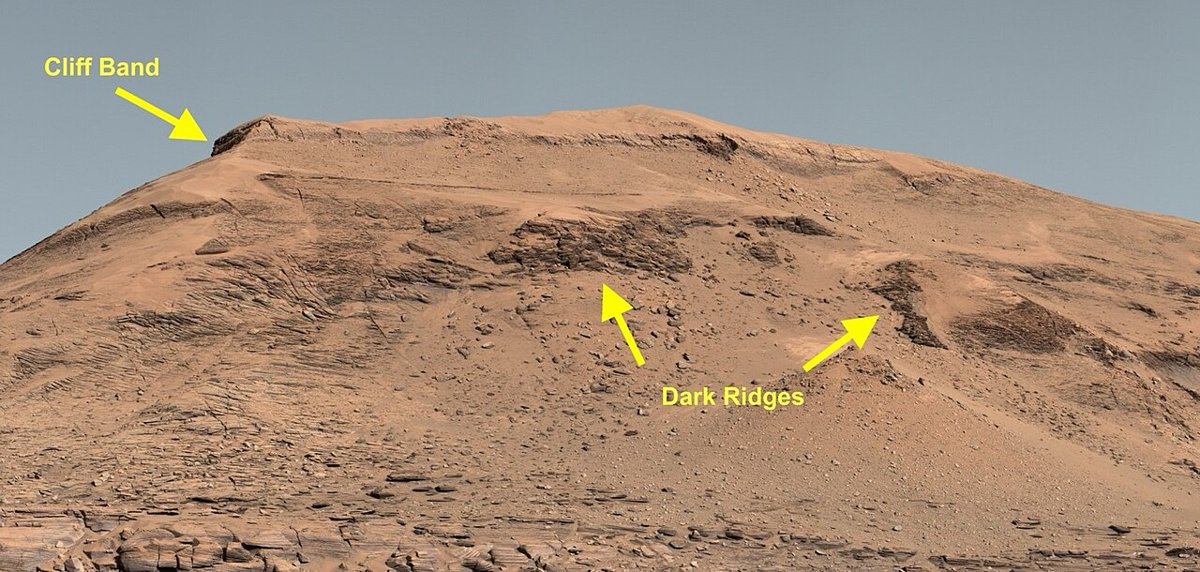
Nearly five thousand sols into its mission on Mars, NASA's Curiosity rover is doing what it does best: staring at rocks and finding something genuinely strange. During sols 4920 through 4926, the rover has been conducting a dedicated science campaign focused on a set of distinctive geological band formations — layered features in the Martian terrain that are adding new complexity to scientists' understanding of the planet's stratigraphic history.
The campaign marks one of those stretches in planetary exploration where the rover team parks the vehicle, points every available instrument at a formation, and methodically collects the kind of dense, overlapping datasets that keep geologists busy for years. It's painstaking work, and it's exactly the sort of thing Curiosity was built to do.
Reading the Bands
Geological banding — the visible layering of distinct rock types, colors, or textures in an exposed section of terrain — is one of the most information-rich features a rover can encounter. On Earth, such bands typically record sequential episodes of deposition: sediment laid down by water, wind, volcanic activity, or chemical precipitation, each layer a page in the planet's geological diary. On Mars, the interpretive challenge is multiplied by the fact that scientists are working with an incomplete understanding of the processes that shaped the surface.
The band formations Curiosity is now surveying present a particular puzzle. During the sols 4920–4926 campaign, the rover has been systematically documenting these features, collecting imagery and compositional data that will allow researchers to characterize the transitions between bands — the contacts where one geological unit gives way to another. These contacts are where the story changes: a shift in mineralogy, grain size, or cementation can indicate a change in environmental conditions, sometimes abrupt, sometimes gradual.
What makes this survey especially valuable is its timing within Curiosity's broader traverse. At nearly 4,926 sols — well over thirteen Earth years of surface operations — the rover has accumulated an enormous baseline of stratigraphic observations. Each new set of band measurements doesn't exist in isolation; it can be compared against thousands of previous observations, building an increasingly detailed picture of how Mars's geological record varies across the terrain Curiosity has covered.
The Long Game of Rover Science
Extended surface campaigns like this one underscore a fundamental reality of planetary exploration: the most scientifically productive work often happens not during the dramatic firsts — the landings, the initial drives, the early panoramas — but during the quiet, methodical phases where a rover settles into a feature and works it thoroughly. A single geological contact might warrant days of observation from multiple angles, in multiple lighting conditions, using different instruments to build a complete compositional and textural profile.
This kind of sustained, detailed fieldwork is possible only because Curiosity has proven remarkably durable. The rover continues to operate and return science data more than a decade into its mission. Its longevity has transformed what began as a surface mission into something closer to a long-term field study — the difference between a tourist snapping photos and a geologist spending seasons mapping an outcrop.
The band survey at sols 4920–4926 is a case in point. Rather than simply driving past these formations and capturing a few images, the rover team has committed multiple sols to systematic documentation. The resulting dataset will be dense enough to support the kind of detailed stratigraphic analysis that, on Earth, requires physical sample collection and laboratory work. On Mars, it all has to be done remotely, with instruments that were selected and calibrated years before anyone knew what formations the rover would encounter.
Building the Next Generation
While Curiosity continues its work on Mars, NASA is already preparing for the next chapter of surface exploration. The agency has been testing advanced rover prototypes in desert environments on Earth — terrain selected specifically for its resemblance to planetary surfaces. These field tests are designed to validate new capabilities that will inform future missions to both the Moon and Mars.
Desert testing is a critical step in the rover development pipeline. The arid, rocky landscapes used for these trials present many of the same navigational and operational challenges rovers face on other worlds: loose regolith, steep slopes, boulder fields, and the need to operate autonomously when communication delays make real-time human control impossible. By pushing prototype rovers through these environments, engineers can identify failure modes and refine designs before committing to the expense and risk of spaceflight.
NASA's current development efforts are focused on advancing rover technology for both lunar and Mars surface missions — a dual-track approach that reflects the agency's broader exploration strategy. Technologies proven on the Moon, where communication delays are measured in seconds rather than minutes, can serve as stepping stones toward the more demanding requirements of Mars operations. Lessons from Curiosity's extended mission — including the kind of sustained science campaigns now underway at the geological bands — feed directly into the design requirements for these next-generation vehicles.
The connection between Curiosity's ongoing work and NASA's rover development program is more than philosophical. Every operational challenge the aging rover encounters, every workaround its team devises, every limitation that constrains what science can be done — all of this becomes data that shapes what the next rover will be able to do. When engineers specify how far a future rover needs to drive, how finely it needs to resolve geological features, or how autonomously it needs to plan its own science campaigns, they're drawing on the accumulated experience of missions like Curiosity's.
Why It Matters
Curiosity's band survey at sols 4920–4926 is a reminder that planetary exploration is fundamentally a cumulative enterprise. No single observation, no matter how dramatic, tells the whole story. It's the accumulation of thousands of careful measurements — each geological contact documented, each compositional anomaly cataloged, each stratigraphic relationship mapped — that gradually transforms a collection of data points into a coherent narrative about a planet's history.
The geological bands Curiosity is now surveying may eventually help answer questions about how environmental conditions on Mars changed over time — questions that bear directly on the planet's potential to have supported life. But those answers won't come from a single campaign. They'll emerge from the painstaking work of correlating these new observations with the vast archive of data Curiosity has already collected, and with measurements from orbit and from other surface missions.
Meanwhile, NASA's investment in next-generation rover technology ensures that when Curiosity's mission eventually ends, the exploration won't stop. The prototypes being tested in Earth's deserts today are the ancestors of the vehicles that will continue the stratigraphic work Curiosity pioneered — with better instruments, greater autonomy, and the accumulated wisdom of more than a decade of Martian fieldwork guiding their design. The bands in the rock are patient. They've waited billions of years to be read. The challenge, as always, is building machines capable of reading them.
