
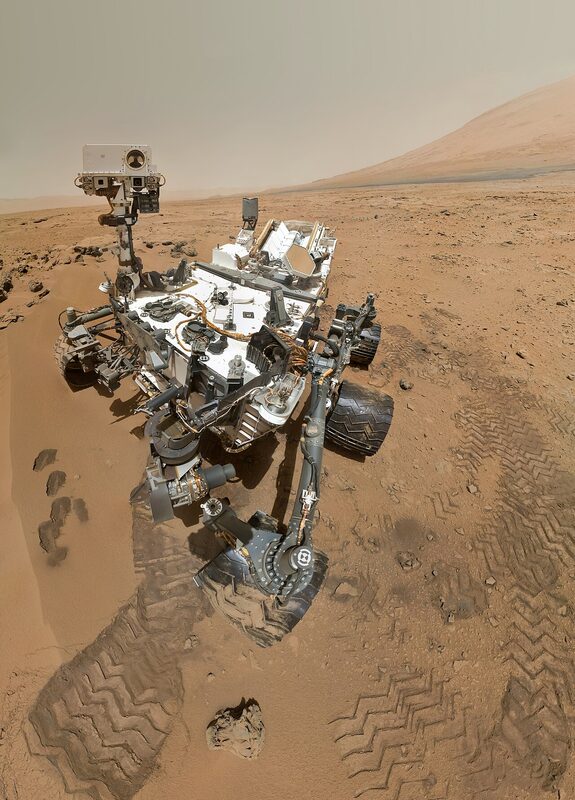
NASA's Curiosity rover has spent more than a decade trundling across Gale Crater, an ancient basin that once held a lake. Its most consequential recent result did not come from a new drive but from a reanalysis of a rock it sampled years ago — and it is the richest inventory of organic molecules ever assembled on Mars. Scientists reported in 2026 that a single mudstone sample contains the most diverse collection of carbon-bearing molecules yet identified on the planet: twenty-one distinct organic compounds, seven of them detected on Mars for the first time, preserved for roughly three and a half billion years in clay-rich rock laid down when liquid water still pooled on the surface.
What "organic" does and doesn't mean
The word organic carries a freight it shouldn't here. To a chemist it means carbon-based molecules, which can be produced by life but also by ordinary geology and by the rain of carbon-rich meteorites that pelts every rocky world. So the finding is not a detection of life, and the scientists involved have been scrupulous about saying so. What makes it significant is twofold. First, diversity: a wide variety of complex organic molecules is more interesting than a single simple one, because it speaks to a rich prebiotic chemistry — the kind of chemical raw material from which life, if it ever arose on Mars, would have had to assemble itself. Some of the newly identified compounds resemble the longer-chain structures that, on Earth, are associated with biological building blocks. Second, preservation: that these fragile molecules survived billions of years of radiation and oxidation, locked inside ancient clay, shows Mars can store such chemistry over geologic time — which means the search for it is not hopeless.
The detection itself is a feat of miniaturized chemistry. Curiosity's onboard laboratory, called SAM, works by heating a pinch of powdered rock in a sealed oven and analyzing the gases that bake off — separating them and identifying each molecule by its mass. The sample in question, drilled from a mudstone the team named Mary Anning 3 in 2020 and analyzed ever since, has been one of the mission's gifts that keep giving: clay minerals are unusually good at trapping and shielding organic molecules from the radiation and oxidants that would otherwise destroy them near the surface, which is why a years-old sample is still yielding first-time detections as the analysis deepens.
The limit of a rover, and the case for bringing rocks home
Curiosity's onboard laboratory is remarkable, but it is a chemistry set bolted to a car-sized robot a hundred million kilometres away, and it cannot run the definitive tests. Distinguishing a biological origin from a geological or meteoritic one requires the full arsenal of an Earth laboratory — instruments too large, too power-hungry, and too delicate to fly. This is precisely the argument for Mars Sample Return, the long-troubled effort to retrieve the cores that the Perseverance rover has been caching in a different, even more promising ancient delta. Curiosity's result raises the stakes on that retrieval: it demonstrates that Mars holds exactly the kind of preserved organic chemistry that would most reward laboratory scrutiny, and that the rovers have done about as much as robotic instruments on the surface can.
It is worth sitting with the restraint on display. A lesser result would have been trumpeted as a hint of Martian life; this one was presented as what it is — a meaningful advance in understanding Mars's habitability, hedged with every honest caveat. That discipline is not timidity. It is what makes the eventual answer, whenever a sample finally reaches Earth, worth believing. For now, the richest organic chemistry ever read on another world sits in a rock on Mars, and in the rover's data, waiting for instruments that can ask it the only question that matters.
