
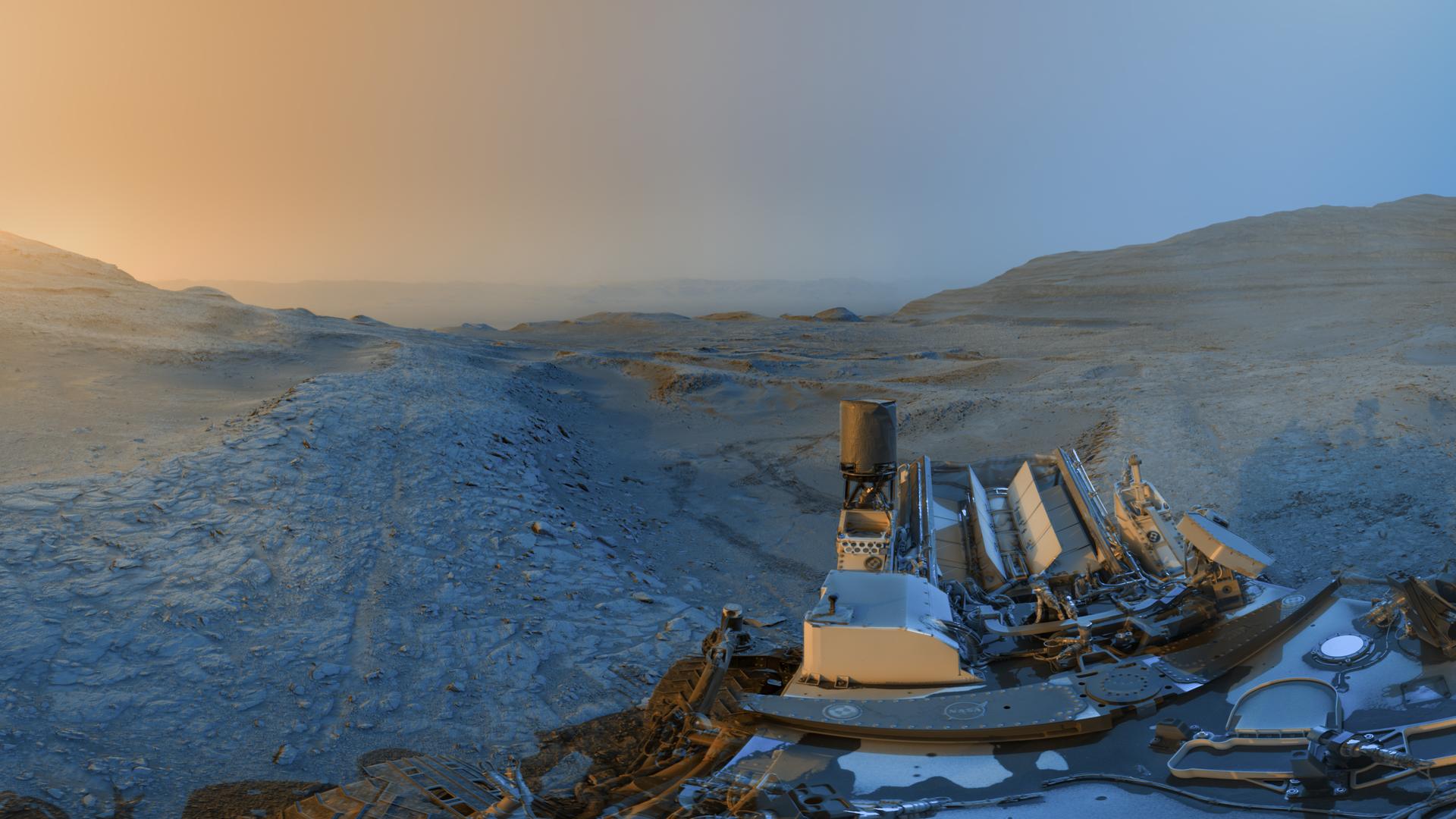
On Aug. 30, 2026, NASA's Curiosity rover logged its 5,000th sol on Mars — a Martian day, roughly 40 minutes longer than an Earth day, and a unit that has effectively become the rover's own calendar. The vehicle was parked at the time on a sand ridge in the lower foothills of Mount Sharp that the team has nicknamed "Chocolatal," inside Gale Crater. To mark the occasion, engineers didn't just log the number and move on. They built a postcard.
The image, released by NASA's Jet Propulsion Laboratory on Sept. 16, 2026, merges two black-and-white panoramas taken with Curiosity's navigation cameras at different times of the Martian day — one grabbed at 9:56 a.m. local Mars time on Sol 5,000 itself, the other from a related panorama on Sol 5,003 (Sept. 2, 2026). The team colorized the morning frame in blue and the afternoon frame in yellow, then merged them into a single two-tone composite. The result looks less like a raw science product and more like a deliberately artistic keepsake — which is more or less the point.
Why the Colors Aren't Real
Curiosity's navigation cameras are black-and-white instruments, built for driving and hazard avoidance rather than true-color imaging. The blue-and-yellow treatment isn't an attempt to show what the scene actually looks like; it visualizes how shadows and lighting shift across a scene over the course of a Martian day. By tinting a morning pass blue and an afternoon pass yellow and layering them together, the team produces a single frame that encodes time-of-day information a normal photograph couldn't carry. It's a working visualization tool that also happens to make an unusually striking image — which is presumably why JPL reached for it for a milestone that's more about sentiment than science.
The Math Behind the Milestone
Curiosity landed inside Gale Crater in 2012. Sol 5,000 arriving on Aug. 30, 2026 puts the rover at roughly 14 years of continuous surface operations — each Martian sol running about 40 minutes longer than an Earth day, so 5,000 of them add up to more Earth-calendar time than the sol count alone suggests. The rover has now spent well over a decade doing work that was never guaranteed to still be happening, a reminder of how much operational margin tends to exist in machinery built to survive a trip to another planet.
The rover's current position matters too. Chocolatal sits in the lower foothills of Mount Sharp, the roughly 3-mile-tall (5-kilometer) mountain that dominates the center of Gale Crater and has been a central destination of Curiosity's mission since it began climbing. The crater's rim sits some 25 miles (40 kilometers) away — a scale that puts Curiosity's slow, methodical climb into perspective. The rover isn't just marking time; it's still climbing, still gaining elevation on a mountain whose rock layers record Mars' transition from a wetter world to the dry one we see today.
Still Working, Not Just Posing
The 5,000-sol postcard arrives alongside continued science work rather than instead of it. In the months leading up to the milestone, Curiosity sent back panoramas from higher up Mount Sharp showing "boxwork" terrain — a lattice of mineral ridges believed to have formed when ancient groundwater deposited minerals along networks of cracks in the rock, with the softer surrounding rock later eroding away and leaving the harder ridges standing exposed. That terrain is part of the same broader story the milestone image gestures at: a record, layer by layer, of Mars going from wet to dry, written into rock the rover is still actively reading.
In that sense, the two-tone panorama functions on two levels at once. To the public, it's a birthday card — a visual way of saying a robot has now been working on another planet for longer than many terrestrial vehicles stay in service. To the mission team, it's also a byproduct of an imaging technique that continues to earn its keep, used here to celebrate a number rather than to solve an immediate science problem.
Why It Matters
Milestones like Sol 5,000 aren't just PR opportunities — they're a proxy for how well engineering assumptions have held up over roughly 14 years of dust, temperature swings, and radiation exposure on another planet. Every extra sol Curiosity operates is additional real-world data on the long-term durability of its plutonium-powered MMRTG design. It's also a reminder that Curiosity remains an active science platform, not a monument: the same rover marking a calendar milestone is simultaneously imaging boxwork terrain that bears on whether — and for how long — Mars once had the flowing or subsurface water that could support life. The postcard is charming. The fact that the rover producing it is still climbing a mountain and reading its rock layers after roughly 14 years is the actual story.
Sources
- Curiosity Postcard Celebrates Rover's 5,000th Day on Mars — NASA Science
- 5000 Days of Curiosity — The Planetary Society
- NASA's Curiosity rover sends stunning new panorama from high on Mars' Mount Sharp — Yahoo News
