
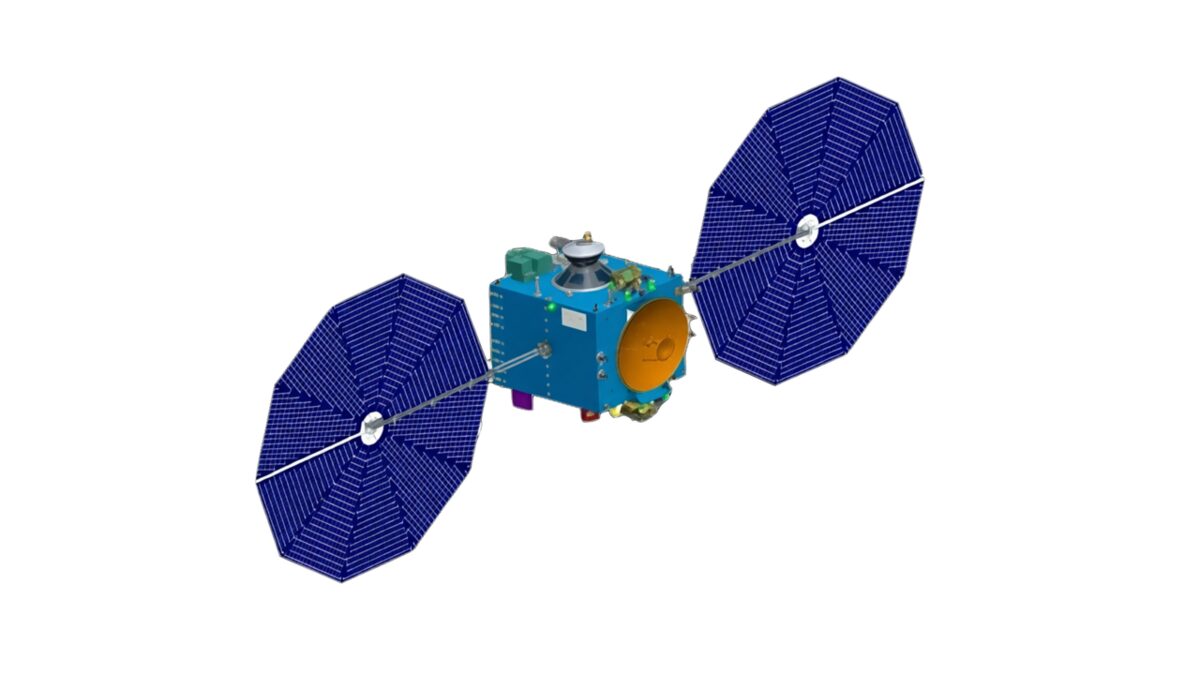
Sometime in the middle of June, China's Tianwen-2 spacecraft is slipping into orbit around one of the strangest small bodies in Earth's neighborhood: Kamo'oalewa, a quasi-satellite less than a hundred metres across that loops around the Sun in near-lockstep with our planet, never quite orbiting Earth but never leaving its vicinity either. After roughly thirteen months in transit since its May 2025 launch, the probe is set to begin a sampling campaign in July, with a capsule of asteroid material targeted to parachute into Inner Mongolia in November 2027. It would make China the third nation to return a sample from an asteroid.
An object defined by a question
Kamo'oalewa — discovered in 2016 by the University of Hawaii's Pan-STARRS survey, and named with a Hawaiian word evoking a wandering celestial fragment — drew intense interest because of a tantalizing hypothesis: that it might be a chip of the Moon, blasted off the lunar surface by an ancient impact and captured into its peculiar Earth-shadowing orbit. Earlier observations found its reflected light resembled lunar rock, and the idea of a lost piece of the Moon orbiting alongside us was irresistible. It also made the object a uniquely valuable sampling target.
Then, just as Tianwen-2 arrived, the story complicated. A study published in Nature Communications in 2026 argues that Kamo'oalewa's surface is better explained not as lunar material but as a highly space-weathered ordinary chondrite — specifically an LL-type, the same broad class as the asteroid Itokawa that Japan's Hayabusa sampled. In this reading, the reddish color that hinted at a lunar origin is instead the signature of an ordinary silicate asteroid whose surface has been baked and battered by eons of solar wind and micrometeorite bombardment. The lunar hypothesis isn't dead, but it now has a serious rival.
The object's orbit is part of what makes it both valuable and tricky. A quasi-satellite is not truly bound to Earth — it orbits the Sun — but its path is tuned so closely to ours that, from our vantage, it appears to trace long loops around the Earth, lingering in the neighborhood for centuries at a stretch. That proximity makes Kamo'oalewa relatively cheap to reach and to return from, which is much of why China chose it. It also makes it a natural laboratory for a class of near-Earth objects that are easy to overlook precisely because they shadow us so faithfully.
Why the disagreement is the point
This is exactly the situation that makes a sample-return mission worth the expense. Spectroscopy from afar reads only the weathered skin of an object and can be fooled; a returned sample, analyzed in terrestrial laboratories with instruments no spacecraft can carry, can settle composition and even age outright. If the grains Tianwen-2 brings back match lunar rock, Kamo'oalewa becomes a free sample of the Moon delivered to near-Earth space. If they match an LL chondrite, it becomes a pristine record of the early solar system — and a cautionary tale about how much we infer from how little.
The retrieval itself is delicate. On a body so small that its gravity is almost negligible, the spacecraft cannot simply land and dig. Tianwen-2 carries three contingency techniques: hovering a metre above the surface while a robotic arm scoops, a touch-and-go probe that sweeps up debris on contact, and an anchored landing that pins the craft down before it samples. Which method it uses will depend on what it finds when it gets close — terrain that, until this month, no spacecraft has ever seen. Whatever Kamo'oalewa turns out to be, the mission is a clean demonstration of a humbling rule of exploration: we frequently reach a world before we have agreed on what it is. The grains Tianwen-2 brings home, falling over Inner Mongolia in November 2027, should finally give Kamo'oalewa the last word in its own identity.
