
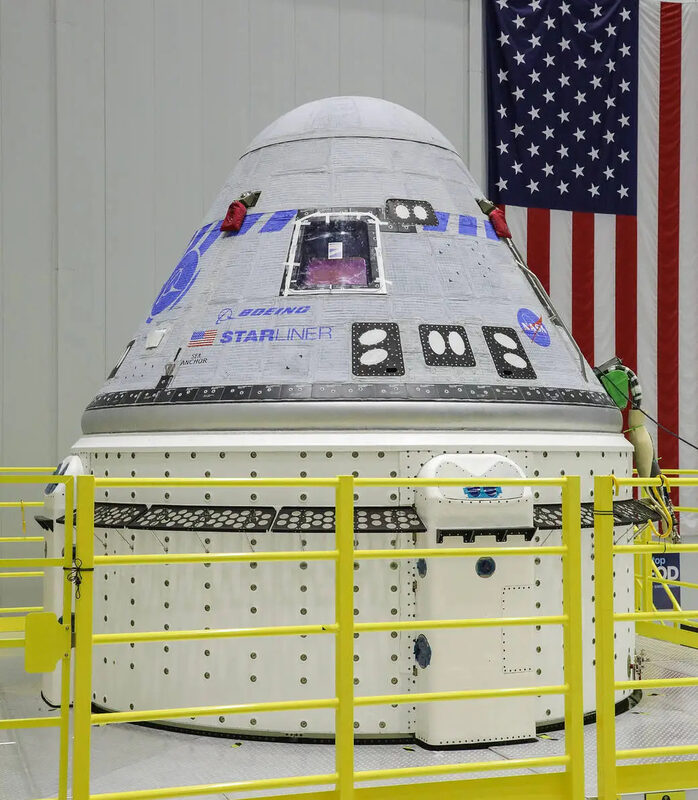
Butch Wilmore and Suni Williams launched aboard Boeing's CST-100 Starliner on June 5, 2024, on what was planned as an eight-day stay aboard the International Space Station. It was the first crewed test flight of Starliner, a mission NASA and Boeing had been working toward for years after repeated delays, cost overruns, and a 2019 uncrewed test flight that had nearly ended in disaster. The mission was supposed to demonstrate that Boeing could reliably transport NASA astronauts to and from the ISS — establishing Starliner as a second source alongside SpaceX's Dragon and reducing the agency's dependence on any single commercial provider. Instead, Williams and Wilmore did not come home until March 2025, after nine months on the station, aboard a Dragon capsule that was not originally scheduled to carry them.
The problems that stranded them were not single or simple. During the approach to the ISS, five of Starliner's 28 reaction control system thrusters failed — thrusters essential for orbital maneuvering and emergency abort. Engineers traced the failures to Teflon seals in the propellant valves that had swollen and blocked propellant flow under conditions that ground testing had not replicated. Separately, the capsule had developed five helium leaks in its service module — small, but adding uncertainty to an already-troubled situation. NASA's analysis concluded that four of the five thrusters could likely be restored to function by heating them in space, and the helium leaks were deemed manageable. But the agency was not confident enough in Starliner's reliability to certify it to carry the crew home safely, given the combination of known issues and the unknowns that remained.
The decision to send Starliner home empty
On August 24, 2024, NASA Administrator Bill Nelson announced that Starliner would return to Earth uncrewed. Wilmore and Williams would extend their stay on the ISS and return on the Crew Dragon Endeavour in March 2025, as part of the Crew-9 mission that was already scheduled. The decision was rational given the information available, but its public framing was awkward: NASA had to simultaneously explain why flying the crew home on Starliner was too risky while maintaining that the capsule was airworthy enough to fly home uncrewed. The distinction — that the threshold of risk acceptable for hardware is lower than for crew — is real but did not communicate simply.
Starliner landed at White Sands, New Mexico, on September 6, 2024, and was recovered for inspection. The post-flight analysis confirmed the thruster failure mechanism and identified the swollen seals as the root cause. Boeing has proposed a fix — replacing the Teflon seals with different materials and modifying the thruster design — and has sought certification to fly a second crewed test mission. NASA has not yet granted it.
The program's uncertain future
Boeing's commercial crew program has cost the company significantly more than the fixed-price contract allowed. Boeing took charges of more than $1.5 billion against the Starliner program before the 2024 crewed test flight, and the post-flight delays add further costs. The financial pressure on Boeing more broadly — its commercial airplane division was simultaneously managing a serious quality-control crisis — made further investment in Starliner harder to justify without a clear path to certification and regular operational missions.
The dependency implications for NASA are significant. The commercial crew program was designed with two providers precisely to avoid relying on SpaceX alone for ISS crew access. With Starliner grounded, Dragon is currently the only American vehicle capable of flying crew to the station. NASA has adjusted manifests to accommodate this, but the agency's redundancy objectives are not being met. The pressure to certify Starliner, if Boeing can demonstrate the fixes are adequate, is real — even knowing that rushing a capsule with a troubled history would be the wrong response to schedule pressure.
Wilmore and Williams, when they returned, did not express bitterness about their extended stay. They had continued working as crew members, conducting science experiments and station maintenance throughout. The nine months added substantially to their career totals of time in space. The mission was not what was planned, but the crew adapted. The spacecraft and the program it represents are still in the adaptation phase, and as of mid-2026, the outcome remains genuinely uncertain.
