
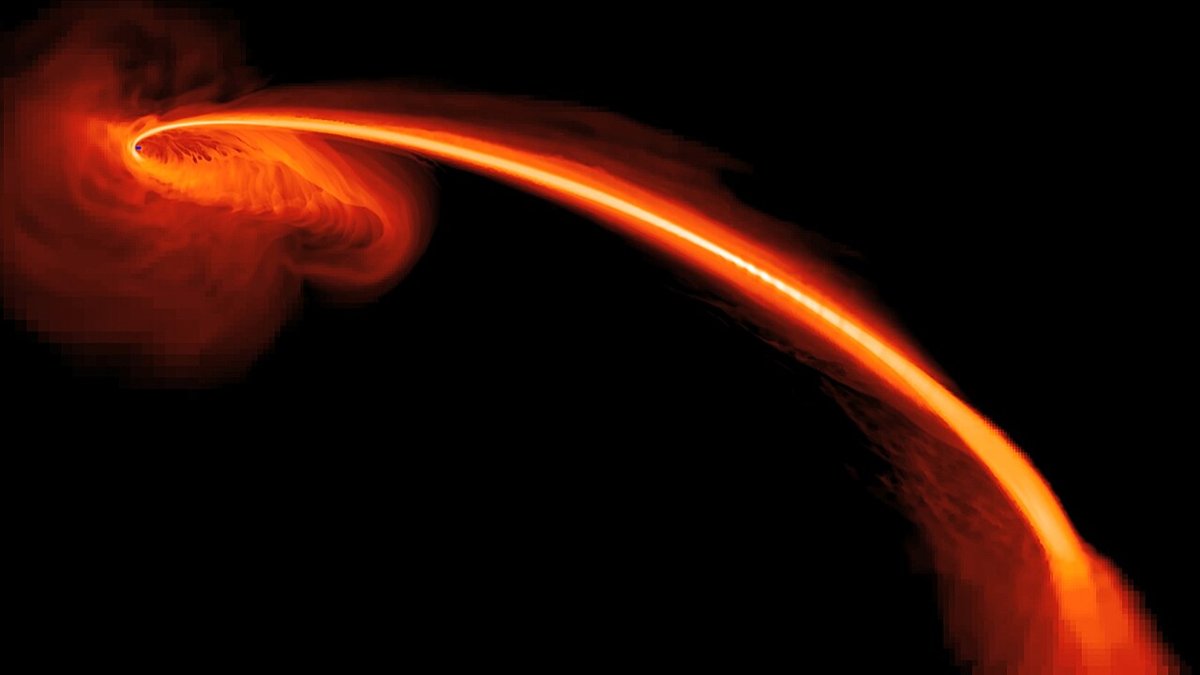
Deep in James Webb Space Telescope images of the early universe, astronomers have found an object that shouldn't exist by the normal rules of stars or black holes. Cataloged as MoM-BH*-1 — named for the survey that found it — the object dates to just a few hundred million years after the Big Bang and shines with roughly 100 billion times the energy output that any ordinary star is capable of producing on its own through nuclear fusion.
The discovery, led by Rohan Naidu, now at the University of Hawai'i's Institute for Astronomy, was published in Nature and posted as a preprint on arXiv. The team wasn't hunting for anything like this; they were surveying the early universe for ordinary distant galaxies when they flagged MoM-BH*-1 as an unusually bright, unusually red point of light. Follow-up spectroscopy is what revealed just how strange the object actually is, turning a routine catalog entry into one of the more unusual findings to come out of Webb's deep-field surveys so far.
Why It Matters
The object appears to be a supermassive black hole — roughly 100,000 times the mass of the Sun — wrapped in an extraordinarily dense envelope of hydrogen and helium gas, with no heavier elements detected at all. That gas cocoon is opaque enough, and structured in just the right way, that from a distance the whole system mimics the light signature of an enormous star roughly the size of the solar system, rather than the sharp, distinctive glow astronomers usually associate with actively feeding black holes. Naidu described the effect directly, saying the hydrogen envelope “looks like a star the size of the solar system. It's huge.”
The spectrum shows the deepest Balmer break — a sharp drop in brightness at a specific wavelength caused by hydrogen absorption — ever recorded in any astronomical object. Researchers interpret this as evidence the black hole is accreting matter far faster than the theoretical Eddington limit, the rate at which radiation pressure from infalling matter would normally blow the surrounding gas away and choke off further growth. A black hole thickly wrapped in its own fuel, growing at extreme speed while that gas simultaneously muffles and reddens its light, would explain both the object's unusual brightness and its bizarre spectral fingerprint in one coherent picture.
That matters well beyond this one object. JWST's deep surveys have turned up a whole population of compact, unexpectedly red sources in the early universe nicknamed “little red dots” — objects that have puzzled astronomers since Webb started returning data, because their colors and compactness don't cleanly match either normal young galaxies or standard actively-feeding black holes known as quasars. If MoM-BH*-1 is representative of the broader population, it suggests at least some little red dots are black holes caught in a specific, short-lived phase: growing so fast, and so thickly shrouded in gas, that they look like stars rather than the black holes they actually are underneath.
That would also help solve a separate, longstanding puzzle in cosmology: how supermassive black holes managed to reach billions of solar masses within the universe's first billion years, when standard growth models struggle to get them there in time even under generous assumptions. A mechanism that lets black holes gorge on gas at multiples of the Eddington limit — hidden inside a cocoon that also happens to make them look deceptively ordinary from a distance — offers a path to explaining both problems at once. Naidu has cautioned that the picture is still evolving rapidly as more of these objects turn up in JWST data, but the discovery gives theorists a concrete, observed example to build models around rather than just a population of unexplained anomalies scattered across deep-field images.
Sources
- A gas-enshrouded and gas-reddened black hole at cosmic dawn — Nature
- A 'Black Hole Star' Reveals the Remarkable Gas-Enshrouded Hearts of the Little Red Dots — arXiv preprint
- Black hole star: Astronomers discover a brand-new type of astrophysical object — Phys.org
- JWST spots a bizarre 'black hole star' 100 billion times brighter than a star — ScienceDaily
