
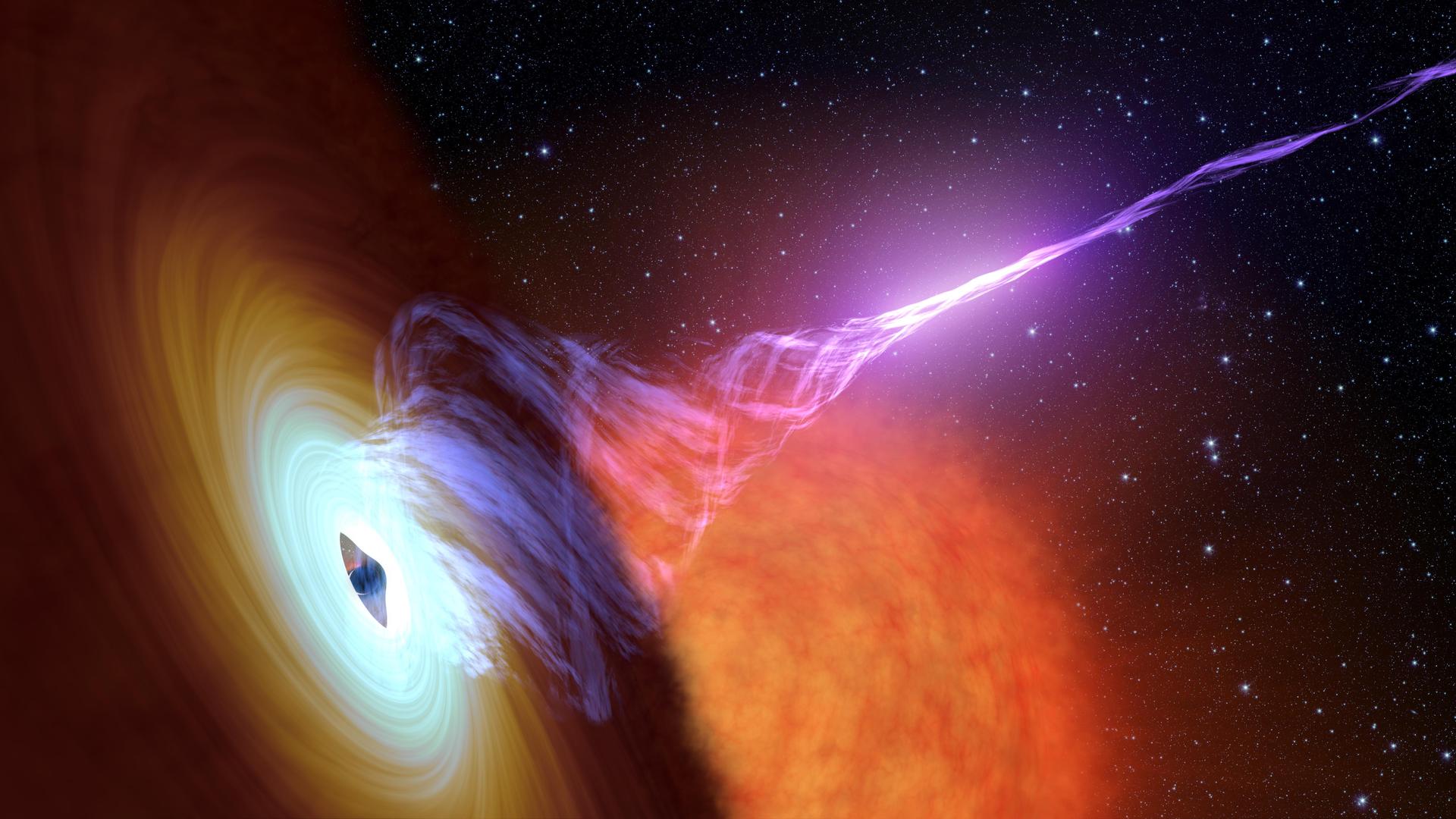
Black holes come in wildly different sizes. Stellar-mass black holes weigh about 10 times the mass of the Sun. Supermassive ones weigh millions of solar masses. According to a paper published in Nature Astronomy on September 17, 2026, they may all turn on their jets under the same condition: when the rate at which they are fed falls to roughly 2% of the Eddington limit.
The work is by Dr Adelle Goodwin of Curtin University and the International Centre for Radio Astronomy Research (ICRAR), and Dr Andrew Mummery of the Institute for Advanced Study in Princeton. Its central claim is blunt. In Goodwin's words, "the physics does not seem to care how big they are."
The setup: stars torn apart
The team's laboratory was the tidal disruption event, or TDE, in which a black hole pulls a star apart. According to Science Times' summary of the study, tidal forces shred the star, the debris forms a hot accretion flow, and magnetic fields plus rotation channel energy into powerful jets of particles and radiation.
The Institute for Advanced Study release describes the messy reality this way. "When a black hole tears apart a star, it does not swallow everything neatly," Goodwin said. The release adds that while a portion of the material is consumed, much is launched back into space in powerful outflows.
The authors analysed 20 TDEs, then narrowed the sample to the 10 that had reliable modelling data. Ten events is a small sample, and the result rests on how well those ten were modelled. But the picture that emerges from them is consistent.
Two jet phases, one threshold
Across the events, the jets appear in two distinct phases:
- An early phase at extreme feeding rates, near peak accretion.
- A delayed phase that begins once feeding drops to about 2% of the Eddington limit.
The delay is not subtle. The Institute for Advanced Study release says the second jet-launching phase occurs hundreds to thousands of days after the star is first torn apart, and Science Times gives the same range. In other words, a telescope that looks only around the time of the flare could miss the second act entirely.
The 2% figure is the same one seen elsewhere. The authors' preprint on arXiv, submitted February 16, 2026 under the title "A universal critical accretion rate for black hole jet formation," says TDEs produce outflows in super-Eddington phases and at a critical rate of about 0.02 of the Eddington luminosity. That value is the same as the critical accretion rate for state transitions observed in stellar-mass black holes. The preprint's conclusion is that supermassive black holes show the same accretion-outflow coupling as their stellar-mass counterparts, so the low accretion-rate threshold for forming a jet is scale-invariant.
Why It Matters
There are two payoffs, one conceptual and one practical.
The conceptual one is unification. A stellar-mass black hole and a supermassive one differ in mass by a factor of hundreds of thousands to millions. If both switch on jets at the same fraction of the Eddington limit, then jet launching looks to be governed by how fast the black hole is being fed relative to that limit, not by its absolute size. That would let astronomers apply what they learn from smaller, nearer, faster-changing systems to the giants, and the reverse.
The practical one is timing. Goodwin put it this way: "Radio telescopes are incredibly powerful, but knowing when to look is just as important as knowing where to look." If a delayed jet is expected once accretion falls to about 2% of Eddington, observers could plan radio follow-up for the window when the jet is likely to appear. According to phys.org, enhanced timing predictions could improve telescope efficiency, including at the SKA Observatory in Western Australia. Science Times likewise says the result lets astronomers connect jet formation with the black hole's feeding cycle for more targeted follow-up. Curtin's release also points to the Australian Government's $387 million investment in the Square Kilometre Array, and says that with the SKA's total cost exceeding $2 billion, improving how telescope time is used could deliver significant benefits.
What is and is not established
A few caveats are worth keeping in view.
- The sample is 10 TDEs with reliable modelling, drawn from 20 analysed. That is enough to see a pattern, not enough to rule out exceptions.
- The threshold is described as "about" 2% of the Eddington limit. The sources do not give an uncertainty range, and we have not seen the full paper text.
- The news sources we could fetch all say the paper appeared in Nature Astronomy, with DOI 10.1038/s41550-026-02951-1. The arXiv preprint page lists no journal reference, and the journal's own page was not fetched for this article.
Even with those limits, the framing is a useful one. A rule that holds from about 10 solar masses to millions is a strong hint that jet launching depends on the feeding rate. Whether it survives more TDEs, and better data on the delayed jets, is what radio follow-up will now test.
Sources
- A universal critical accretion rate for black hole jet formation (arXiv preprint, Goodwin and Mummery)
- WA scientist helps crack black hole 'burp' mystery (EurekAlert, Curtin/ICRAR release)
- IAS scholar reveals universal rule of black hole 'burps' (EurekAlert, IAS release)
- Black holes from stellar to supermassive size may follow one jet-launching rule (phys.org)
- How Black Holes 'Burp' Powerful Jets After Feeding on Stars, Scientists Find (Science Times)
