
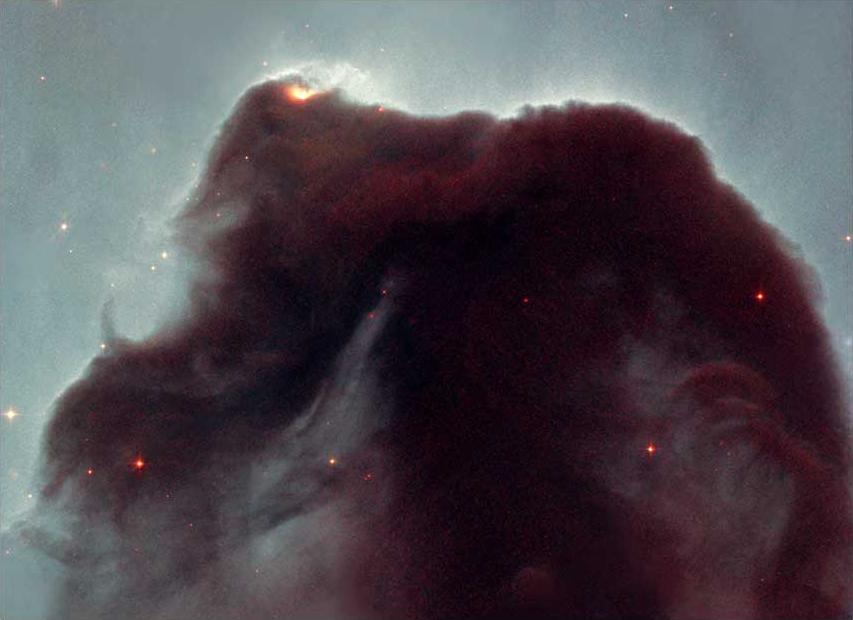
At first glance it looks like a hole in the sky. A rich field of stars toward the constellation Ophiuchus suddenly stops at the edge of a roughly round patch of nothing. That patch is Barnard 68, and it is not empty. It is a dark molecular cloud, a knot of dust and gas dense enough to absorb nearly all the visible light coming from the stars behind it.
NASA's Astronomy Picture of the Day for November 29, 2026 features the cloud. A word of caution before anyone reads this as breaking news: APOD credits the image to the FORS Team and Antu, one of the 8.2-meter telescopes of ESO's Very Large Telescope (VLT), and the key measurements discussed here come from an ESO study announced in January 2001. The APOD feature is the reason to look at Barnard 68 again, not a fresh discovery. Still, the object is worth a second look, because a lot of what we know about it comes from careful measurements rather than from pretty pictures.
What exactly are we looking at?
Barnard 68 is a compact cloud of cold gas and dust. In visible light it shows up only as a silhouette: the dust grains scatter and absorb starlight so well that the cloud looks like an opaque black disk. According to ESO's press release on the cloud, its temperature is about 16 kelvin, only a few degrees above absolute zero. Reference summaries put its mass at about twice that of the Sun.
The cloud gets its name from E. E. Barnard, who catalogued it in 1919. The catalogue was published in 1927. In visible light, Barnard 68 is seen only because of what it blocks.
How far away is it? That depends on whom you ask
The sources don't agree on the distance, and the gap is worth spelling out. APOD describes Barnard 68 as about 500 light-years away. ESO's press release gives about 410 light-years. The commonly cited modern figure is about 125 parsecs, or roughly 407 light-years, which is very close to ESO's value.
So the best reading is a distance of around 400 light-years, with APOD's 500 as a rounder, looser number. Distances to dark clouds are hard to pin down, because the cloud gives off no visible light of its own. Astronomers have to work it out indirectly, using the stars in front of it and behind it.
Size estimates vary too. APOD and other references describe the cloud as about half a light-year across. ESO quotes about 12,500 astronomical units, which is closer to a fifth of a light-year. Some of the difference probably comes from where each measurement places the cloud's fuzzy outer edge. Either way, Barnard 68 is small by molecular-cloud standards. That is part of why it makes such a clean test case.
Seeing through the dark
Barnard 68 is opaque only at visible wavelengths. As APOD notes, the cloud becomes transparent in infrared light. Longer wavelengths slip past the dust grains that block shorter ones, so an infrared camera can look straight through what an optical camera sees as solid black.
That transparency is what made the cloud scientifically useful. Observations with ESO telescopes, including the VLT, found about 3,700 background stars hidden behind Barnard 68. About 1,000 of them showed up only in infrared light. Each background star works as a probe: the more its light is dimmed and reddened, the more dust lies along that line of sight. With thousands of probes spread across the cloud, astronomers could map how much material sits at each point and build a picture of the cloud's internal structure. ESO's study drew on observations from both its La Silla and Paranal observatories. Later, the Herschel space observatory added constraints on how the dust is distributed.
A cloud balanced on a knife edge
The most interesting result is not the cloud's look but its physical state. ESO's analysis found Barnard 68 in near-equilibrium. Its own gravity pulls inward, and the thermal pressure of its cold gas pushes outward, and the two are almost evenly matched.
"Almost" is the important word. ESO describes the balance as one that may not last long. If gravity wins, the cloud will collapse. APOD puts it plainly: Barnard 68 is likely to collapse and form a new star system. A cloud this close to the tipping point gives astronomers a look at the conditions just before star formation starts. Those conditions are usually hidden inside much larger, messier stellar nurseries.
The cloud's history matters too. ESO's astronomers believe that Barnard 68 is probably the remnant of a larger cloud. ESO says strong stellar winds and ultraviolet radiation from young, massive stars, along with supernova explosions, would have worn that larger cloud away over time, leaving the compact core we see today. In that reading, Barnard 68 is what survived after its surroundings were cleared out. It is also a reminder that star formation is shaped by the stars that came before.
Why It Matters
Star formation is one of the basic processes in astronomy, and one of the hardest to watch directly. The earliest stages happen inside cold, dusty clouds that block the very light telescopes rely on. Barnard 68 is a rare, nearly ideal laboratory. It is nearby, small and isolated, and its edges are sharp. It sits in front of enough background stars, about 3,700 in ESO's study, to let astronomers measure its interior from their reddening. And it appears to be close to the gravitational tipping point where a cloud stops being a cloud and starts becoming a star system.
The disagreements among sources, about distance and size, also show how much of this field rests on careful indirect inference. A dark cloud tells you almost nothing about itself unless you can measure what it does to the light passing through it. For an object that looks like a hole in space, Barnard 68 has given astronomers a great deal of information.
