
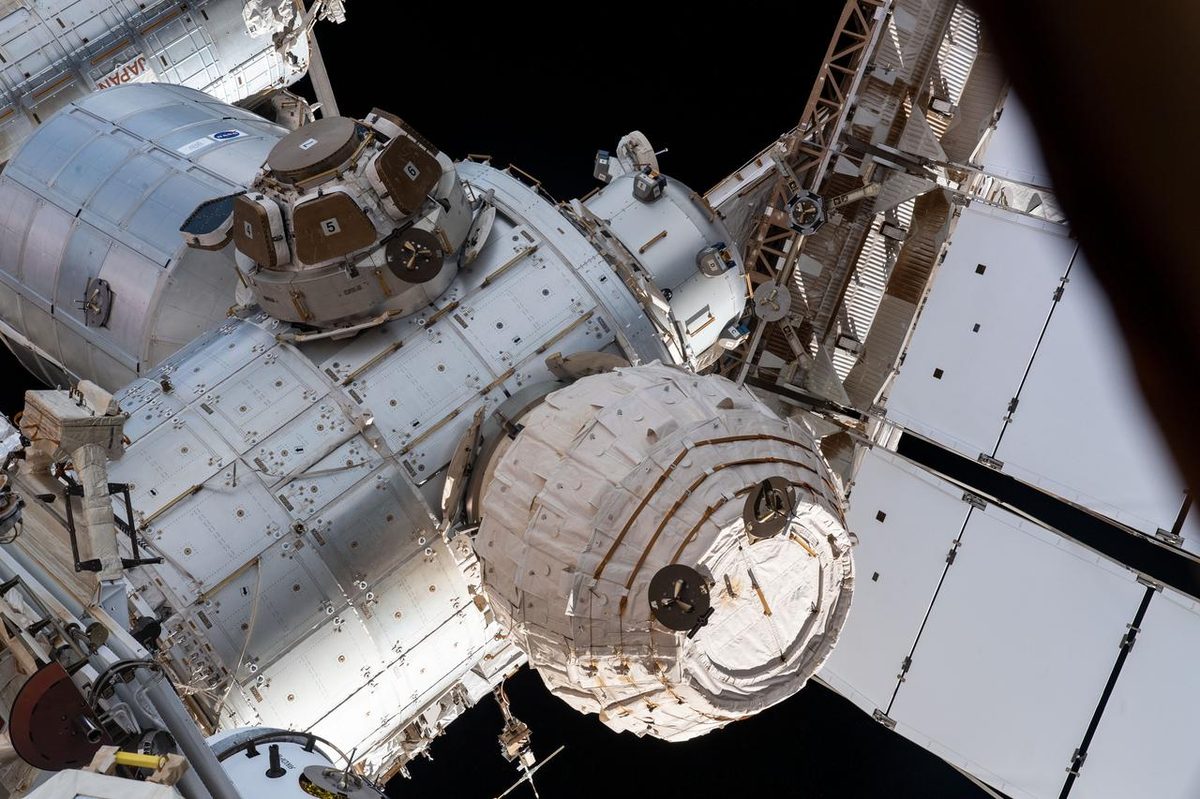
There is a peculiar kind of ambition embedded in a plan that hinges on someone else's retirement. Axiom Space has spent the better part of a decade building toward a moment that cannot arrive until the International Space Station — the most expensive object ever constructed by human hands — is deliberately de-orbited into the South Pacific. That moment is now visibly approaching, and Axiom's first hardware is going up to meet it.
Axiom Module 1, known as AxM-1, is the first privately owned module ever to be added to the ISS. It is scheduled to dock at the station's forward port on Node 1 — the same port that has hosted visiting spacecraft from the Shuttle era onward. Once berthed, it will serve as a habitable addition to the station: a commercial crew quarters, a demonstration platform, an anchor for what comes next. But its real purpose is architectural. Every subsequent Axiom module — AxM-2, AxM-3, and the planned power and thermal module — will attach to it, gradually assembling a free-flying station in miniature while it is still parasitically connected to the ISS's power, communications, and life support infrastructure.
When NASA finally decommissions the ISS, currently targeted for 2030, the Axiom segment is designed to detach as a coherent, independently operable station. The ISS becomes the scaffold. The scaffold comes down. The building stays up.
Why Build On Someone Else's Station
The logic of docking to the ISS before going independent is more than financial, though the financial case is obvious enough. Building and launching an entire space station from scratch — obtaining the orbital mechanics expertise, the life support systems, the power generation, the thermal management — requires a staggering capital investment before a single customer pays a single dollar. By hitching to the ISS first, Axiom sidesteps the chicken-and-egg problem that has killed commercial space habitat companies for decades. They get a working environment to sell access to while their own hardware matures.
But there is also a technical logic. The ISS has 25 years of accumulated engineering knowledge baked into its systems, and any module that attaches to it must meet the same rigorous standards that govern every joint on the station. This forces Axiom's hardware through a qualification gauntlet that an independent station would not face until it was already in orbit. By the time AxM-1 separates from the ISS, it will have been space-qualified in the harshest possible environment, with engineers who understand exactly how their systems behave over years of operation rather than months of simulation.
NASA's logic is different but complementary. The agency has made no secret of its desire to transition low Earth orbit to commercial operators while it focuses its long-range ambitions on the Moon and Mars under the Artemis program. The ISS costs NASA approximately $3 billion per year to operate. That money, the agency's planners argue, could sustain lunar surface operations, gateway infrastructure, and deep-space missions if commercial entities can credibly take over LEO. Axiom is one of several companies — alongside Blue Origin's Orbital Reef and Northrop Grumman's planned station — that has received NASA funding under the Commercial Low Earth Orbit Destinations program, known as CLD. But Axiom is the only one actually bolting hardware to the ISS right now.
What AxM-1 Actually Is
The module itself was built with Thales Alenia Space, the Franco-Italian aerospace manufacturer that has built pressurized modules for both the ISS and NASA's Lunar Gateway. Thales Alenia built the Multi-Purpose Logistics Modules that flew on the Space Shuttle, the Tranquility node, and the Cupola. Their involvement in AxM-1 is not incidental — Axiom needed a manufacturer that already understood how to build to ISS interface standards, and there are perhaps three companies in the world that do.
AxM-1 is a large-diameter pressure vessel, roughly analogous in size to the ISS's existing American segment modules. Inside, it is configured primarily as crew quarters — each berth is substantially larger and more private than anything currently available on the ISS, a deliberate selling point for Axiom's commercial crew missions. The interior design was handled by Philippe Starck, which initially prompted eye-rolls in some quarters of the aerospace community, but the rationale is coherent: Axiom's customers are paying tens of millions of dollars for a ticket, and they will care about the lived environment in ways that career astronauts typically do not. The module also carries a substantial scientific research rack capacity and large-format windows for Earth observation and photography.
The attachment point at Node 1's forward port is significant in another way. That port currently docks visiting cargo vehicles on occasion, but it is not permanently occupied. Using it preserves the ISS's operational flexibility while giving Axiom the structural connection they need. When subsequent Axiom modules arrive — AxM-2 carries a research and manufacturing focus, while AxM-3 is slated for Earth observation — they will stack onto AxM-1 rather than onto the ISS directly. The ISS never has to modify its own structure beyond the single interface already being used.
The Decommissioning Countdown and What It Means for LEO
The 2030 target for ISS decommissioning is not a hard deadline, and there is genuine uncertainty about whether the timeline will hold. The station has been extended before — its original planned retirement has slipped repeatedly — and there are ongoing concerns about structural degradation, particularly in the Russian segment, where fatigue cracking around some module welds has been documented since at least 2021. If the station is extended to 2032 or 2035, Axiom's plan still works; the segment simply remains attached longer. If decommissioning comes earlier, Axiom will need its own power and thermal module — currently planned but not yet launched — to be operational first.
That dependency reveals the real risk in the Axiom model. The company is not building a station in isolation. It is building one in sequence, with critical milestones tied to a government program's schedule, a geopolitical partnership's stability, and a decommissioning decision that involves NASA, the White House, and international partner agencies in Europe, Japan, and Canada. The Russian partnership — Roscosmos operates the entire propulsion and attitude control system for the Russian Orbital Segment — adds a layer of complication that the war in Ukraine has made impossible to ignore.
None of this makes the Axiom plan implausible. It makes it a genuinely complex infrastructure bet, the kind that requires sustained institutional commitment and capital across a decade or more. The company has raised over $350 million in private funding and holds NASA contracts worth hundreds of millions more. It has flown four private astronaut missions to the ISS under its Axiom Mission program — Ax-1 through Ax-4 — giving it more operational experience with commercial LEO human spaceflight than any other private entity except SpaceX itself.
AxM-1's arrival at the ISS is not the culmination of that effort. It is closer to the moment when the foundation of a building is poured: visible, tangible progress, but still far from the structure it will eventually become. The ISS took thirteen years to assemble across forty-two missions. Axiom is attempting something comparable on a compressed timeline, with private capital rather than sovereign budgets, and with the added constraint that the anchor point for their construction site is scheduled for demolition. It is an extraordinary engineering and financial tightrope, and the first module going up is the first step onto it.
For the history of human spaceflight, that step matters. If Axiom succeeds in detaching a functional independent station from the departing ISS, it will mark the first time a commercial entity has operated a crewed orbital outpost without a government station to lean on. That transition — from state-sponsored to commercially sovereign in LEO — is what the entire CLD program is trying to catalyze. AxM-1 is where it starts becoming real.
