
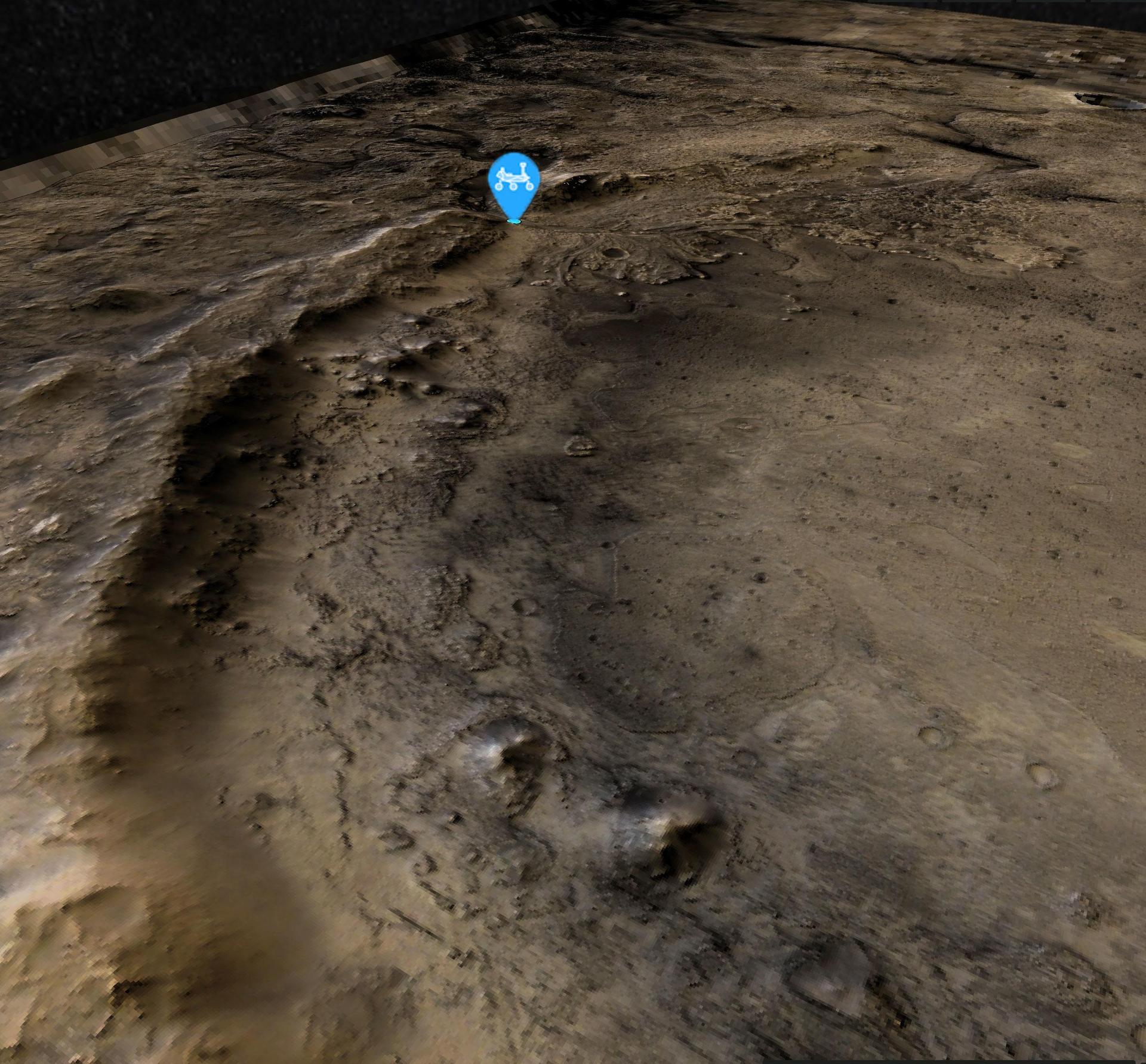
Long before Jezero Crater held a lake, before the delta that drew Perseverance there in the first place had even begun to form, the ground beneath it was being hammered. Repeatedly. Violently. And according to a new study from NASA's Perseverance rover team, the evidence of that hammering is still sitting in plain sight on the crater's rim — a layered slab of bedrock more than 3.9 billion years old that scientists say is among the oldest terrain any Mars rover has ever examined up close.
The formation has been nicknamed the "Broom Point member," and it is not subtle. At 245 feet (75 meters) thick, it stacks six distinct rock types on top of one another — breccias, fine pulverized dust, and layers shot through with tiny dark glassy beads that researchers say rival material found at Earth's Chicxulub impact site, the crater linked to the extinction of the dinosaurs. The layers themselves are tilted at more than 80 degrees from horizontal, a geometry that doesn't happen by accident.
"During this violent era, it wasn't rain or snow falling from the sky, but an almost constant barrage of molten rock droplets," said Alex Jones, the study's lead author, in comments released by NASA's Jet Propulsion Laboratory.
Reading the Rock: A Two-Impact Story
The steep tilt of the Broom Point layers is the detail that makes this more than just another catalog of ancient debris. According to the research team, the sequence records what they describe as a "one-two punch" — two separate, massive impacts whose effects are stacked into the same slice of crust.
The first blow came from the formation of the Isidis Basin, an impact structure roughly 1,200 miles (1,900 kilometers) across — a scar so large it dwarfs Jezero Crater's own 28-mile (45-kilometer) diameter many times over. That impact is thought to have tilted the rock that would become the Broom Point sequence. Later, the impact that carved out Jezero Crater itself fractured and further uplifted the same material, pushing it into the steeply angled orientation Perseverance now sees exposed on the rim.
Ken Farley, Perseverance's deputy project scientist at Caltech, framed the discovery in terms of what makes Mars a uniquely useful archive. "Mars lacks plate tectonics to recycle its crust, this ancient record remains intact, giving us a rare glimpse into a geological time period that doesn't exist on our own planet," Farley said, according to a press release from the American Geophysical Union (AGU), which published the findings.
On Earth, tectonic recycling, weathering, and billions of years of erosion have erased nearly all direct evidence of the intense bombardment that pummeled the inner solar system in its early history. Mars, without moving plates to grind that crust back into the mantle, appears to have simply kept the receipt.
How the Rover Got There
Perseverance landed in Jezero Crater in 2021 and spent its early years investigating the crater floor and the remnants of a river delta that once fed a lake there. The rover reached the crater rim itself later — accounts place the arrival at the rim in late 2024, with detailed exploration of the rim terrain, including the Broom Point outcrop, getting underway in early 2025.
That climb up and along the rim put the rover's instruments in contact with rock that predates the crater-forming impact — material that had already been shaped and reshaped before Jezero even existed as a depression in the landscape. The gas-bubble cavities noted in the once-molten rock, alongside the glassy impact beads, are treated by the team as physical confirmation that this material was subjected to the kind of heat and pressure only a major impact event can produce.
As part of the campaign, Perseverance drilled and stored two rock cores from the sequence, informally named "Bell Island" and "Main River." Both are being held in the rover's sample cache. The AGU release and follow-on reporting note the cores' relevance to potential future Mars Sample Return efforts — actually dating this material precisely requires the kind of laboratory equipment that doesn't fit on a rover, meaning any confirmation of Broom Point's exact age will have to wait until, and unless, samples make the trip back to Earth.
The peer-reviewed study, titled "Stratigraphy Preserved on the Jezero Crater Rim Reveals Repeated Impacts on Early Mars," was published July 15, 2026, in the Journal of Geophysical Research: Planets, with Alexander J. Jones of Imperial College London as lead author.
Why It Matters
The early solar system was a genuinely dangerous place. During the period roughly 4.1 to 3.8 billion years ago known to planetary scientists as the era of heavy bombardment, asteroid and comet impacts battered the young rocky planets at a rate almost impossible to picture today. Earth almost certainly endured the same pummeling Mars did, but plate tectonics has spent the intervening billions of years subducting, folding, and eroding that record into obscurity. What happened during Earth's most formative geological chapter has largely been erased from Earth itself.
Mars, lacking that recycling machine, offers something close to a preserved crime scene. A single outcrop like Broom Point — with its six rock types, its impact glass, and its two overlapping deformation events legible in the tilt of the layers — lets scientists reconstruct a sequence of events (basin-forming impact, then crater-forming impact) with a level of physical detail that has no equivalent on Earth. That has implications beyond Mars: understanding how often and how hard the inner solar system got hit during this period informs models of when and how conditions favorable to life could have stabilized on any of the rocky planets, including our own.
It also sharpens the case for Mars Sample Return. The "Bell Island" and "Main River" cores are, for now, informed guesses about age based on geological reasoning and stratigraphy. Only precise radiometric dating in an Earth-based lab can turn "more than 3.9 billion years" into a firm number — and firm numbers are what let this kind of story move from a compelling narrative to a calibrated timeline of solar system history.
