
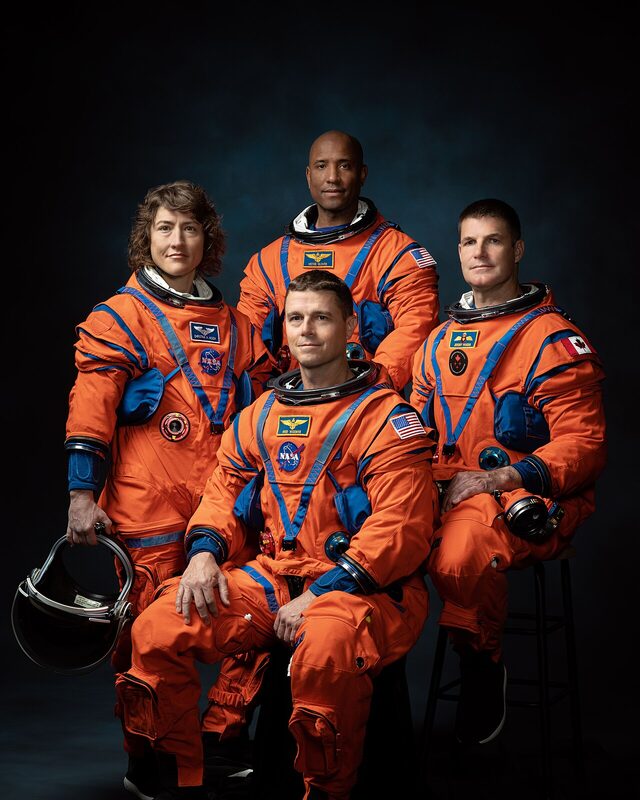
On Tuesday, June 9, at NASA's Johnson Space Center in Houston, the agency will introduce the astronauts assigned to Artemis III. The names will lead every headline. The more revealing story is what those astronauts are actually being asked to do — because Artemis III is not, any longer, the mission most people still picture.
For years Artemis III was shorthand for one thing: the first crewed return to the surface of the Moon since 1972, boots in the south-polar regolith. That is no longer what the flight is designed to accomplish. NASA has recast Artemis III as a test flight whose central objective is to demonstrate that its Orion crew vehicle can rendezvous and dock with a commercial Human Landing System — the maneuver on which any real landing depends. The first crewed touchdown has slid to Artemis IV, now targeted near the lunar south pole around 2028.
Why the mission changed shape
The reframing is not a loss of nerve; it is an admission of sequence. A crewed landing requires a lander that works, and the landers are the long pole. NASA does not build them — it buys the service, from SpaceX's Starship variant and Blue Origin's Blue Moon. Neither has yet demonstrated the full chain a landing needs: reaching orbit, refueling there, and executing a crewed descent. With both providers wrestling this year with their flagship rockets, the lander timeline, not the Orion timeline, governs when astronauts can land. Rather than let the whole program wait, NASA split the difference: fly the crew, prove the docking, and land on the next mission once a lander is ready.
It helps that the pieces ahead of Artemis III are no longer hypothetical. Artemis II has already flown its crew around the Moon, validating Orion and the Space Launch System with people aboard. Artemis III inherits that confidence and adds the next untested link — joining Orion to a separately launched lander in space, a docking between two large vehicles that has to be routine before it can ever precede a descent.
The docking itself is no formality. Joining two large crewed-class vehicles in space — aligning, closing, and latching Orion to a lander that launched separately — is a maneuver the United States has not performed in deep space since Apollo, and never with the specific hardware Artemis uses. Get it wrong and there is no landing; get it routine and the surface mission that follows inherits a solved problem instead of an open risk. That is the logic of spending a crewed flight on a rehearsal: the riskiest new step in the chain gets its own dedicated test, with people aboard to prove the systems behave as they will on the day it counts.
What to listen for on June 9
When the crew is announced, the substantive questions are not about personalities but about profile. Will Artemis III practice that docking in the vicinity of the Moon, or closer to home? Which lander will it rendezvous with, and is that lander on a schedule that matches the crew's? The answers will say more about the program's health than the roster does. A crew assignment is a commitment of years; naming one now signals NASA's confidence that the flight will happen on a horizon worth training toward.
There is also a human dimension worth keeping in view. The astronauts named this week will spend years rehearsing a flight whose definition has already shifted once. That is the nature of a program stretched across administrations, budgets, and the readiness of commercial partners — all variables that have moved the landing date before and may again. The trajectory back to the Moon is real and, with Artemis II behind it, further along than it has been in fifty years. But the cadence remains the open question, and Artemis III's redefinition is the clearest signal yet of how NASA is managing the gap between ambition and hardware. The names will be the celebration. The mission profile is the news.
