
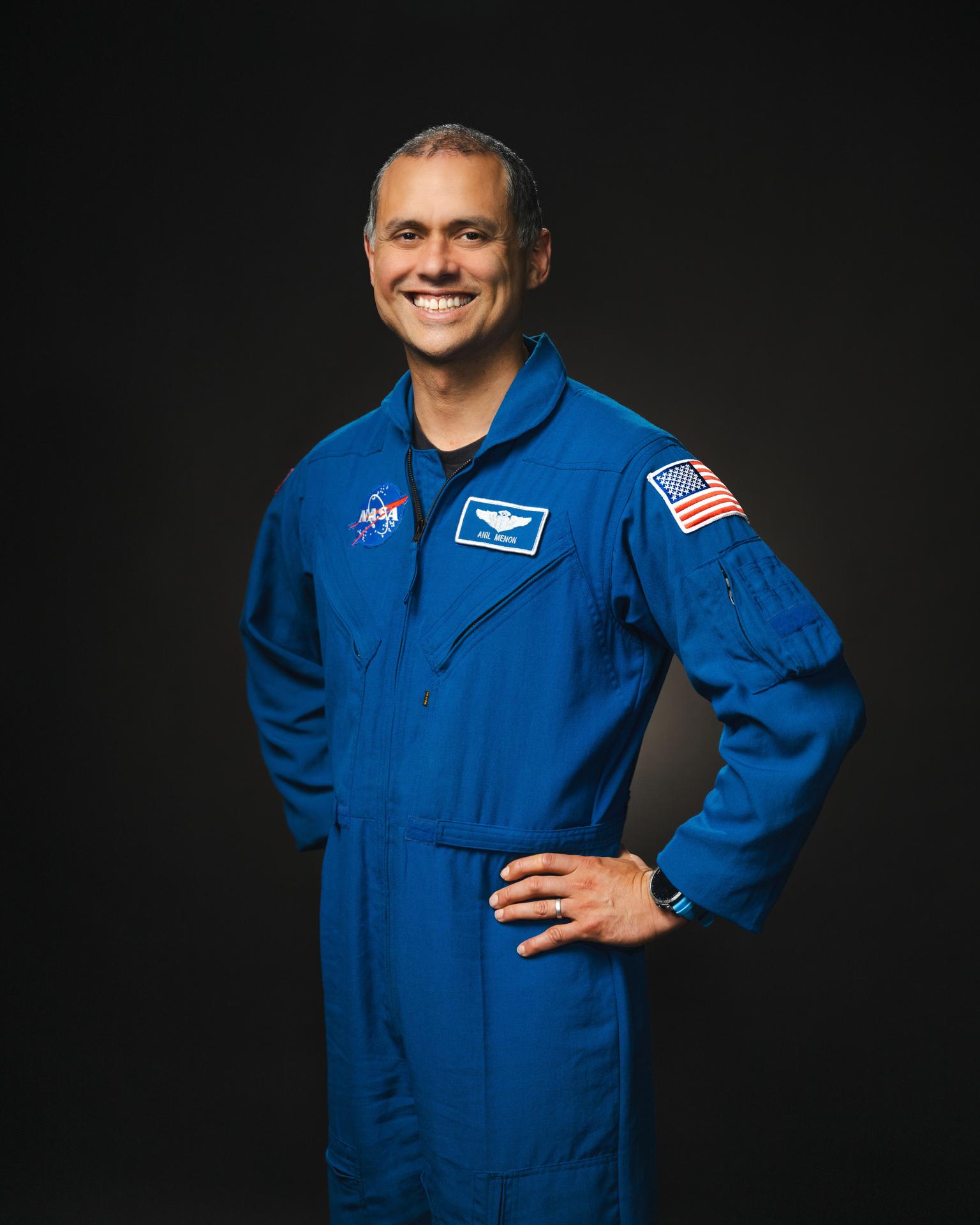
NASA astronaut Anil Menon has spent years taking care of other people's trips to space. On July 14, he finally gets his own — and he's getting there the old-fashioned way, strapped into a Russian Soyuz capsule instead of a NASA-contracted Crew Dragon.
According to NASA Media Advisory M26-051, published July 9, 2026, Menon will launch aboard Soyuz MS-29 from the Baikonur Cosmodrome in Kazakhstan at 10:47 a.m. EDT on July 14. He'll be joined by Roscosmos cosmonauts Pyotr Dubrov and Anna Kikina, both of whom have flown before. The capsule is scheduled to dock at the International Space Station's Prichal module at 1:56 p.m. EDT that same day, with hatch opening about two hours later at 3:55 p.m. EDT.
It's a short commute for a long stay. Menon, Dubrov and Kikina are slated to remain aboard the station for roughly eight months as part of Expedition 74/75, with a return to Earth expected in April 2027.
A Doctor Who's Treated Astronauts — Now Joining Them
Menon's path to his first mission is unusual even by astronaut standards. Born in Minneapolis to Indian and Ukrainian immigrant parents, he holds a neurobiology degree from Harvard, a master's degree in mechanical engineering, and an M.D. from Stanford, according to a Tech Times profile of the astronaut. He completed residencies in both emergency and aerospace medicine. Before joining NASA's astronaut corps, Menon worked as SpaceX's first flight surgeon, helping certify Crew Dragon for human flight during the 2020 Demo-2 mission and attending recovery for four crewed Dragon flights. He's also a colonel in the U.S. Space Force and, even now, continues practicing emergency medicine at Memorial Hermann's Texas Medical Center in Houston.
That combination — a spacecraft-company flight surgeon turned station crewmember, still moonlighting in a hospital ER — makes Menon something of a hybrid figure in an astronaut corps increasingly stocked with commercial spaceflight veterans. His seat assignment, however, has nothing to do with SpaceX. He's flying under the long-running NASA-Roscosmos seat-sharing agreement that puts American astronauts on Soyuz vehicles and Russian cosmonauts on American ones, a practice that has continued largely uninterrupted even as the two countries' broader relationship has soured.
The Science Manifest
Per NASA's advisory, Menon's research portfolio during Expedition 74/75 spans several distinct threads: semiconductor crystal production in microgravity, AI-assisted ultrasound imaging, studies of blood flow under weightlessness, and work with bioprinted vascular constructs — lab-grown tissue structures that mimic blood vessels. None of the specific experiment names, principal investigators, or expected findings were detailed in the advisory, but the mix reflects the station's usual balance of materials science and human-health research, the latter made more urgent by his own medical background.
One Complication: A Broken Robotic Arm
The July 14 date wasn't always a sure thing. A Tech Times report published June 29 — citing the same July 14 timeline, converted to 2:43 p.m. UTC — detailed a roughly six-and-a-half-hour spacewalk scheduled for June 30, about two weeks before launch, to replace a failed wrist joint on Canadarm2, the ISS's robotic arm. The joint had been drawing motor current without producing movement since a May 27 malfunction, and NASA determined it could only be fixed by astronauts working on it directly, not remotely.
Canadarm2 is used for a wide range of station operations, including berthing unpiloted cargo vehicles and assisting with external maintenance, so the joint failure was not a trivial fix. The Tech Times report framed the spacewalk as a prerequisite rather than a routine, unrelated task: without a working arm, the station couldn't safely manage the logistics of the incoming crew swap. NASA's own July 9 advisory — issued more than a week after that spacewalk date — confirms the July 14 launch remains on schedule, indicating the repair cleared the way as planned.
Why It Matters
On the surface, this is a routine crew rotation — one more three-person swap in a station partnership that has run continuously for a quarter-century. But it's a useful snapshot of where that partnership stands in 2026. Even with Crew Dragon flying regularly and Boeing's Starliner in the mix, NASA still sends astronauts to Baikonur, and Roscosmos still sends cosmonauts to Florida, because the seat-swap arrangement gives both agencies a guaranteed presence on the station regardless of which vehicle happens to be grounded or delayed. Menon's flight is a small, concrete demonstration that this redundancy still functions as intended.
Menon himself is also a data point in a broader shift in astronaut backgrounds. A commercial-sector flight surgeon — someone who spent years on the ground crew, not the flight crew, of a private launch company — is now headed to orbit himself. As commercial spaceflight matures, more of NASA's astronaut corps is likely to arrive with resumes that include time at SpaceX, Blue Origin, or other private operators rather than exclusively military test-pilot or research-scientist tracks.
Finally, the Canadarm2 wrist-joint issue is a reminder that even routine ISS operations run on aging, single-string hardware that occasionally needs an urgent spacewalk fix before life goes on. The station is well past its original design lifetime, and dependencies like this one — a functioning robotic arm being a precondition for a crew launch — are exactly the kind of thing that becomes more common, not less, as the outpost ages.
