
Most of what planetary scientists know about the first solids in the Solar System comes from rocks they can hold. Meteorites carry grains called calcium-aluminum-rich inclusions, or CAIs, which are the oldest known Solar System solids. Working out how those grains formed has meant reasoning backward from the finished product. A new observation from the Atacama Large Millimeter/submillimeter Array (ALMA) shows the process from the other direction: around a young, massive star in Orion, the same kind of material seems to be turning from solid into gas.
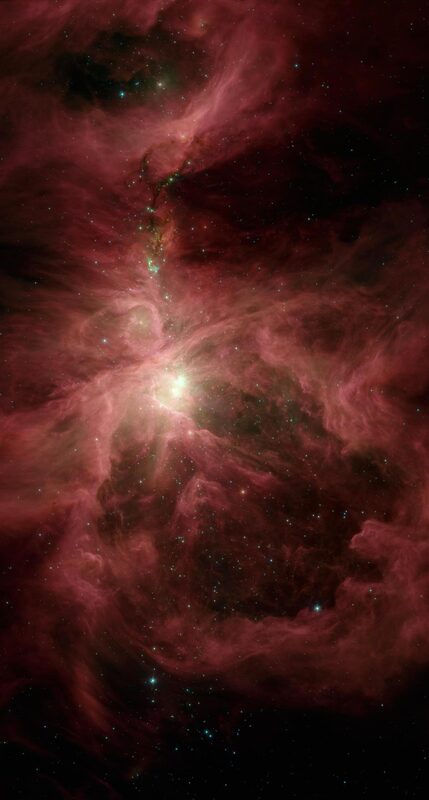
A team led by Ziwei E. Zhang and Nami Sakai of RIKEN, with Tomoya Hirota of the National Astronomical Observatory of Japan's (NAOJ) Mizusawa VLBI Observatory, reports the first detection of titanium monoxide (TiO) in a star-forming region. The target is Orion Source I, a massive protostar about 1,350 light-years away. The results appeared in The Astrophysical Journal Letters on October 23, and NAOJ announced them in November.
"We're seeing the rock evaporate from solid into gas," said Adam Ginsburg, an associate professor at the University of Florida. Ginsburg identified the system and developed some of the analysis techniques the team used.
What the telescope actually saw
The team detected three rotational emission lines of TiO. These are spectral signatures produced as the molecule changes its rotational state. Seeing more than one line makes the identification much firmer than a single feature would.
Where the molecule sits matters as much as the detection itself. According to the paper's abstract, the TiO emission is spatially resolved within roughly 50 astronomical units of the protostar. The ALMA Japan release says the TiO is concentrated near the base of a rotating disk wind, the outflow of gas lifting off the disk that surrounds the young star. Its distribution in both position and velocity matches that of aluminum monoxide (AlO), which has also been observed in this source.
That match is the key to the result. Titanium and aluminum are both characteristic elements of CAIs. When two molecules made from the defining ingredients of the oldest Solar System solids show up together, in the same compact region close to a forming star, it fits the idea that refractory material is being vaporized there.
Getting the measurement was not easy. The ALMA Japan release notes that the detection required some of the highest frequencies ALMA can observe, including its Band 10 receiver, which was developed with a leading contribution from a research team at NAOJ.
The numbers behind "efficient"
The quantitative results go beyond a simple detection. The team measured a TiO column density of (3.0 ± 0.4) × 1015 molecules per square centimeter. They also compared TiO with silicon monoxide (SiO), finding a ratio of XTiO/SiO ≈ (12.8 ± 1.7) × 10-3.
The comparison point is CI chondrites, a class of meteorite whose composition is a standard reference for Solar System elemental abundances. The measured TiO-to-SiO ratio is higher than the Ti/Si ratio in CI chondrites. The authors read this as a sign of efficient dust-to-gas conversion near the protostar. In other words, titanium-bearing solids are not just shedding a little material at the edges. Enough is being vaporized that titanium appears over-represented in the gas compared with silicon.
The obvious caveat is that this is an approximate estimate. The paper notes that it rests on only three transitions, that the gas near the outflow base is probably out of local thermodynamic equilibrium, and that the SiO abundance used came from much lower-resolution observations, so the derived ratio could be considered an upper limit. A molecular ratio in gas is also not the same thing as an elemental ratio in a rock. Even so, the authors conclude that the inferred abundance implies efficient conversion of titanium- and silicon-bearing dust to gas around the disk.
Seeds first, volatiles later
The broader context is a long-standing picture of how planetary building blocks form. As Universe Today explains in its coverage, elements that stay stable at high temperatures, such as calcium, aluminum, and titanium, are thought to form dust first, with more volatile material such as water accreting later. In that sequence, refractory "seed" grains come early, which is one reason CAIs are considered so old.
The paper's title, "Dust-seeding Molecules in a Massive Protostar," points to the same framework. The authors describe TiO and AlO as key dust-seeding refractory molecules. Watching them where refractory solids are being destroyed gives astronomers a physical setting where that early chemistry can be studied directly instead of only inferred from meteorites.
Orion Source I has already produced chemical surprises. The University of Florida notes that salty compounds, including salt in gaseous form, were previously found coming from the same disk, another sign that unusually hot, mineral-derived chemistry is going on close to the star.
Why It Matters
The most important claim may be methodological. According to the University of Florida, this is the first region in which scientists have been able to determine the composition of solid materials outside the Solar System without collecting a sample and bringing it back to Earth. For our own Solar System, getting a solid's composition usually means having the rock in hand, whether from a meteorite fall or a spacecraft that brings material back. Here the composition is read from gas that used to be solid.
That makes a comparison possible. As Ginsburg says in the University of Florida and Universe Today coverage, researchers can now start comparing their measurements with how the Solar System formed, where ratios between elements can be measured because the rocks can be brought into a lab. If the ratios line up, that would support the view that CAI-like solids form through broadly universal high-temperature processes around young stars. If they differ, it would raise questions about how typical the early Solar System was, or about which stellar environments produce which kinds of primitive grains.
Some care is needed. Orion Source I is a massive protostar, and the Sun was not. Conditions within 50 au of a young massive star are not a simple stand-in for the early solar nebula. The value of the observation is not that Orion Source I is a copy of our past. It is that it gives a real, measurable case of refractory minerals vaporizing, which models of CAI formation can now be tested against.
The result is also a reminder of what high-frequency radio astronomy can now do. Three molecular lines, resolved within about 50 au of a star 1,350 light-years away, are enough to put numbers on a process that until now was mostly reconstructed from meteorites.
Sources
- Traces of Vaporized Minerals Found 1,350 Light-Years Away (ALMA Japan / NAOJ)
- Dust-seeding Molecules in a Massive Protostar: Detection of TiO in Orion Source I (The Astrophysical Journal Letters)
- Vaporized rock in space (University of Florida News)
- Detection of Vaporized Rock Reveals the Birth of a Solar System (Universe Today)
