
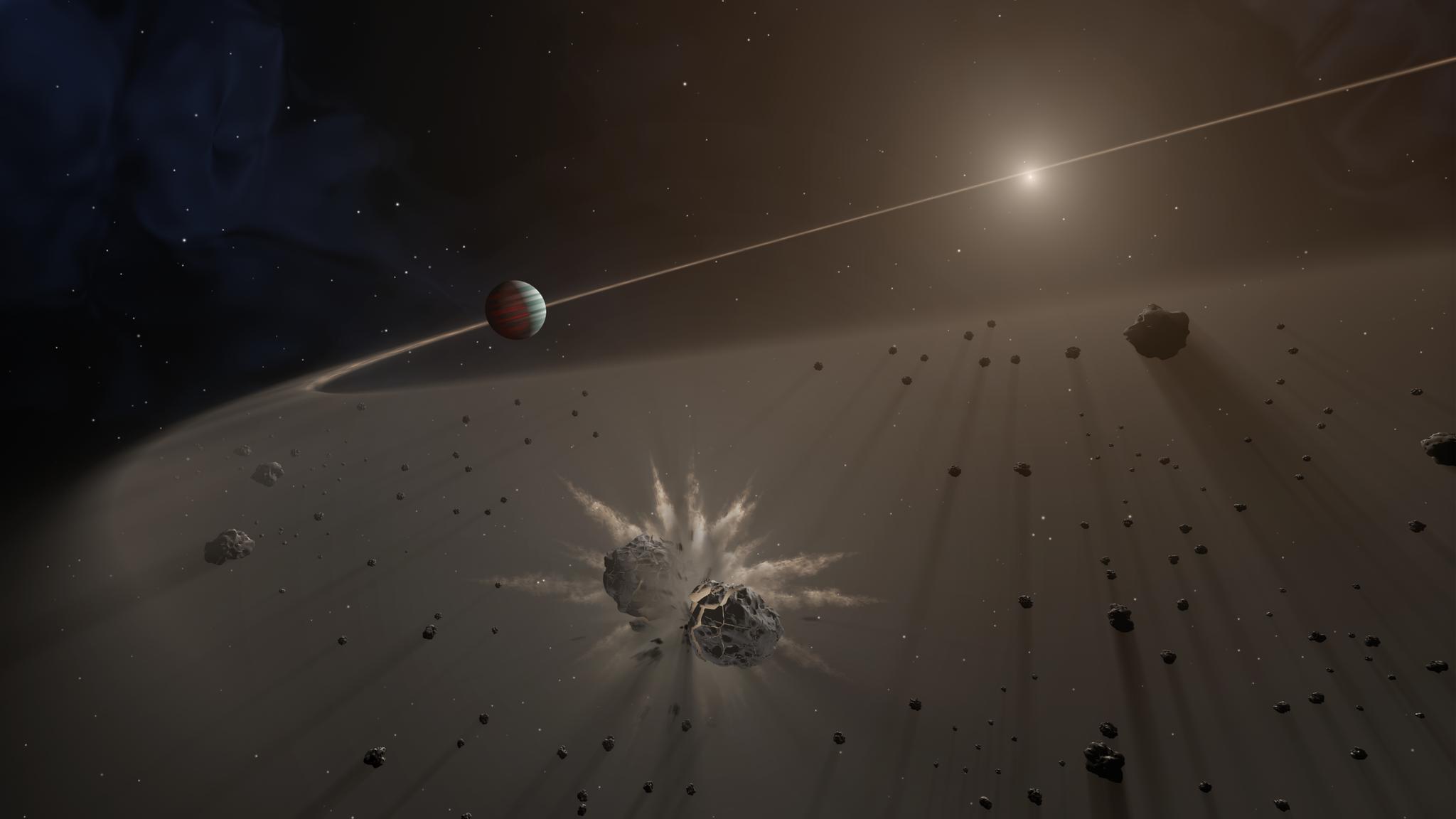
Planet formation is supposed to take time. Dust grains have to stick together, clumps have to grow into pebbles, pebbles into planetesimals, and eventually a body massive enough to pull in a thick envelope of gas has to assemble itself out of the swirling disk around a young star. The textbook estimate for how long a Jupiter-sized planet needs to pull that off has hovered around 5 million years — a number drawn from the youngest confirmed giant planets on record, a pair orbiting PDS 70 and another pair around WISPIT 2.
A newly confirmed world just blew past that number by a wide margin.
In a paper published Sept. 16, 2026, in The Astrophysical Journal Letters, a team led by Andrea Bernardi, a PhD candidate at Universidad Diego Portales in Chile, confirmed Elias 2-24 b: a Jupiter-sized planet less than one million years old, still embedded in the gas-and-dust disk of its host star, Elias 2-24, roughly 450 light-years from Earth. It is, by a comfortable margin, the youngest exoplanet ever found.
How They Found It
Elias 2-24 b wasn't spotted in a single dramatic observation. Bernardi's team, working with co-author Lucas Cieza, built the case by returning to archival images that had been sitting in the data vaults of W. M. Keck Observatory since 2018 and 2020. Those images came from Keck's NIRC2 instrument paired with a coronagraph — a mask that blocks out the overwhelming glare of the host star so that much fainter, closely orbiting companions can be seen.
The team then layered in data from the Atacama Large Millimeter/submillimeter Array (ALMA) and the European Southern Observatory's Very Large Telescope (VLT), which together map the structure of the disk itself: its gaps, gas motions, and dust distribution. Combining the direct-imaging evidence of a planet with the disk data confirmed both the planet's presence and its remarkably young age.
The planet sits about 55 times farther from Elias 2-24 than Earth sits from the Sun, placing it in the outer reaches of a disk that is, by planetary standards, barely out of the oven.
Why the Age Matters More Than the Discovery
Finding another giant exoplanet is not, on its own, headline material at this point — astronomers have catalogued thousands. What makes Elias 2-24 b different is the number attached to it: less than 1 million years, against a previous record of about 5 million years held jointly by two planets around PDS 70 and two around WISPIT 2.
That's not an incremental record. It's a fivefold-or-greater cut to the fastest known formation timeline for a gas giant. Current models of giant planet formation — built around the slow accretion of solids followed by runaway gas capture — generally assume a giant planet needs on the order of 5 million years just to reach the mass and size seen here. Elias 2-24 b did it, or at least got far enough along to be detected as a Jupiter-sized body, in a fifth of that time or less.
Why It Matters
Planet-formation timelines aren't just academic bookkeeping — they're load-bearing assumptions in models of how solar systems, including our own, come together. If giant planets can reach Jupiter-scale sizes in under a million years, then the processes that build them — whether that's core accretion, gravitational instability in the disk, or something else — have to work faster than the standard models allow, or a different formation pathway is at play entirely. Either way, a single confirmed case like Elias 2-24 b is enough to force a re-examination of the timing constraints that go into every simulation of how gas giants, and the systems around them, take shape. Keck Observatory's own description of the find — a planet "still forming around its young star, offering a rare glimpse into the earliest stages of planetary formation" — underscores that this isn't just a new entry in an exoplanet catalog. It's a live snapshot of a process astronomers usually only get to reconstruct after the fact, once a system has already settled into its mature configuration.
What Comes Next
Because Elias 2-24 b is still embedded in its natal disk, it offers a target for follow-up observation that a fully formed, disk-free planetary system can't provide: astronomers can watch the surrounding gas and dust directly, correlating disk structure with the planet's own growth. Further ALMA and VLT observations, along with continued direct imaging, should help pin down whether Elias 2-24 b is an outlier — a fluke of a particularly fast-forming system — or a sign that giant planets across the galaxy come together faster than current models predict.
