
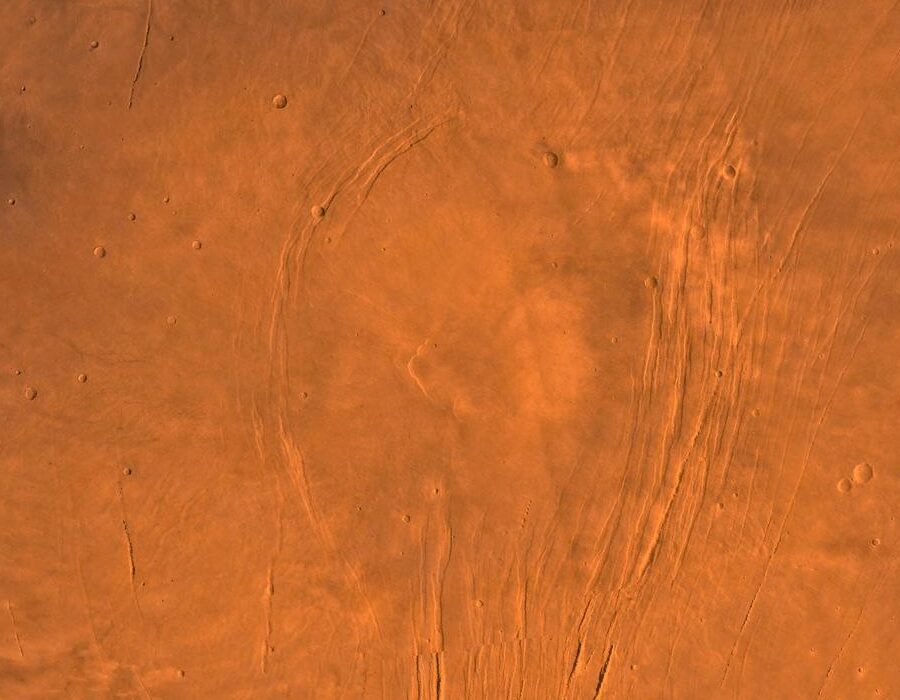
Mars has the biggest volcanoes in the Solar System and no eruption anyone has ever seen. That has long been one of the planet's stranger contradictions. Olympus Mons rises about 26 kilometres and spans roughly 600 kilometres, and Alba Mons, also in the Tharsis region, is the largest Martian volcano by area. Yet nobody has watched lava move on Mars or caught a plume rising from one of these peaks. The usual assumption has been that the planet's volcanic engine wound down long ago.
A paper published on 4 November in Science Advances complicates that picture. Using the European Space Agency's ExoMars Trace Gas Orbiter (TGO), a team led by Alexander Trokhimovskiy reports hydrogen chloride (HCl) gas rising over fresh fissures on the flanks of Alba Mons, at a time of year when the gas should not be there. The researchers interpret it as magmatic degassing: volcanic gas slowly escaping from a system that is dormant but not extinct.
"Our findings suggest that Mars has retained enough internal heat to support volcanic activity until recently, and possibly still does," said co-lead Daniel Mège of the Space Research Centre of the Polish Academy of Sciences, in ESA's announcement.
A gas with a known routine, behaving out of turn
Hydrogen chloride is not new to Mars science. TGO first reported HCl in the Martian atmosphere in 2021, and since then the gas has followed a seasonal pattern that researchers tie to the planet's dust and water cycles. That background routine is what makes the new signal stand out.
Over Alba Mons, the orbiter's Atmospheric Chemistry Suite (ACS) infrared spectrometers picked up HCl spikes in early northern summer, just after the winter frosts sublimate, which breaks the usual seasonal pattern. According to Sci.News, the gas appeared at parts-per-billion levels during the cold aphelion season. Those are tiny concentrations, but a localised spike in the wrong season was enough to draw attention to what was happening on the ground below.
Cracks nobody had catalogued
The atmospheric data alone would have been suggestive. What makes the case is the imagery. TGO's own camera, CaSSIS, showed fresh, narrow fissures on the volcano's flanks, in some cases hundreds of metres long, with colour changes along them. The team also drew on images from HiRISE and CTX. Together the images show fissures, some only tens of centimetres wide, grouped into swarms tens of kilometres long that run along topographic ridges. Sci.News reports that features like these had not been identified on Mars before.
Mège described the search in blunt terms in a statement sent to Space.com: "The TGO was able to find the smoking gun. It was like looking for a needle in a haystack."
Why it shows up in summer
The timing has an explanation, and it will be familiar to anyone who has studied fumaroles on Earth. In winter, when temperatures on the volcano drop as low as -120 °C, ice is thought to seal the fissures and trap the gas. As the season turns and that ice sublimates, the trapped gas escapes. So the HCl is not tracking a sudden eruption. It is tracking the thaw of a cap sitting on top of a slow, steady leak.
The leak is modest. Assuming HCl lasts about one sol in the Martian atmosphere, the team estimates a seepage rate below 3 kilograms per second. Sci.News notes that this sits at the low end of terrestrial volcanoes, which typically emit anywhere from a few kilograms to more than 100 kilograms per second. Mars, if this reading is correct, is barely exhaling, but it is exhaling.
The case for a sleeping magma chamber
The interpretation the team favours is a dormant magma chamber beneath Alba Mons that is still releasing volatiles through cracks in the overlying rock. That would fit with earlier, indirect lines of evidence. As Space.com summarises, researchers had already found signs that some Martian volcanoes were active within the last few million years, and seismic monitoring has recorded marsquakes. What was missing was a direct sign of a volcanic system doing anything today.
The seepage interpretation also answers an awkward question: if Mars has live volcanism, why haven't thermal surveys found hot spots? Sci.News, which quotes Nicolas Thomas of the Universität Bern on how the finding fits into the Martian chlorine cycle, points out that this kind of low-level degassing does not require a strong thermal signature. A cold surface with gas slowly leaking through it would look ordinary to an instrument searching for heat. In other words, earlier searches may have been looking for the wrong sign.
Caveats still apply. The detection is of a trace gas at parts-per-billion levels, and the seepage estimate depends on an assumed atmospheric lifetime for HCl. The volcanic reading is the team's argument for why the gas appears where and when it does. It is not a direct observation of magma. But the combination of an out-of-season chemical spike, fresh fissures directly beneath it, and a plausible ice-seal mechanism makes a coherent case that is hard to explain with dust and water cycles alone.
Why It Matters
Whether Mars is geologically dead shapes how scientists model its interior, its thermal history and its atmosphere. If Alba Mons is still degassing, the planet has held on to more internal heat than a simple cooling story would predict, and the volcanic record of the last few million years may be part of activity that has not fully stopped.
There is an astrobiology angle too. Space.com notes that a dormant magma chamber could support hydrothermal environments, places where heat and water meet underground. Mège told Space.com that looking for Martian life in the seeping fissures of the Alba Mons region "would make a lot of sense." A volcano that is still venting gas could give that search a specific target.
And for TGO itself, the result is a strong argument for long-baseline monitoring. The 2021 HCl detection set up a seasonal baseline, and only against that baseline could a localised, out-of-season spike be recognised. Finding the anomaly required years of knowing what normal looked like.
