
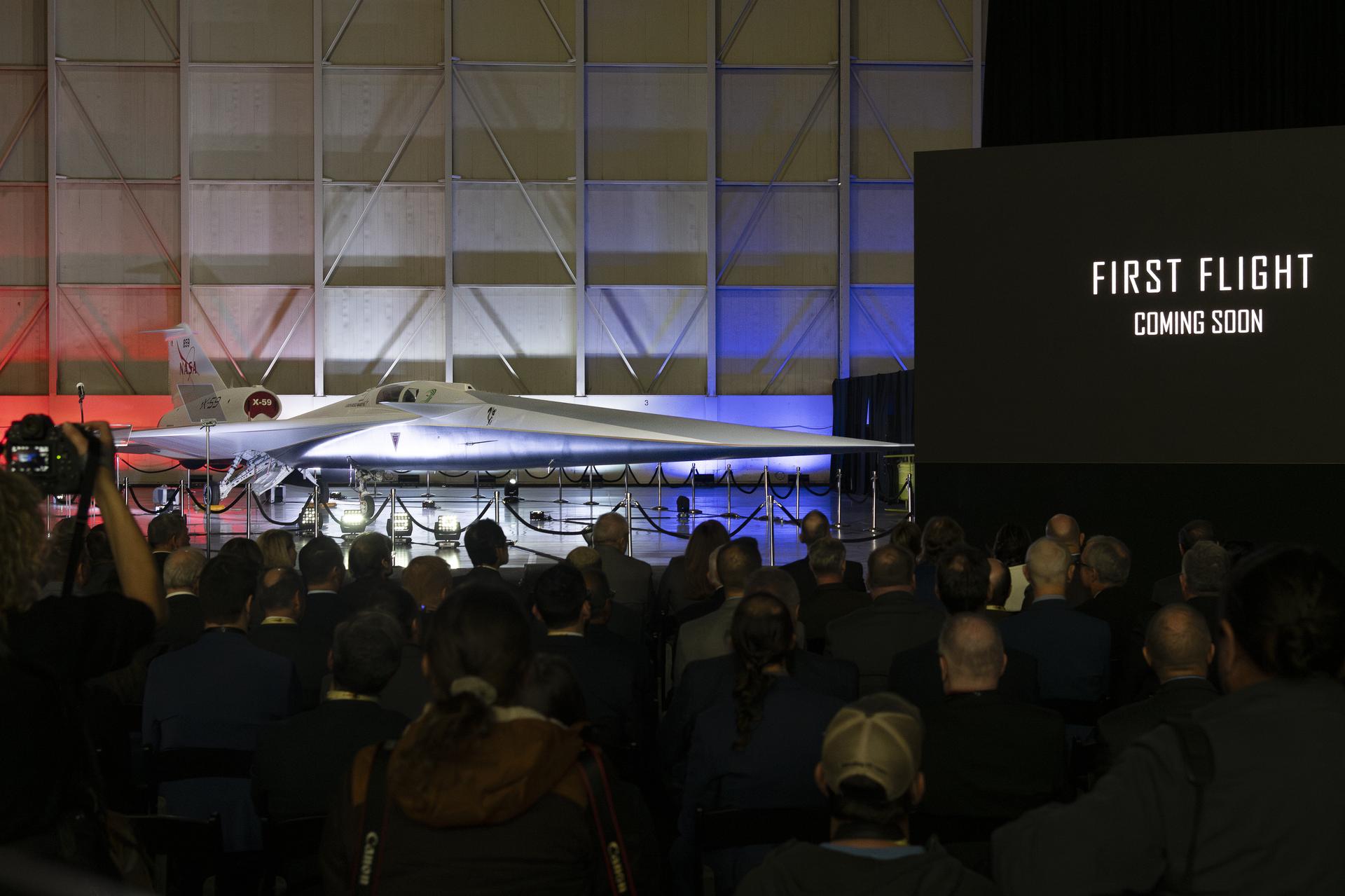
For decades, "sonic boom" has meant one thing to most people: a sudden, window-rattling crack that made supersonic flight over populated areas a nonstarter. NASA wants to change that association, and on August 10 the agency's Quesst mission team published a detailed explainer laying out the physics behind why its X-59 experimental aircraft is expected to produce something very different — a soft, delayed thump rather than a boom.
The piece, posted to the official Quesst mission blog, is less a news update than a physics lesson aimed at the public ahead of the community overflight tests the X-59 is being built to support. It walks through what a sonic boom actually is, why the X-59's shape changes the outcome, and why the timing of what people hear on the ground matters as much as the loudness.
What's Actually Happening When a Plane "Breaks the Sound Barrier"
According to NASA's explainer, the popular image of a sonic boom — a single, instantaneous crack at the moment a jet "breaks the sound barrier" — is a misconception. There is no one barrier-breaking instant that generates the sound. Instead, an aircraft moving faster than sound continuously generates pressure waves as it pushes through the air, and those waves merge into shock waves that travel outward and downward, eventually reaching the ground as what listeners perceive as a boom. The sound isn't produced at a single crossing point; it's produced continuously, for as long as the aircraft is supersonic.
That distinction matters for how NASA has approached the X-59's design. If the shock waves that make it to the ground can be kept weak and spread out in time, rather than merging into one sharp spike, the result isn't a crack — it's closer to a dull thump, or as other coverage of the aircraft's test milestones has described it, something more like the sound of a car door closing.
How the Numbers Work: 55,000 Feet, One Minute Later
NASA's explainer includes specifics on how that translates to a real flight. The X-59 cruises at roughly 55,000 feet — well above commercial airliner altitudes — and because of the distance the pressure waves have to travel down through the atmosphere, the resulting sound doesn't reach the ground until about a minute after the aircraft has actually passed overhead. That delay is a direct consequence of the altitude and the physics of how the shock waves propagate, and it's a detail NASA is flagging explicitly for the communities that will eventually hear the aircraft fly over during upcoming test flights: the sound people notice will lag well behind the moment the plane is actually above them.
Why NASA Is Publishing a Physics Lesson
The explainer isn't just public outreach for its own sake. NASA states plainly that the data gathered from community responses to the X-59's flights will be shared directly with regulators, who will use it to help set new noise-based standards for supersonic flight over land. That's the entire point of the Quesst mission: current rules effectively ban civil supersonic flight over land because of boom noise, and NASA's approach to lifting that restriction isn't to argue the rule should be relaxed — it's to build an aircraft quiet enough that regulators can write a new noise threshold around it, then prove the aircraft meets it in front of real communities.
That's also why the explainer spends so much time on the "why" of the physics rather than simply asserting the aircraft will be quiet. Community members who will hear the X-59 fly over are also, in effect, being asked to serve as data points in a regulatory process — and NASA appears to be betting that explaining the minute-long delay and the mechanics of shock-wave merging ahead of time will make the eventual thump less startling and the resulting survey data more useful.
Why It Matters
The X-59 doesn't need to be popular to succeed technically, but any future business case for a supersonic airliner revival — something a new noise-based standard would help make possible — depends on regulators agreeing that a quiet enough boom can be permitted over populated areas. That agreement, in turn, depends on real people on the ground reporting that what they heard was tolerable, not alarming. A one-minute gap between an aircraft's flyover and the sound it produces is exactly the kind of detail that could confuse survey respondents or skew community feedback if it isn't explained beforehand. By publishing the underlying physics now, ahead of the community flight tests, NASA is trying to make sure the data regulators eventually receive reflects genuine reactions to the aircraft's acoustic signature rather than confusion about timing. In a program where the entire regulatory outcome hinges on public perception data, that kind of groundwork isn't incidental — it's part of the experiment.
