
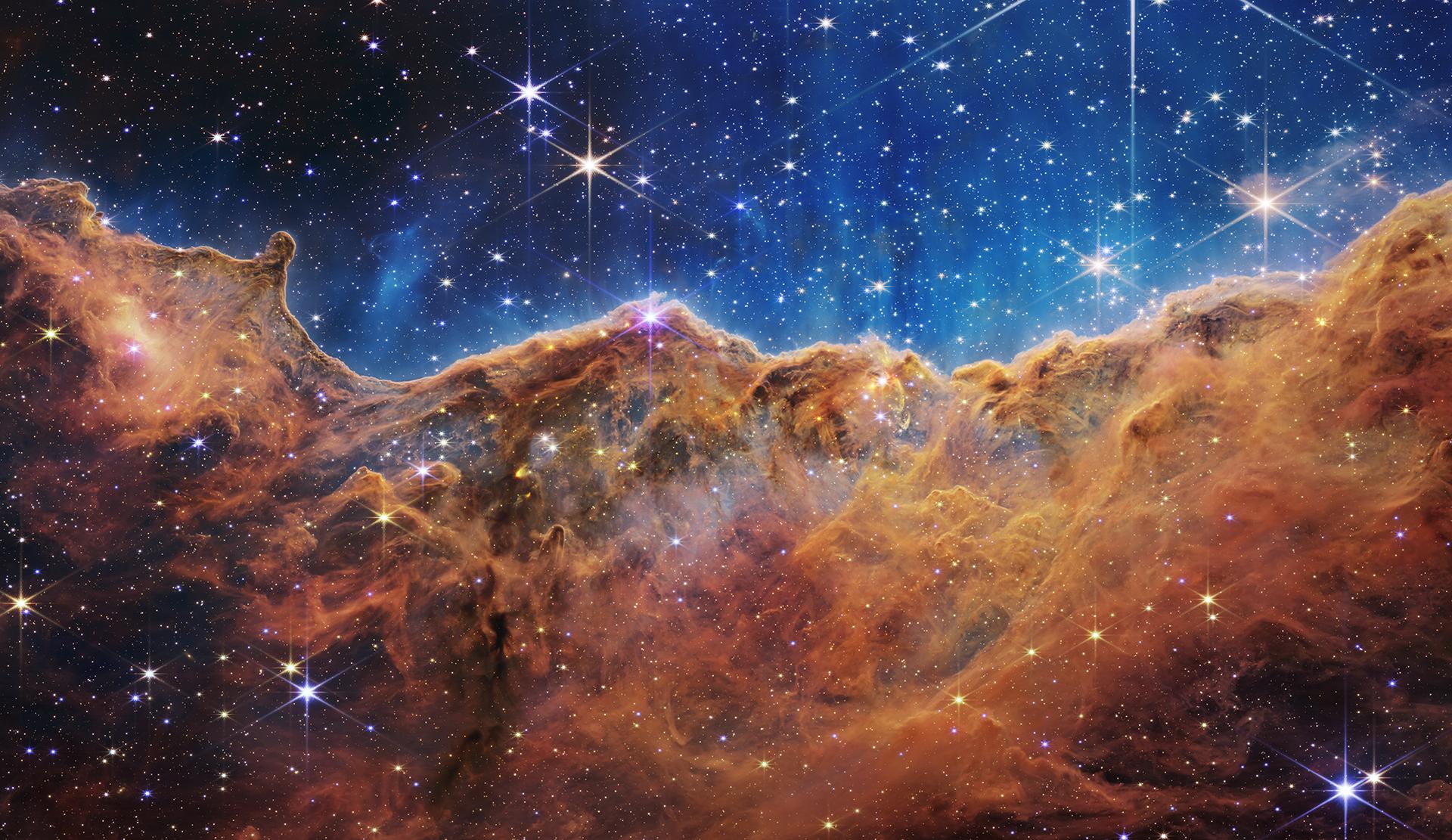
Point a visible-light telescope at the right patch of the Carina Nebula, near the towering formation known as the Cosmic Cliffs, and you'll see mostly darkness — a dense, isolated knot of gas and dust called a cometary globule, its contents hidden behind a wall of obscuring material. Point the James Webb Space Telescope at the same spot, and the darkness turns out to be full of stars.
NASA released the image on August 21, 2026, built from data the telescope's Near-Infrared Camera (NIRCam) captured on August 6. The agency has nicknamed the object the "Treasure Chest," and the name is not just marketing copy. Where earlier observations showed little more than a dark, comet-shaped smudge with a dense head and a sweeping tail, Webb's infrared vision — tuned to wavelengths that slip through dust that blocks visible light — cracked the lid open. Inside: a compact cluster of roughly 70 young stars, huddled together some 7,500 light-years from Earth.
The image credits researcher M. Reiter, with an acknowledgement to M. H. Özsaraç, and was produced jointly by ESA, NASA, and the Canadian Space Agency as part of Webb's ongoing survey of the Carina Nebula — a sprawling stellar nursery roughly 260 light-years across, the nearest high-mass star-forming region to Earth, and home to tens of thousands of protostars alongside some of the Milky Way's most massive stars.
What exactly is a cometary globule, and why does it hide stars?
Cometary globules are a recognizable feature of turbulent star-forming regions like Carina. They form when intense radiation and stellar winds from massive, already-formed stars nearby erode a surrounding cloud of gas and dust unevenly, sculpting it into a dense head with a tail streaming away — something like a windsock made of interstellar material, pointing away from whatever is blasting it. The head stays dense enough to shield its interior from the same radiation that carved it, and it's exactly that density that makes the object opaque at visible wavelengths astronomers have traditionally relied on.
That opacity is also what makes cometary globules interesting: dense pockets of gas and dust are where stars form. The Treasure Chest's head has been collapsing and fragmenting into stars for some time, but until Webb turned its infrared instruments on it, most of that activity was invisible.
A young cluster, and one heavyweight member
Follow-up analysis reported alongside the image, drawing on the new infrared data, pegs the cluster's age at about 1.3 million years old — a substantial revision upward from an earlier estimate of roughly 100,000 years. In stellar terms, 1.3 million years is still extremely young; for comparison, the Sun is about 4.6 billion years old. But the correction matters for anyone trying to model how clusters like this one evolve, since getting the age wrong by more than an order of magnitude throws off calculations of how far along the stars are in shedding their birth material and settling toward the main sequence.
The standout among the roughly 70 stars is an O-type star weighing in at about 19 times the mass of the Sun. O-type stars are the rarest and most massive class on the main sequence, blue-white and furiously luminous, and they are vanishingly uncommon compared to smaller stars like the Sun. Finding one anchoring a compact, still-forming cluster gives astronomers a rare close-up look at how the most massive stars shape the environments they're born into — including, potentially, the very cometary globule that once hid the cluster from view.
Discs that might become worlds
Beyond the census and the age revision, the image's most forward-looking detail may be this: many of the smaller stars in the cluster still show circumstellar discs — the flattened rings of leftover gas and dust that swirl around a young star before gravity, collisions, and time turn some of that material into planets. Discs like these are the observational starting point for planet formation, and catching dozens of them at once, in a single young cluster, offers a snapshot of planetary systems at their earliest and most uncertain stage.
Why It Matters
Webb was built in large part to solve exactly this kind of problem: seeing through the dust that has always hidden the first moments of star and planet formation from optical telescopes. The Treasure Chest image is a compact demonstration of that capability. A region that looked like an empty dark patch to previous generations of instruments turns out to contain nearly 70 stars, a rare massive O-type star, and a scattering of planet-forming discs — details that reshape both the age estimate for the cluster and the broader picture of how a single stellar nursery can produce objects across such a wide range of masses at once. Every disc Webb catches intact is also a data point for the far larger question of how common planetary systems are, and how early in a star's life the raw material for those systems starts taking shape.
