
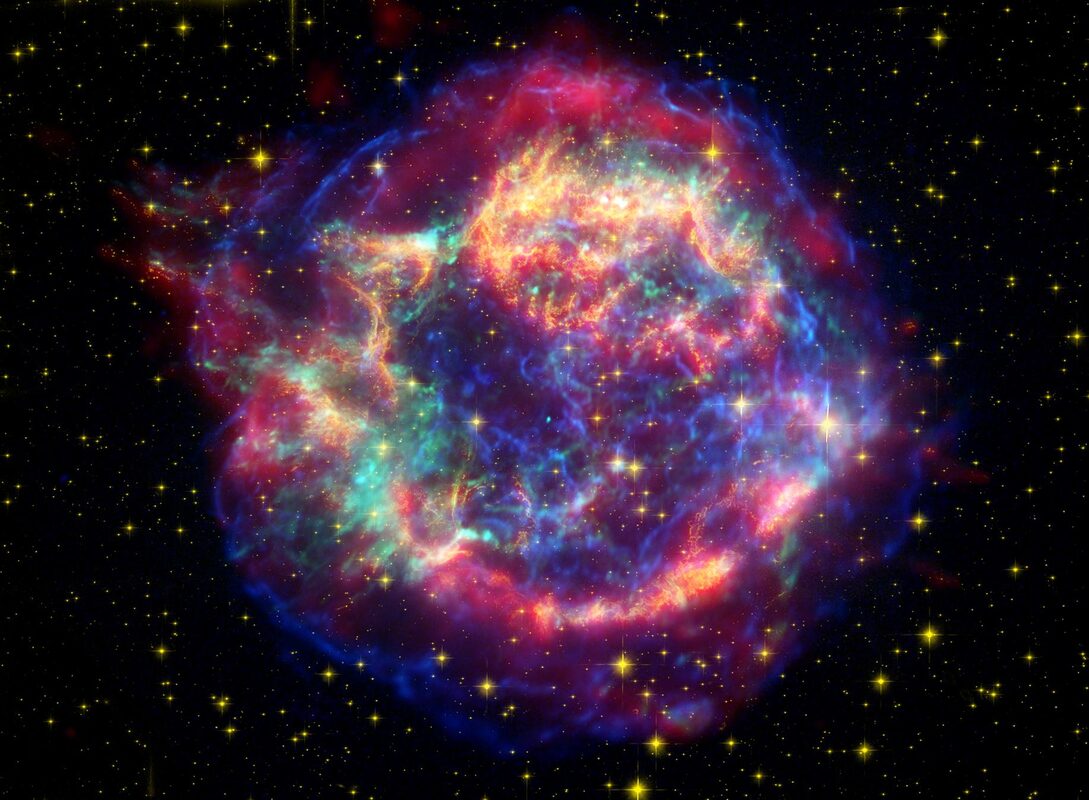
A massive star's inside is usually pictured as layers, with each shell burning a different fuel around the core. Just before the core collapses, though, that layering may not hold. A new study using NASA's James Webb Space Telescope argues that the star that became the Cassiopeia A supernova remnant had some of its inner shells merge shortly before it exploded, and that the evidence is still there in the dust.
The paper, titled "JWST Resolves Dust Emission from Individual Ejecta Clumps in Cassiopeia A: Dominant Grain Compositions Point to a Shell Merger in the Progenitor," was published Monday, Nov. 23, in The Astrophysical Journal Letters. Tea Temim of Columbia University is the lead author. Her co-authors include Richard Arendt, Dan Milisavljevic, Danielle Dickinson, J. Martin Laming, Ilse De Looze, Christopher Fryer and Mikako Matsuura.
Reading a star's history in its dust
Dust may seem like an odd place to look for clues about the final hours of a star's life. But as NASA explains, a star's shells hold different elements, and when the star goes supernova those elements are scattered into space, where some condense into dust grains. If the ejecta in one place are mostly oxygen and silicon, they will form different dust than ejecta rich in carbon. So a map of grain types is also, roughly, a map of how the elements were spread through the debris.
That is what Webb's Mid-Infrared Instrument (MIRI) provided. Its mid-infrared observations of Cassiopeia A were sharp enough to separate the dust emission from individual ejecta clumps, not just give an average over large regions. The team used earlier data from NASA's retired Spitzer Space Telescope to choose three regions to study in detail.
- Two regions in the reverse-shocked ejecta. One was dominated by silica dust and the other by carbon dust. A reverse shock is an inward-moving shock wave that collides with debris thrown outward by the supernova, so these regions sample the star's own ejected material.
- The "Green Monster." This structure was first discovered by Webb. It is rich in complex magnesium silicates, and NASA describes it as made of material the star shed before it exploded, not of supernova ejecta.
The main result comes from the contrast between the two ejecta regions. In a star with neatly separated shells, you would expect clean chemical boundaries in the debris. The paper compares the dust-derived abundances with models of explosion nucleosynthesis and finds they favor progenitors that underwent a carbon-oxygen shell merger, adding to the growing evidence for that scenario in Cassiopeia A.
What a shell merger means
"Material within these shells churns and circulates, which can cause the shells to merge shortly before the supernova explosion," Temim said in NASA's announcement. "So, for example, the oxygen- and carbon-burning shells in a star merge together and change the structure of the star significantly," she added, which would change the chemical abundances seen in the ejecta afterward. Once two burning layers combine, their material mixes, so the debris that leaves the star does not look like it came from an untouched onion.
Co-author Dan Milisavljevic of Purdue University said the resolution Webb provides lets researchers "tie the explosion back to the makeup of the progenitor star hundreds of years afterward," telling them about what was happening, he said, "in the hours leading up to core collapse." That timeframe is the striking part. These are not changes over thousands or millions of years. They are rearrangements in the star's interior that happened close to the end, and they left a signature that can still be read in the remnant.
The Webb study does not stand alone. NASA says it builds on X-ray observations from NASA's Chandra X-ray Observatory and the JAXA-led XRISM, and that signatures of the merger appear throughout much of the remnant rather than in one isolated patch. The researchers also present the dust-composition approach as a new method for inferring how a progenitor star was structured inside.
An independent X-ray check
A separate preprint posted to arXiv in October 2026 reaches a compatible conclusion by a different route. Kuboike, Sato and Matsunaga used deep Chandra X-ray data to study the oxygen-rich ejecta in Cassiopeia A. They found that the oxygen- and silicon-rich ejecta are well reproduced by oxygen-layer material in presupernova models of 17 to 20 solar masses that experienced strong shell-merger-induced burning and mixing. Ejecta rich in neon, by contrast, retain more neon and magnesium and resemble less strongly processed oxygen-shell material.
The two components are not evenly mixed. According to the preprint, they are spatially segregated on remnant-wide scales, with the neon-rich ejecta concentrated toward the north and the oxygen- and silicon-rich ejecta more prominent in the southeast. That suggests the star's interior was uneven in its final stages, with some regions heavily reworked by the merger and others much less so. Dust and X-rays trace different physics, so agreement between them makes the case stronger than either would alone.
The Green Monster, briefly
The Green Monster is mostly a side story here, since it is circumstellar material and not ejecta. It is still worth explaining. An August 2026 arXiv paper by Orlando, Janka, Milisavljevic, De Looze, Temim and colleagues used 3D hydrodynamic simulations to test how its odd hole-and-ring structures formed. In one scenario they examined, fast-moving knots of ejecta punch through a dense shell of circumstellar material, producing holes and rings. The observed structures are about 1 to 3 arcseconds across, or roughly 0.016 to 0.048 parsecs.
The authors conclude that no single idealized scenario explains all the features. The simulated structures are also short-lived, becoming significantly distorted within 30 to 60 years after the forward shock passes.
Why It Matters
Astronomers can't look inside a massive star in its last hours, and in a remnant like Cassiopeia A the star itself is gone. What remains is the debris, and the question has been how much of the progenitor's interior that debris still records. This work suggests that dust chemistry, resolved clump by clump, can answer some of that, and that it is consistent with what X-ray data show about the same ejecta.
If the method holds up, it gives researchers another way to test models of massive-star interiors, including how shell mergers right before collapse shape the material a supernova spreads into space. Several caveats apply. The Webb study looked closely at three regions chosen using Spitzer data, and the X-ray analysis is still an arXiv preprint submitted to a journal. Still, a dust map that records events from the hours before core collapse is an unusual and useful kind of evidence, and Cassiopeia A is a valuable test case for it.
Sources
- NASA's Webb Shows How Supernova Dust Chronicles Star Evolution (NASA Science)
- JWST Resolves Dust Emission from Individual Ejecta Clumps in Cassiopeia A: Dominant Grain Compositions Point to a Shell Merger in the Progenitor (The Astrophysical Journal Letters)
- Remnant-wide mapping of heterogeneous presupernova burning histories in the O-rich ejecta of Cassiopeia A (arXiv)
- Deciphering the 'Green Monster' in Cassiopeia A (arXiv)
