
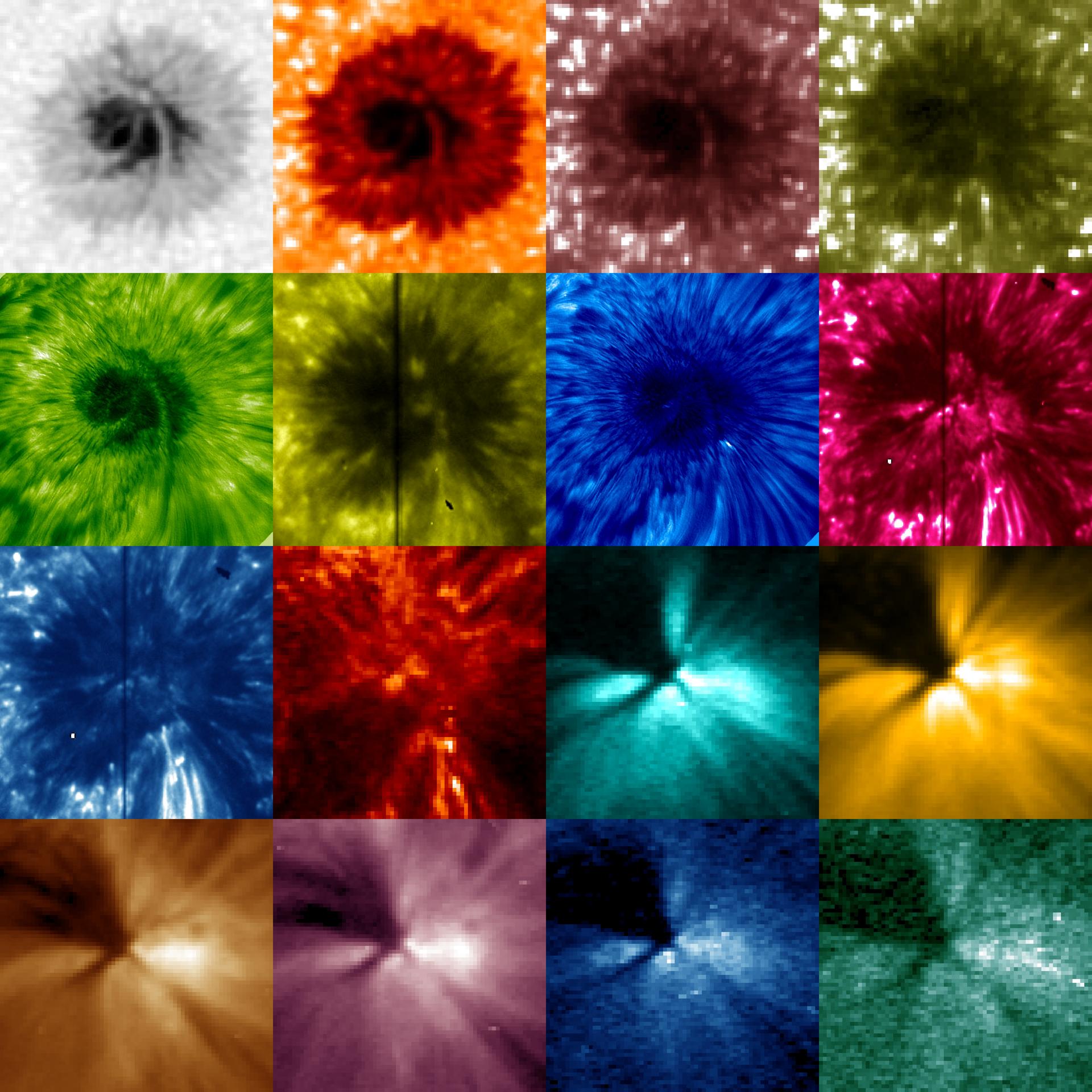
Seen in the red light of hydrogen-alpha, the area around a sunspot keeps moving. Thin dark spikes called dynamic fibrils shoot up out of the chromosphere, slow down, stop and fall back, usually within a few minutes. Solar physicists have long suspected that these jets are driven from below, by waves that leak upward out of the sunspot. A new study from Yunnan Observatories of the Chinese Academy of Sciences (CAS) adds statistical support to that idea. It also shows that the direction of the local magnetic field changes how the jets behave.
The work appeared in The Astrophysical Journal on November 10, according to CAS, and a preprint by Guotang Wu, Xiaoli Yan and colleagues was posted to arXiv on November 13. The team tracked 176 individual dynamic fibrils around one sunspot. They measured how fast each jet rose, how hard it braked, how far it reached and how long it lasted. They then compared the rhythm of the fibrils with the waves that ripple outward across the sunspot's penumbra.
An hour of watching one sunspot
The observations come from a single day, January 10, 2023. On that day the New Vacuum Solar Telescope (NVST), in southwestern China, imaged active region NOAA 13182 in H-alpha for just over an hour. It took a snapshot every 45 seconds, Universe Today reports. The researchers combined that ground-based view with extreme-ultraviolet imaging and vector magnetic field maps from NASA's Solar Dynamics Observatory (SDO). Universe Today adds that the study also drew on China's CHASE satellite.
The combination matters. H-alpha shows the chromosphere, where the fibrils form. SDO's extreme-ultraviolet imaging shows hotter layers above, up into the corona, and the vector magnetic field data reveal how the field is oriented around the sunspot.
What a typical fibril looks like
Averaged over all 176 events, the preprint reports these values:
- Maximum velocity: 15.9 ± 4.5 km/s
- Deceleration: 120 ± 43 m/s²
- Maximum length: 1.13 ± 0.48 megameters, or about 1,130 km
- Duration: 270 ± 63 seconds, about four and a half minutes
That deceleration is less than half of the Sun's surface gravity of roughly 274 m/s², and the gap is informative. A jet that was simply thrown upward and then fell freely along a vertical field line would slow down at the full gravitational rate. The weaker braking is consistent with material moving along field lines tilted away from vertical, pushed by a disturbance and not just coasting.
Most of the jets traced a single clean arc in time-distance plots. CAS reports that 132 of the 176 fibrils followed single-parabolic paths: up, slow down, back down. The other 44 showed multi-parabolic motion, with more than one rise-and-fall cycle in the same structure.
The correlation that points to shocks
The clearest result is a relationship between two quantities. Fibrils that launched faster also decelerated harder. The team found a positive correlation with a coefficient of ρ = 0.71, which CAS describes as consistent with shock-driven models.
Shock-driven models of dynamic fibrils hold that sound-like waves from below travel upward along magnetic field lines into the thinning chromosphere. There they steepen into shocks and kick plasma upward. In that picture, a stronger shock gives the plasma a faster start and more apparent deceleration afterward, which would tie the two quantities together in the way the team observed. Universe Today describes the mechanism as waves that grow steeper and stronger until they "break," each breaking wave producing a magnetoacoustic shock that pushes chromospheric plasma upward.
Keeping time with the penumbra
The second line of evidence is timing. Sunspots carry oscillations, and in the penumbra these appear as running penumbral waves, ripples that spread outward from the dark umbra. CAS reports that the dominant oscillation period of one multi-parabolic fibril event was 287 seconds, while that of the running penumbral waves was 263 seconds. Universe Today describes the fibrils' rhythmic pulsing as almost matching the five-minute cadence of the running penumbral waves. The preprint states that the consistency between the periodicities of the fibrils and the running penumbral waves is identified for the first time.
A shared beat does not prove cause and effect. Still, combined with the velocity-deceleration correlation, it makes a consistent case. The authors conclude that their results support the interpretation that the fibrils are driven by slow magnetoacoustic waves, the field-guided version of ordinary sound waves.
Field tilt changes the jets
The magnetic data add a third finding. When the team sorted fibrils by local field orientation, those in regions of more vertical field showed larger decelerations and shorter periods. Fibrils in regions of more horizontal field showed the opposite: gentler braking and longer periods.
CAS says this difference may stem from the effect of magnetic field inclination on the acoustic cutoff frequency, which regulates how slow magnetoacoustic waves propagate. Universe Today says the result confirmed a long-standing theory about how magnetic tilt affects solar sound waves. A fuller test would need more sunspots than this one.
Why It Matters
Universe Today notes that the Sun's outer atmosphere is hundreds of times hotter than its surface. Explaining that difference, the coronal heating problem, remains one of the main open questions in solar physics, and the central issue is how energy gets from the Sun's interior to its upper atmosphere. Dynamic fibrils are one place where wave energy visibly does work on plasma.
The study does not solve coronal heating. It does tie a large, measured sample of chromospheric jets to a specific wave driver and to the magnetic geometry that shapes them. It also reports multiwavelength signatures of the events reaching from the chromosphere through the transition region to the corona. Universe Today notes that SDO observations showed corresponding signatures in gas heated to hundreds of thousands or even millions of degrees. The authors describe this as a potential contribution to energy transport and heating, not a confirmed one, and that caution is warranted for a single sunspot observed for about an hour.
The obvious next step is better resolution. Universe Today points to bigger ground-based telescopes such as the Daniel K. Inouye Solar Telescope, which it says can resolve the magnetic threads inside these jets. More sunspots, longer observing runs and sharper images would show whether the field-tilt pattern holds generally, and how much energy these small jets actually deliver upward.
CAS says the research was supported by the CAS Strategic Priority Research Program, the National Key R&D Program of China and other programs.
