
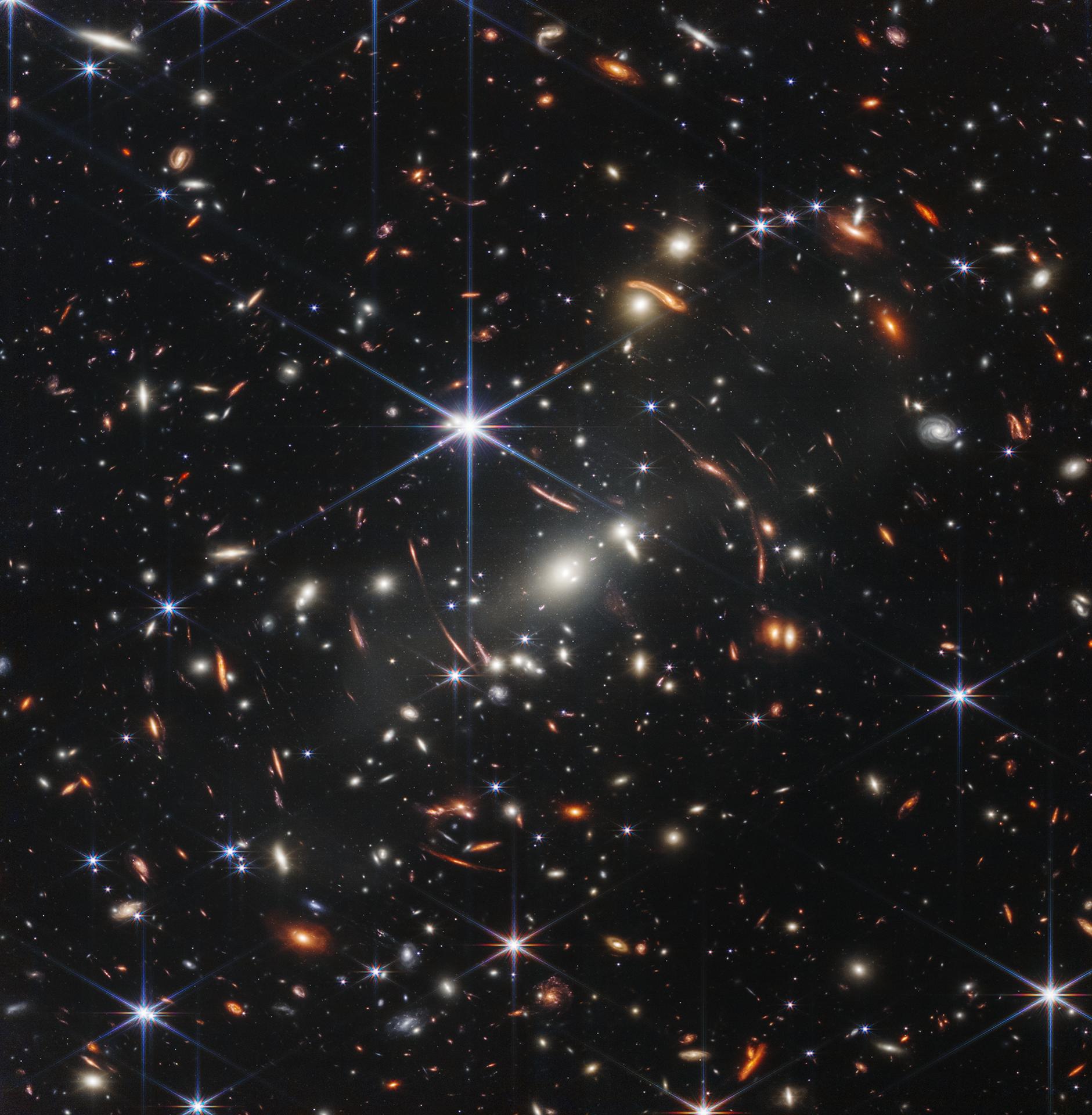
Some galaxy clusters act less like neighborhoods of stars and more like funhouse mirrors. ESA/Webb's Picture of the Month for September, released on Sept. 29, 2026, shows one of them: the cluster MACS J0454.1-0300, where the mass of the cluster bends the light of galaxies far behind it, smearing them into arcs and, in some cases, repeating them several times across the frame. The image has been titled "Galaxies in a cosmic house of mirrors," and this time the title is fairly literal.
The headline result is not just that the image is pretty. According to the ESA/Webb release, researchers have now found the same rare lensing arrangement twice in a single cluster, something not seen before.
What the image shows
MACS J0454.1-0300 sits in the constellation Orion, at a right ascension of 4h54m11s and a declination of -3d00m52s. Webb sees it as it was when the Universe was about 8 billion years old. The picture was taken with Webb's NIRCam instrument and covers a field of view of 2.22 by 2.15 arcminutes.
The orange galaxies scattered through the scene are a clue to the geometry. Those are objects lying far behind the cluster, not members of it. Their light has to pass through the cluster's mass on its way to us, and the cluster's gravity distorts that light. The result is the warped, stretched and duplicated shapes that give the image its hall-of-mirrors character.
Four images, twice
The key number is this: a single background galaxy showing up as four or more separate images happens in only 10 to 20 percent of galaxy clusters. It is a relatively uncommon configuration to begin with. Finding it once in a cluster is a modest stroke of luck. Finding it twice in the same cluster is, as far as the ESA/Webb release says, unprecedented: this is the first time the arrangement has been seen more than once in one cluster.
The two lensed systems are very different objects, and they sit at very different distances in cosmic time.
- A galaxy group seen 2 billion years after the Big Bang. The release describes this as an apparent merger accompanied by a burst of star formation.
- A single galaxy seen 800 million years after the Big Bang. This is the earlier, and so more distant, of the two.
Put against the cluster's own epoch of roughly 8 billion years after the Big Bang, both lensed systems are being observed as they were billions of years before the cluster light we see. The lensing lets Webb look through the cluster at objects that would otherwise be far harder to study.
Magnification that resolves the small stuff
Lensing does more than copy a galaxy. It also magnifies it. In this field, bright knots within the lensed galaxies are as small as 5 light-years across, and in some cases they are magnified by more than a factor of 300. That is a large boost, and it is what allows structures this small to be picked out in galaxies so far away.
The sources do not go into further detail about what those knots are, so we will not guess here. What the release does make clear is the scale involved: features only a few light-years wide, in galaxies seen at 800 million and 2 billion years after the Big Bang, made visible by a cluster whose light left when the Universe was about 8 billion years old.
Why It Matters
Gravitational lenses are natural magnifying glasses, and the quality of the view depends on how the lensing is arranged. Four or more images of one galaxy are a relatively uncommon outcome, turning up in only 10 to 20 percent of clusters. A cluster that produces that arrangement twice offers two such views at once, onto two different galaxies at two different epochs.
The magnification is the practical payoff. Clumps as small as 5 light-years across, boosted by more than 300 times in some cases, give researchers a way to examine very early galaxies at a level of detail that would otherwise be out of reach. One of the targets is a group that appears to be merging and forming stars in a burst, seen 2 billion years after the Big Bang. The other is a galaxy seen just 800 million years after.
There is also a statistical point. Because the four-plus-image arrangement is found in only a minority of clusters, a cluster that hosts it twice looks like a promising target for further study of the early Universe, though the sources do not say what follow-up is planned.
Independent coverage of the image, including a Sept. 29 piece from PetaPixel, also emphasizes the warped and multiplied galaxies of MACS J0454.1-0300 and calls it one of the best examples of gravitational lensing ever seen. The ESA and ESA/Webb pages remain the primary references for the numbers quoted here.
