
Astronomers have spent decades writing equations for one of the messiest events a binary star can go through: the moment one star swells up and swallows its partner. That phase, called common-envelope evolution, shapes many of the compact binaries we see today, but nobody had watched it unfold from start to finish. Now a team says it has. A paper published Nov. 18 in Nature describes AT 2025abao, a transient in the Andromeda galaxy nicknamed "Bao." In it, a star of about 0.7 solar masses spiraled into the envelope of a giant roughly seven times the Sun's mass. Telescopes followed the process for years before it ended in an eruption.
According to NASA, it is a first-of-its-kind stellar merger. The James Webb Space Telescope looked at the aftermath 47 days after the eruption peaked, the earliest follow-up of such an event ever made.
A big star and a small one
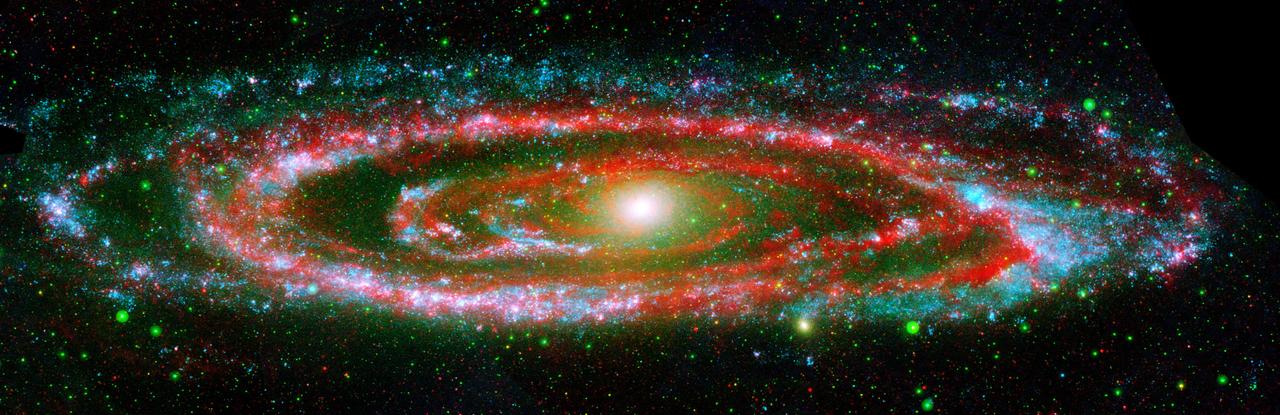
The system sits about 2.5 million light-years away, Space.com reports. The primary is a heavyweight. NASA puts it at seven times the Sun's mass, 350 times its radius and 18,000 times its brightness. The Nature abstract classifies it as an asymptotic giant branch (AGB) star, a late, bloated stage of stellar life. Some coverage simply calls it a red giant. The companion, which the team calls "Little Bao," is far smaller at about 0.7 solar masses.
The speed is what stands out. NASA says the two stars came together after only seven orbits, or about seven years. Other known binary mergers, involving two smaller stars, took thousands of orbits to finish.
Seven years of warning signs
Bao didn't come out of nowhere. Lead author Viraj Karambelkar, a NASA Hubble Fellow at Columbia University, and his colleagues had flagged the source well before it erupted. In a preprint submitted in May 2025, under the survey designations WNTR23bzdiq and WTP19aalzlk, the team traced a slow brightening over seven years:
- A 0.5-magnitude rise in optical light from 2018 to 2021.
- A 1-magnitude outburst from 2021 to 2023 that lasted about 1,000 days.
- A second 1-magnitude rebrightening in 2024.
- A 1-magnitude climb in mid-infrared light over ten years in NEOWISE data.
The preprint describes a progenitor with a surface temperature of about 3,500 K and a luminosity of about 16,000 Suns, consistent with an early-AGB star of 7 ± 2 solar masses. During the eruption, its luminosity rose to about 50,000 Suns. The authors suggested, cautiously and with a question mark in the title, that they might be seeing the onset of common-envelope evolution. The eruption in late 2025 followed that brightening.
NASA's timeline shows how many instruments were involved. The source was first caught in NEOWISE data in February 2023. The WINTER infrared survey recorded brightening and dust in September 2024. In July 2025, SPHEREx saw it fade in visible light while brightening in the infrared. The Zwicky Transient Facility detected the eruption on Oct. 17, 2025. Swift and Gemini North followed up in November, and Webb observed it on Dec. 24, 2025, using Director's Discretionary Time.
Friction as a power source
The physics behind the brightening is the most interesting part of the paper. According to the Nature abstract, the team's spectroscopy is best explained by the 0.7-solar-mass companion spiraling inward inside the giant's convective envelope. As the small star plowed through the giant's outer layers, drag converted orbital energy into heat, and that heat powered the seven-year rise in brightness. The authors call this one of the first direct observations of energy dissipated by frictional drag.
The final merger threw off the outermost 10 percent of the stellar envelope at about ten times the primary's escape speed, the abstract says. Space.com reports that the eruption expelled roughly 0.1 to 0.2 solar masses of material. Co-author Karel Temmink, a Ph.D. student at Radboud University, led the simulations, according to NASA; other co-authors include Kishalay De of Columbia and Nadia Blagorodnova of the University of Barcelona.
The result is not completely settled in every account. Space.com quotes Karambelkar saying that the stars merging is not the only possibility, and that both stars surviving in a much shorter orbit cannot yet be ruled out without continued monitoring. NASA's announcement describes the event as a merger and says Webb's data proved the stars merged, and the Nature abstract talks about the merger ejecting the outer envelope. Even so, the remnant is still being watched, and NASA says only future observations will show how it settles.
Why It Matters
Common-envelope evolution is how many compact binaries are thought to form. When one star engulfs another, theorists have to estimate how much of the energy released by the inspiral goes into ejecting the envelope. That estimate is usually written as a single parameter, alpha, and it affects predictions for which systems end up as tight binaries and which ones fully merge. NASA notes that astronomers have usually had to reverse-engineer such events that happened long ago.
Bao gives a measurement from an event watched in real time. The Nature paper constrains the fraction of dissipated orbital energy available to unbind the envelope to between about 0.01 and 0.4. That is still a wide range, but it comes from watching the process happen rather than reconstructing it afterward. The seven-orbit timescale is also a useful data point for anyone modeling how fast an inspiral can proceed in a massive giant.
The discovery also shows how much infrared surveys can do. Much of the early evidence came from NEOWISE, WINTER and SPHEREx, which picked up dust forming around the star while optical brightness dropped.
There should be more cases to come. NASA says the Nancy Grace Roman Space Telescope's Galactic Bulge Time-Domain Survey will yield a huge number of new transient events that could benefit from similar analyses, and Karambelkar expects "a large influx of similar discoveries just ahead." With a larger sample, astronomers could test whether Bao is typical or unusually fast and could tighten the range on alpha. The work was funded in part by a grant from NASA's Astrophysics Data Analysis Program.
The usual way to study stellar mergers has been to find the remnant and work backward. Bao is a case where astronomers watched the companion spiral in, measured the efficiency of the process, and had Webb observing 47 days after the eruption peaked.
Sources
- NASA Data Clinches First-of-Its-Kind Stellar Merger (NASA Science)
- An inspiral of a star inside a common envelope with its giant companion (Nature)
- The slow brightening of WNTR23bzdiq / WTP19aalzlk: Possible onset of common-envelope evolution in an AGB star? (arXiv)
- Astronomers witness a star eating its companion in 1st-of-its-kind observation (Space.com)
