
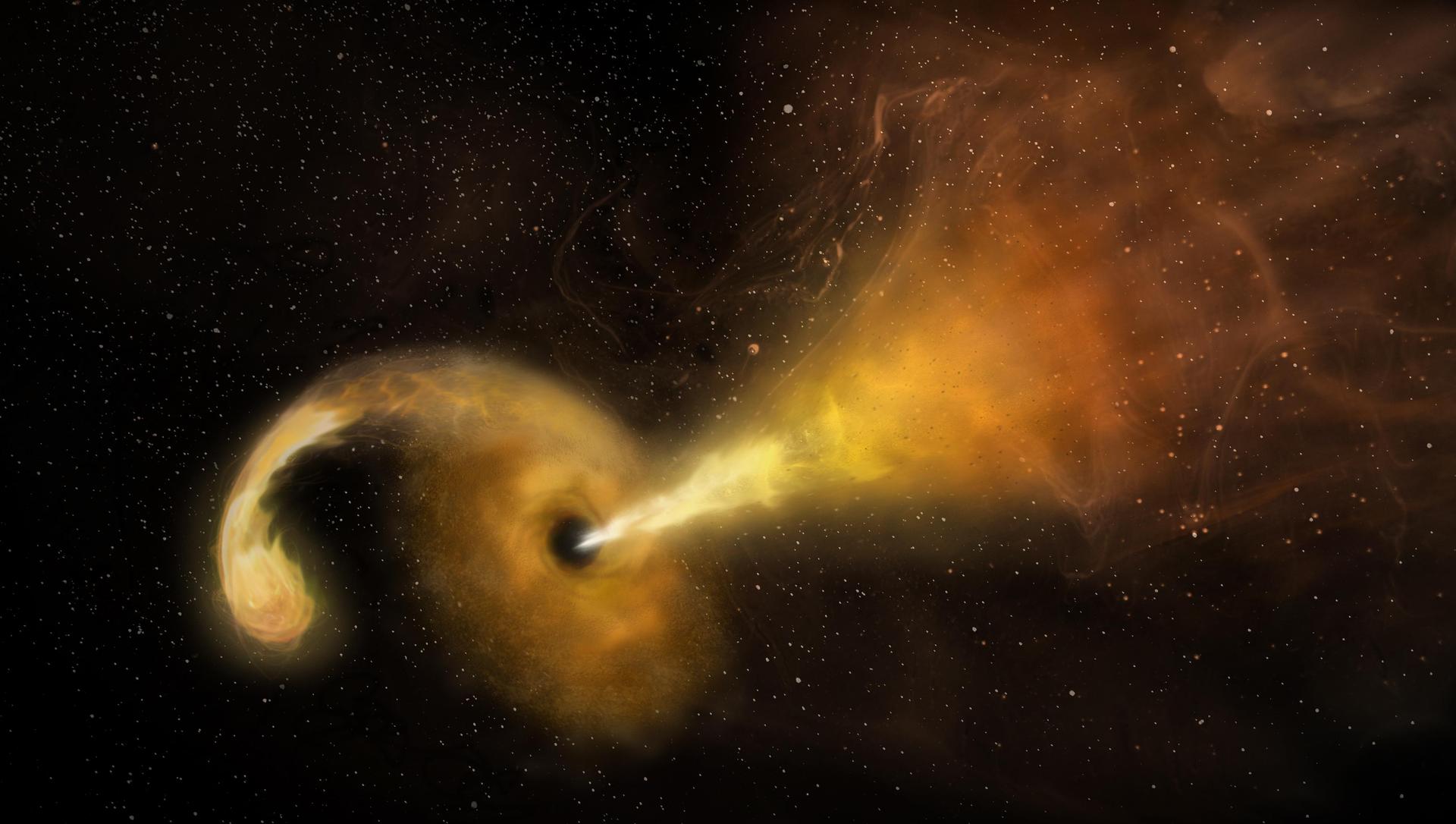
Every galaxy is supposed to keep its black hole where it belongs: dead center, anchoring the stars that orbit it. So when astronomers spotted a stellar-mass feeding frenzy erupting some 30,000 light-years off-center in a distant galaxy, the obvious question was what a black hole was doing way out there in the first place.
On July 27, NASA's Neil Gehrels Swift Observatory team, working with researchers led by the University of North Carolina at Chapel Hill, announced the answer: a black hole weighing roughly a million times the mass of the sun had apparently been ejected from the core of its host galaxy — likely during a past galactic merger — and was now shredding a star from its new, off-kilter address. The event, cataloged as TDE 2025abcr, marks the largest offset ever recorded for a tidal disruption event discovered through optical light. The findings were published July 27 in The Astrophysical Journal Letters.
What actually happened
The host galaxy, WISEA J014656.04-152214.7, sits about 750 million light-years away in the constellation Cetus — unremarkable by cosmic standards, until a star wandered too close to a black hole that had no business being where it was. Tidal forces stretched and ultimately tore the star apart, and the resulting debris, compressed and heated as it swirled toward the black hole, briefly outshone the entire host galaxy in ultraviolet light. At its peak, the flare reached roughly 10 billion times the sun's luminosity, with debris heated to about 54,000 degrees Fahrenheit (30,000 degrees Celsius).
The event was first flagged in November 2025 by the Zwicky Transient Facility (ZTF) at Palomar Observatory, using an AI classifier called "tdescore" — developed by Robert Stein at the University of Maryland and NASA Goddard — built to sift the flood of transient alerts for signatures specific to tidal disruptions. Follow-up confirmation came from Chile's 4.1-meter SOAR telescope, which nailed down the spectroscopic fingerprints — and the location — of the flare.
That location is the whole story. Tidal disruption events are typically found dead center in their host galaxies, because that's where supermassive black holes are supposed to live. TDE 2025abcr instead flared up more than 30,000 light-years from its galaxy's nucleus — the farthest offset ever observed for an optically discovered tidal disruption event, and well beyond the previous confirmed case, which sat about 2,600 light-years out. Researchers say the most plausible explanation is that the black hole was never at the center to begin with, having been flung out — or left stranded — after its galaxy merged with another one at some point in the past.
Explainer: what is a tidal disruption event, exactly?
A tidal disruption event, or TDE, happens when a star strays close enough to a black hole that the black hole's gravity pulls harder on the near side of the star than the far side. That differential force — the same tidal effect that raises ocean tides on Earth, just monstrously amplified — stretches the star into a long streamer of gas. Some of that gas escapes; the rest falls inward, forms a hot accretion disk, and radiates intensely across X-ray, ultraviolet, and optical wavelengths as it spirals toward the black hole.
They're rare. Researchers estimate any given galaxy hosts a TDE only about once every 100,000 years, which is part of why each new detection is treated as a scientific event in its own right — and why finding one in an unexpected place is even more valuable.
Who found it
The discovery brought together two teams. On the Swift side, the analysis was led by Robert Stein of the University of Maryland and NASA's Goddard Space Flight Center, with S. Bradley Cenko, Swift's principal investigator at Goddard, among the lead researchers. The UNC-Chapel Hill contingent — Jonathan Carney, Igor Andreoni, Akash Anumarlapudi, and Benjamin C. Kaiser — handled much of the ground-based follow-up and classification work that turned a ZTF alert into a confirmed, characterized event. The paper's DOI is 10.3847/2041-8213/ae77f3.
Why It Matters
Astronomers have long suspected that "wandering" black holes — supermassive or intermediate-mass black holes that aren't anchored at a galactic center — should be relatively common, ejected or stranded by the violent gravitational choreography of galaxy mergers. The trouble has been finding them: an isolated black hole sitting quietly in a galaxy's outskirts gives off essentially no light of its own. The only way to spot one is to catch it in the act of doing something dramatic, like eating a star.
TDE 2025abcr is being described as the first strong evidence that ground-based optical telescopes — not just X-ray satellites — can reliably catch wandering black holes doing exactly that. That matters because optical surveys like ZTF (and its forthcoming, much more sensitive successor instruments) scan huge swaths of sky every night, which means tools like the "tdescore" classifier could start turning up a real population of off-center black holes rather than one-off curiosities. That, in turn, would let astronomers test predictions about how many black holes get kicked out of galactic centers during mergers, how far they travel, and how long they linger before eventually being swallowed back into their host galaxy or wandering forever. It's a small step toward mapping a population of black holes that has so far been almost entirely invisible.
